The Anthropic API, commonly called the Claude API, uses prepaid, pay-as-you-go billing: if the account has no balance, requests fail immediately. For teams in mainland China, the real obstacle is often not model capability but the top-up step itself: which currency to pay in, how the exchange rate is calculated, how long credit takes to arrive, whether an invoice is available, and whether unused balance can be refunded.
This article breaks those questions down. Where specific unit prices, exchange rates, and promotions are involved, always refer to the on-site pricing and top-up pages. This article deliberately does not hard-code any numbers.
Note: Anthropic and Claude are trademarks of their respective owners. This article uses the common process as of October 2026. Interfaces, prices, and invoice policies are subject to the official pages and the on-site model pricing.
1. Start by separating the two top-up paths
Path A: an official Anthropic account
Attach a payment method in the Anthropic Console and purchase credit or enable auto-reload. The advantage is a clear billing entity and immediate access to new models. The cost is that you need a usable overseas payment method, reliable access to the Console, and you must handle exchange rates, taxes, and invoices yourself.
This path suits teams with an overseas entity or overseas payment channel that only need Claude.
Path B: a domestic AI gateway
Register with the ZSQH AI Gateway, top up the account balance in RMB, and use an API key from the same account to call Claude. A gateway usually provides both an Anthropic-compatible endpoint and an OpenAI-compatible endpoint: the former for tools such as Claude Code, the latter for the OpenAI SDK ecosystem.
This path suits teams that pay domestically, need RMB invoices, connect to several model providers, and want to see all usage in one console.
Neither path replaces the other; they differ in who owns the billing relationship and where operational responsibility sits. Before choosing, ask three questions: does the payment method work, does the invoice satisfy finance, and who is responsible when something goes wrong?
2. How prepaid billing works
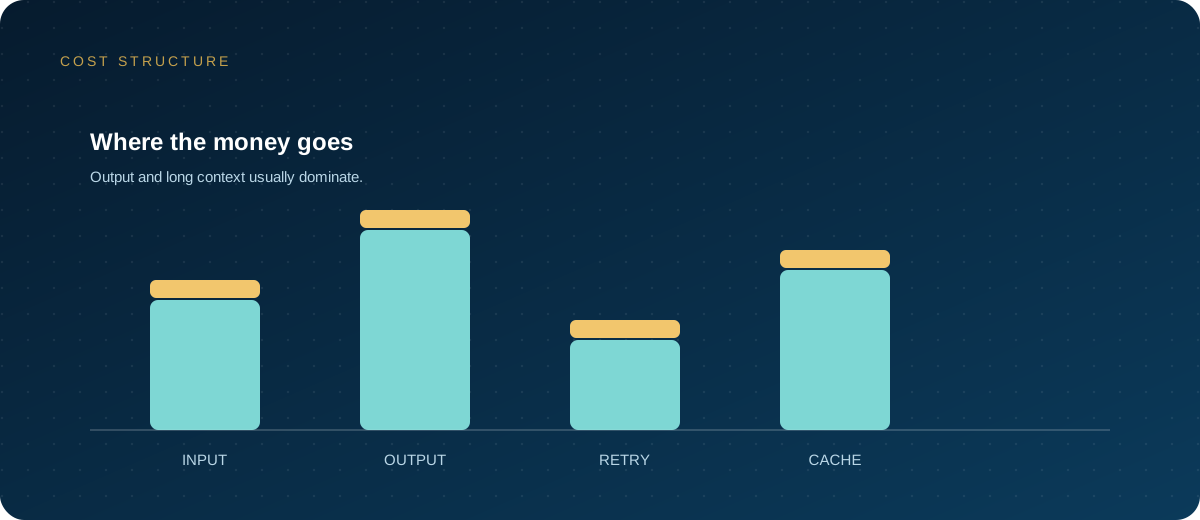
The Anthropic API bills by token, with input and output priced separately. Cache reads and writes, batch processing, and other features may have their own prices. Topping up is essentially converting a sum of money into account credit; each request then deducts according to actual consumption.
| Billing dimension | What it covers | Common pitfall |
|---|---|---|
| Input tokens | System prompts, message history, and tool definitions all count | Stuffing an entire repository into the context inflates input cost |
| Output tokens | Content generated by the model | Output usually costs more than input, so long answers are more expensive |
| Caching | Cached portions are billed at the cache rate | Assuming that enabling caching means every request will hit |
| Model tier | Opus, Sonnet, and Haiku differ significantly in price | Using the top tier for simple tasks |
| Retries | Every retry is a new request | Resending blindly after a 429 doubles the cost |
See model pricing for actual rates. When budgeting, do not guess an "average cost per call." Multiply your real usage logs from the past week by the unit price; the error will be much smaller.
3. Exchange rates and fees: get the math right
Gateway top-ups are usually settled in RMB, and the provider must convert RMB to USD to pay upstream. Three layers of cost are involved:
- Settlement rate: the exchange rate at a specific point in time, either live or end-of-day.
- Payment channel fee: bank cards, corporate transfers, and third-party payments have different rates.
- Service fee: whether the platform adds a layer on top of the exchange rate.
A useful verification formula:
Usable credit (USD) = RMB paid ÷ settlement rate − channel fee − service fee
You do not need to memorize any specific number. Confirm three things on the top-up page: which line shows the exchange rate, whether fees are itemized, and whether the credited amount follows this formula. If the page only says "pay X, get X" without explaining the conversion, ask for a written explanation before paying.
Also distinguish promotional credit from cash balance. Promotional credit usually cannot be refunded or invoiced, may expire, and may be consumed after cash balance. For corporate budgeting, track promotional credit separately or the month-end reconciliation will not match.
4. Credit arrival, refunds, and invoices checklist
Credit arrival
- Online payments usually arrive within minutes; corporate transfers may require manual confirmation.
- After arrival, check that the "balance" and "transactions" pages agree.
- If payment succeeded but the balance did not change, save the order number before contacting support and do not pay twice.
- For a large top-up, send a small amount first to verify the path, then top up the rest.
Refunds
- Whether unused cash balance is refundable, how much, and where it is returned depend on the platform terms.
- Consumed amounts, promotional credit, and campaign credit are usually non-refundable.
- Refund timing follows the payment channel and may cross business days.
Invoices
| Item | What to confirm |
|---|---|
| Invoice type | Standard or special VAT invoice |
| Billing entity | Company name, tax ID, address and phone, bank account |
| Invoice amount | Based on the amount paid or the credit received |
| Timing | How long after payment, and whether retroactive invoices are supported |
| Supporting documents | Order number, contract, payment receipt |
For enterprise procurement, put invoice requirements in the purchase order rather than asking after payment. Individual testers should start with a small top-up and add more once the model and integration work, so the balance does not sit idle for long.
5. The first call after topping up
Once the credit arrives, send a minimal request to the Anthropic-compatible endpoint:
export ANTHROPIC_API_KEY="sk-your-key"

curl "https://ai.zhongshangqihang.com/v1/messages" \
  -H "x-api-key: $ANTHROPIC_API_KEY" \
  -H "anthropic-version: 2023-06-01" \
  -H "content-type: application/json" \
  -d '{
    "model": "claude-sonnet-4-5",
    "max_tokens": 64,
    "messages": [{"role": "user", "content": "Reply with OK only"}]
  }'
A 200 response with content means the key, balance, and model are all working. If you get insufficient quota, troubleshoot in this order:
- Check whether the balance has arrived.
- Check whether the key has a spending limit.
- Check whether the requested model is enabled in your current plan or group.
- Check whether you hit a rate limit rather than a balance problem.
6. Cost control and security
Cost control depends on visibility, not on using the service sparingly:
- One key per project, with a budget limit per project.
- Use Haiku or Sonnet for simple classification, extraction, and rewriting; reserve Opus for complex reasoning.
- Summarize long documents before adding them to context instead of resending the full text every time.
- Enable usage logs and review the consumption ranking once a week.
- Add backoff to retries; do not resend immediately after a 429.
On security: keep keys only in server-side environment variables, never in front-end code or Git; verify the domain and payee before topping up; do not trust "cheap top-up" offers that ask for your account password; use corporate payment and contract processes for business purchases; and revoke keys promptly when staff leave or a project ends. Keep top-up records, order numbers, and invoice files for at least one financial cycle; you will need them for reconciliation.
7. FAQ
Is a top-up the same as a subscription?
No. A subscription is for individual use of the product; an API top-up is for programmatic calls. The quotas are separate and cannot offset each other.
After paying in RMB, is the bill in USD or RMB?
It depends on the provider. A gateway usually issues RMB orders and RMB invoices, while the usage page may also show USD consumption for reconciliation with upstream.
Can I request an invoice immediately after topping up?
Most platforms allow it after payment succeeds, but the timing, type, and whether a contract is required depend on platform policy. Enterprises should confirm before paying.
Can unused balance be refunded?
It depends on the terms. Unused cash balance, promotional credit, and consumed amounts follow different rules. Confirm at top-up time rather than waiting until you no longer need the service.
Why are two identical requests charged differently?
Input length, output length, cache hits, and model tier all affect the charge. Match the request ID against usage logs to find the difference.
Next steps
If you need RMB top-up, unified billing, RMB invoices, and access to Claude, OpenAI, DeepSeek, and other models at the same time, register for the ZSQH AI Gateway, top up a small amount, and verify one request before splitting keys by project. Prices and exchange rates are subject to model pricing.
Related reading: