Whether to replace the Claude API starts with trigger conditions: access and payment restrictions, costs exceeding budget, insufficient context, unstable coding or agent tasks, latency below requirements, or changing compliance rules. Migrating merely because a leaderboard ranking changed is usually not worth the cost.
This article places OpenAI's GPT series, Google's Gemini series, DeepSeek, and Chinese models in one decision table, offers scenario-based recommendations, and includes a migration checklist. Models and prices follow the on-site model pricing and each vendor's official pages.
Note: Anthropic and Claude are trademarks of Anthropic; OpenAI and GPT are trademarks of OpenAI; Google and Gemini are trademarks of Google LLC; DeepSeek is a trademark of DeepSeek. Tongyi, Doubao, Kimi, GLM, and other names belong to their respective owners. This article has no affiliation or agency relationship with these companies; comparisons are based on public information and common production scenarios.
1. When a switch is worth considering
- Access and payment: the current channel cannot connect reliably, or finance cannot complete payment and reimbursement.
- Cost: cost per task consistently exceeds budget and does not improve after prompt and caching optimization.
- Context: long documents, codebases, or meeting notes exceed the available context and quality drops noticeably after splitting.
- Coding and agents: tool calling, structured output, or multi-turn task success rates fall short.
- Latency: time to first byte or full response time cannot support the product interaction.
- Compliance: data storage, cross-border transfer, or industry requirements change and the current option no longer satisfies them.
One trigger does not require a switch; two or more justify a formal evaluation. Separate "must change" from "can optimize" first.
2. Four alternative routes
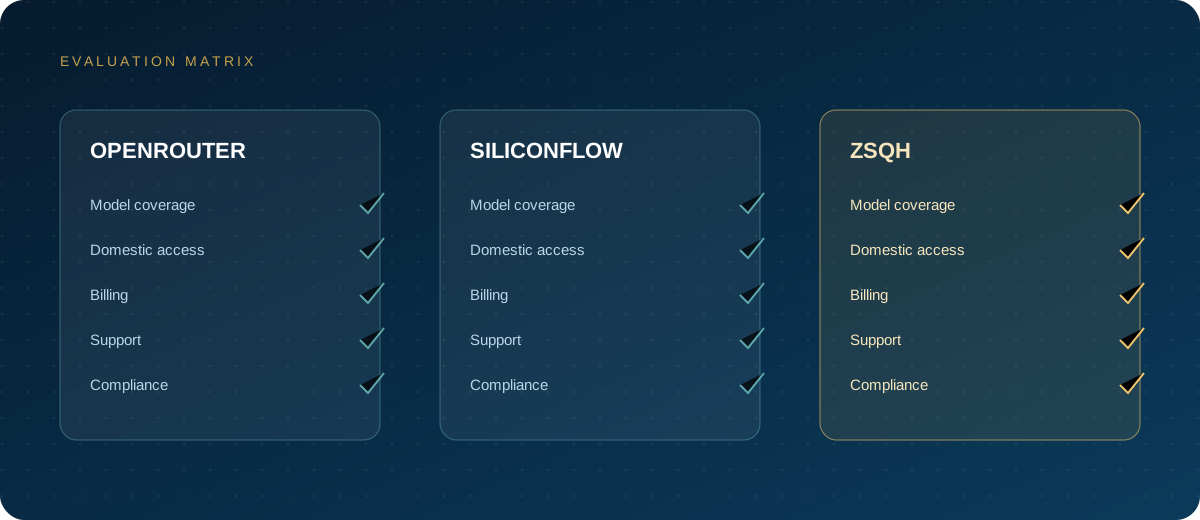
| Route | Representative | Strengths | Main cost |
|---|---|---|---|
| OpenAI GPT series | OpenAI | Tool calling, structured output, mature ecosystem | Access and payment barriers, price varies by tier |
| Google Gemini series | Long context, multimodality, Google ecosystem integration | Regional availability, differing terms and quotas | |
| DeepSeek | DeepSeek | Chinese, reasoning, cost-sensitive scenarios | Peak-hour throttling, capability limits need testing |
| Chinese models and gateways | Tongyi, Doubao, Kimi, GLM, and aggregator gateways | RMB settlement, invoices, low integration cost | Uneven model capability, requires task-based selection |
This table is for initial screening only; it does not mean any vendor is better at every task. Model versions update quickly, so retest with a fixed evaluation set before choosing.
3. Scenario-based selection: a decision table
| Scenario | Preferred candidates | Reason | Cautions |
|---|---|---|---|
| Complex coding and refactoring | Claude, high-tier GPT | Long-code comprehension, instruction following, tool calling | Evaluate with real repository tasks, not just leaderboards |
| Long-document summarization and Q&A | Gemini, Claude | Long context and citation ability | Note the difference between advertised and effective context |
| Agents and tool calling | GPT, Claude | Tool schemas, parallel calls, error recovery | Test multi-turn stability and failure retries |
| Chinese content and customer service | DeepSeek, Chinese models | Chinese fluency, local service, controlled cost | Terminology consistency, sensitive terms, compliance |
| Multilingual go-to-market | GPT, Gemini, Claude | Multilingual coverage and translation quality | Spot-check low-resource languages separately |
| Cost-sensitive batch tasks | DeepSeek, lightweight Chinese models | Low cost per task | Include retry and human review costs first |
"Preferred candidates" is not a ranking. Actual selection should weigh quality, latency, price, compliance, and operations together.
4. Coding and agents: do not judge by benchmarks alone
Differences in coding and agent scenarios often lie not in "whether it can write code" but in instruction following over long context, whether tool-call parameters are correct, whether it recovers from failure, and whether output is stable and parseable.
Prepare three task types for evaluation: defect fixes in a real repository, cross-file refactoring, and multi-step tasks requiring two or three tools. Use at least twenty of each, recording first-pass rate, average turns, manual correction time, and cost per task. A high leaderboard score with an incompatible tool schema still means rewriting after migration.
Also count tool-call failure modes: missing parameters, type errors, timeouts, and duplicate calls. Classifying these errors is more useful than looking only at the overall success rate. For multi-step tasks, confirm the model retains intermediate state and truncates correctly when tool output is too long; otherwise the context fills quickly with irrelevant content.
5. Long documents, multiple languages, and latency
Long context requires distinguishing the nominal window from the effective window. Fitting a document inside the window does not mean the model reliably cites passages in the middle. Retrieve and segment first, keep sources, double-check key conclusions, and switch to a summary plus original excerpts beyond a certain length.
For Chinese and multilingual scenarios, also consider tokenization and billing. The same Chinese passage may count differently across vendors, so list prices are not directly comparable when billing is per token. For latency, separate time to first byte, full response time, and streaming interruption rate, and measure in the target network environment.
For multilingual evaluation, do not look only at translation fluency. Put glossaries, brand names, numbers, and units into the test set and check consistency; for markets such as Russian and Arabic, also check character sets, typesetting, and localized expression.
6. Migration checklist: from Claude to another model
- Inventory call sites: SDK, model names, system prompts, tool definitions, response formats, and retry logic.
- Freeze an evaluation set: sample from production logs, covering normal, edge, and failure cases.
- Rewrite prompts: different models vary in sensitivity to system prompts, example count, and format constraints.
- Adjust tool schemas: confirm parameter types, required fields, parallel calls, and error return formats.
- Replace model names: read from configuration, never hardcode; keep a gradual-rollout switch.
- Run both models in parallel: compare pass rate, latency, cost, and human intervention rate.
- Switch small traffic first: start with a non-critical feature and watch error rates and user feedback.
- Keep rollback: retain the old channel for at least one billing cycle and retire it only after confirming stability.
import os
from openai import OpenAI

client = OpenAI(
    api_key=os.environ["ZSQH_API_KEY"],
    base_url="https://api.zhongshangqihang.com/v1",
)

MODEL = os.environ.get("CHAT_MODEL", "model-name-from-the-pricing-page")

resp = client.chat.completions.create(
    model=MODEL,
    messages=[
        {"role": "system", "content": "You are a rigorous technical assistant. Output JSON only."},
        {"role": "user", "content": "Break the following requirement into three steps."},
    ],
    response_format={"type": "json_object"},
    max_tokens=800,
)
print(resp.choices[0].message.content)
If the target model does not support JSON mode, switch to prompt constraints plus parse validation; do not treat a format failure as a model capability problem. Read model names from environment variables so switching models changes only configuration.
7. Cost, contracts, and compliance
Compare cost on a "per qualified task" basis: include input, output, retries, cache hits, and human review. Looking only at token list prices easily ignores long prompts and failed retries. Specific prices follow model pricing and vendor official pages.
Teams in China should also confirm the contracting entity, currency, invoice type, refund rules, and data terms. When using overseas models, assess cross-border data transfer and personal information protection requirements; when using domestic models, verify provider qualifications, content safety policies, and service levels. Whichever you choose, never put keys in the frontend.
8. Common pitfalls
- Treating leaderboard rankings as production performance.
- Changing only the model, not the prompts and tool schemas.
- Load-testing with a single short request and ignoring long context and concurrency.
- Looking only at unit price without counting retries and human cost.
- Switching everything at once without a rollback plan.
FAQ
Must I replace the Claude API?
Not necessarily. First confirm whether the problem comes from model capability, prompts, network, or budget. If caching, segmentation, degradation, and prompt optimization solve it, migration is unnecessary.
Which is best: GPT, Gemini, or DeepSeek?
There is no universal answer. Coding, long documents, agents, and Chinese customer service have different priorities, so selection results differ. Compare on a small scale with real tasks, then combine models by scenario.
Do I need to change the SDK when migrating?
If the target gateway provides an OpenAI-compatible interface, you can usually keep using the OpenAI SDK and change only base_url, the key, and the model name. Native Claude SDK call sites need adaptation to message formats and tool definitions.
Can Chinese models replace Claude for agents?
Validate by task. Focus on tool-call parameter accuracy, multi-turn task completion, timeout and rate-limit behavior, and recovery after failure. Passing simple Q&A does not mean the agent scenario is viable.
How do I avoid cost increases after migration?
Establish a baseline first: record current tokens, retries, and human cost per task; retest with the same task set after migration. Optimize caching, batching, and model tiering together rather than only changing vendors.
Next steps
Use a batch of real tasks at the ZSQH AI Gateway to compare output and cost across Claude, GPT, Gemini, DeepSeek, and other models, then decide the primary model and degradation order. Available models and costs follow model pricing.
Related reading: