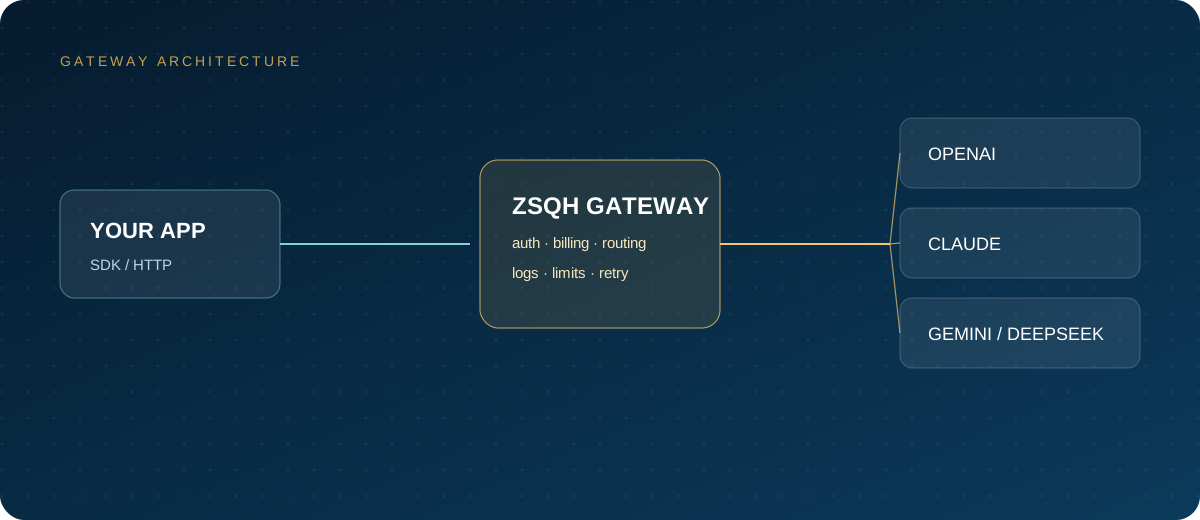
When companies buy DeepSeek API access, the conversation usually collapses into two questions: how much to deposit and what the unit price is. What actually determines whether the integration can run for years is something else entirely: who owns the account, how quota is divided, whether the data terms survive an internal review, whether invoices can be booked, and whether costs are predictable.
DeepSeek's API follows an OpenAI-compatible style, so migration is quick. That speed is also a trap: many teams skip procurement and start on a personal account, then discover at scale that permissions, contracts, and billing do not line up. This guide is an executable procurement checklist, covering accounts, quota, compliance, cost, and contracts in the order you should handle them.
Note: DeepSeek is a trademark of its owner. This article reflects common API patterns as of October 2026. Models, prices, and data terms are subject to official documentation and the model pricing page; no unit prices are hard-coded here.
1. The procurement checklist in five parts
| Area | Questions to settle | Deliverables |
|---|---|---|
| Accounts and access | Who is the legal entity? How are keys split by project? | Account register, key inventory |
| Quota and rate limits | Prepaid balance, concurrency, retry behavior | Budget sheet, alert configuration |
| Compliance and data | Is data retained? Is it used for training? | Clause excerpts, data processing agreement |
| Cost | Input/output mix, cache hits, retries | Cost model, monthly reconciliation sheet |
| Contracts and invoicing | Contracting entity, currency, invoice type | Contract, invoice, payment receipt |
If any of these five areas is confirmed only verbally, expect rework later. Compliance and invoicing usually require internal processes too, so start them in parallel with technical integration rather than after it.
2. Accounts and access: never run enterprise workloads on a personal account
- Register with a company-domain email and bind the account to the corporate entity, so it can be recovered after the owner leaves.
- Set up at least two administrators, enable two-factor authentication, and keep an audit trail for critical actions.
- Split keys by environment: separate keys for production, testing, and development, never shared.
- Store keys in server-side environment variables or a secrets manager. Keep them out of the frontend, the code repository, and chat logs.
- Label every key with an owner, purpose, and creation date, and review the inventory quarterly.
- Revoke keys immediately when a contractor leaves or a project ends — don't wait for contract settlement.
How the console groups keys by project or application depends on the current UI. Whatever the interface looks like, the principle stays the same: one key serves one environment, so incidents are easy to isolate and contain.
3. Quota and rate limits: prepaid does not mean unlimited
DeepSeek API typically uses a prepaid balance with pay-as-you-go deduction; requests fail once the balance runs out. When procuring, don't just ask "how much can we deposit" — confirm four control points at the same time:
| Control | Recommended practice | Why |
|---|---|---|
| Account balance | Keep 1–2x one month of projected usage | Avoid large idle deposits and mid-month outages |
| Project budgets | Split by business line, each with its own cap | Stop one experiment from draining the whole group |
| Concurrency and rate | Load-test against peak traffic, not averages | Surface queuing and timeouts early |
| Alerts | Balance, error rate, and latency | Intervene before users are affected |
Throttling and queuing policies vary by model, account, and platform load; consult the official documentation for current rules. The engineering answer is not "find a channel with no limits" — it is to build retries, backoff, degradation, and idempotency into the code. Firing requests again immediately on a 429 or 5xx only amplifies congestion; use exponential backoff with jitter and a maximum retry count.
4. Compliance and data: put six questions in the purchase order
- Are inputs and outputs retained? For how long?
- Is API data used for model training by default? Can enterprise customers opt out?
- In which region is data stored? Does it involve cross-border transfer?
- Can you sign a data processing agreement that defines responsibilities?
- Who are the subprocessors? Will changes be announced in advance?
- How are security-incident notification deadlines and response procedures written into the contract?
Don't rely on verbal assurances from sales. Archive the official terms, privacy policy, data processing agreement, and security documentation, then send them to legal and security for review. When workloads involve customer contracts, source code, personal information, or financial data, redact or switch to structured fields first; don't feed raw data into a model.
5. Cost: a low unit price does not mean a controllable bill
DeepSeek costs come from four sources: uncached input, cache-hit input, output, and extra requests caused by retries. Context caching usually lowers the cost of repeated prefixes, but the hit rate depends on request structure; if you prepend a timestamp, random ID, or changing content on every call, the cache rarely helps.
A sensible order for cutting costs:
- Compress input first: retrieve only relevant chunks and summarize conversation history.
- Stabilize the prefix: keep system prompts and tool definitions fixed to raise cache hit rates.
- Limit output: set a sensible maximum output length and require structured results.
- Split by task: use a lightweight model for simple classification and extraction, and reserve reasoning models for complex work.
- Batch offline jobs: run summaries and labeling that don't need real-time responses in off-peak windows.
- Talk about switching vendors last: if the waste is still there, another vendor will bill you the same way.
export DEEPSEEK_API_KEY="your-key"

# Direct to the official API: verify the key and available models
curl "https://api.deepseek.com/models" \
  -H "Authorization: Bearer $DEEPSEEK_API_KEY"

# Through ZSQH AI Gateway: OpenAI-compatible endpoint
curl "https://ai.zhongshangqihang.com/v1/chat/completions" \
  -H "Authorization: Bearer $DEEPSEEK_API_KEY" \
  -H "Content-Type: application/json" \
  -d '{"model":"<model-name>","messages":[{"role":"user","content":"Reply with OK only"}]}'
Model names follow the model pricing page; don't ship the placeholder from the example. After the first successful call, record the usage fields in the response and reconcile them against the bill once.
6. Contracts, payment, and invoicing
| Item | Direct official | China-based AI gateway |
|---|---|---|
| Contracting entity | Online platform terms or verified enterprise entity | Domestic company contract |
| Settlement currency | Platform-dependent | CNY |
| Invoice | Requested under platform rules | Standard or special VAT invoice, platform-dependent |
| Payment | Corporate or online payment supported by the platform | Bank transfer or online payment |
| Best for | Teams already verified on the platform | Teams that need one bill across multiple models |
For company payments, use corporate transfer and keep the contract, order, payment receipt, and invoice together. Mixing personal transfers into company books makes reimbursement and reconciliation painful. When choosing a gateway, verify three things — service level, refund policy, and data terms — rather than looking only at unit price.
7. Go-live acceptance checklist
- Enterprise account and two administrators configured.
- Production, test, and development keys separated, each with an owner.
- Balance alerts and project budgets in place.
- One minimal request succeeds from the production network.
- Retry and degradation paths for 429, 5xx, and timeouts connected to monitoring.
- Data terms and compliance materials archived.
- Contract, invoice, and payment receipt handed to finance.
- A fallback model or channel has been rehearsed; switching does not disrupt business.
FAQ
Is a contract mandatory for enterprise DeepSeek API procurement?
Whenever company data, corporate reimbursement, or customer-facing services are involved, use a contract and corporate payment. Small personal top-ups are fine for validation, but not for carrying enterprise workloads long term.
Can unused prepaid balance be refunded?
That depends on platform terms and the contract. Rules for unused balance, promotional credit, and consumed amounts differ; write them down before payment rather than asking after you stop using the service.
Is API data used for training?
Terms for the API and consumer products can differ, and enterprise editions, regions, and time periods may vary too. The signed data processing agreement and official terms govern; run a compliance review before sending sensitive data.
Direct official access or a gateway — which should we choose?
If you are already verified on the platform and only need DeepSeek, direct access is a shorter path. If you want several models behind one console with unified CNY billing and invoices, a gateway saves effort. Fees and exchange rates follow the model pricing page.
Where does cost usually leak?
The usual suspects are repeated context, cache misses, overly long outputs, and unlimited retries. Start with request logs, break out input structure, cache hits, and retry counts, then decide what to optimize first.
Next steps
Create a test key on ZSQH AI Gateway, run real tasks for a week, and record usage, failure rate, and cost per task before deciding on procurement scale. Model availability and pricing follow the model pricing page.
Related reading: