DeepSeek API relays and proxies are often treated as a minor matter of "just changing the address." In practice, the real questions are four: how billing works, whether the network is stable, who is responsible when something breaks, and whether key handling and data processing are compliant.
This article compares the common options and provides migration and verification checklists. Specific prices, model names, and availability are subject to the on-site model pricing page and the provider's own documentation.
Note: DeepSeek is a trademark of its owner. This article is not affiliated with DeepSeek. The relay market changes quickly; this article uses the common form as of October 2026 and does not constitute an endorsement of any provider.
1. Definitions: relay, proxy, and gateway are not the same thing
- API relay: forwards requests to an upstream model service and may also provide billing, quotas, and logging. Some "relays" on the market are simply shared or resold keys; stability and compliance depend on the operator.
- Network proxy: an HTTP, SOCKS, or reverse proxy that only solves network reachability and does not change API semantics; the key is still yours.
- Self-hosted proxy: you deploy a reverse proxy or open-source gateway on your own server and control keys, logs, and routing, but you also carry the upstream account, bandwidth, and operations costs yourself.
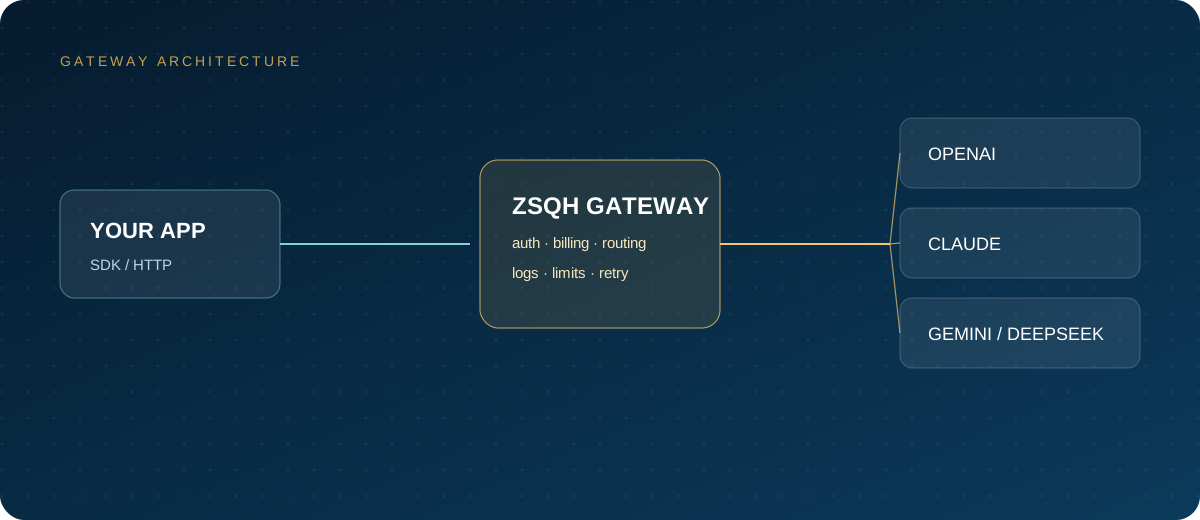
- Unified AI gateway: an OpenAI-compatible endpoint that aggregates multiple models and provides a unified key, billing, and console. Both commercial gateways and self-hosted open-source setups can fall into this category.
When these four concepts are mixed together, network problems are easily mistaken for model problems. Before signing up, ask clearly: which layer of service does the provider offer, and whose key is it?
2. Four options in one table
| Dimension | Official direct | Self-hosted proxy | Commercial relay | Unified AI gateway |
|---|---|---|---|---|
| Billing transparency | Official bill, clear basis | Upstream bill plus your own costs | Depends on the operator; reconciliation needed | Unified on-site bill with published pricing rules |
| Network stability | Affected by local egress | Depends on server and network path | Depends on the relay's network path | Depends on gateway network path and upstream |
| Rate limits and concurrency | Official account-level limits | You control it, but upstream limits still apply | May use a shared pool; confirm | Depends on gateway rules and plan |
| Model coverage | DeepSeek only | Depends on connected upstream | Usually broader; verify | Multiple models, per pricing page |
| Key risk | Key stays with you | Key stays with you | May use shared or resold keys | Usually issues an independent key |
| Operations and support | Official documentation | All on you | Depends on the provider's capability | Console, tickets, and documentation |
No single option suits every team. If you only use DeepSeek and network and payment are smooth, official direct access is the most straightforward. If you need a fixed egress and auditing, choose a self-hosted proxy. If you have no operations staff, evaluate a commercial relay. If you need multiple models on one bill, look at a gateway.
3. Pricing: do not look only at the "multiplier"
Relays commonly quote "official price times a multiplier" or "token packages." A low multiplier does not mean a low total cost. At minimum, clarify eight things:
- Are input and output priced separately, and is the multiplier the same for both?
- Is input that hits the cache discounted, and how is the discount calculated?
- Are reasoning tokens produced by thinking counted as output?
- Are failed and retried requests billed?
- Is usage returned in full for streaming requests?
- Are there minimum top-up amounts, expiration dates, or refund rules?
- Are invoices supported, and what are the exchange rate and settlement currency?
- Can usage statistics and bills be broken down by project, key, and model?
Put these terms into your comparison table and then test with the same batch of requests to calculate the real cost. Specific prices and billing methods are subject to the on-site model pricing page and the provider's bill.
4. Stability: verify with data, not marketing
Look at at least six metrics: success rate, P50/P95 latency, time to first token, timeout rate, 429 ratio, and output speed. Test with prompts of realistic length, covering streaming, long context, and concurrency.
import os
import statistics
import time
from openai import OpenAI

client = OpenAI(
    api_key=os.environ["RELAY_API_KEY"],
    base_url=os.environ["RELAY_BASE_URL"],
    max_retries=0,
    timeout=60,
)

prompt = "Explain the main stages of cross-border e-commerce order fulfillment in 200 words."
latencies, errors, usage = [], 0, []

for i in range(20):
    start = time.perf_counter()
    try:
        resp = client.chat.completions.create(
            model=os.environ["RELAY_MODEL"],
            messages=[{"role": "user", "content": prompt}],
            max_tokens=512,
        )
        latencies.append((time.perf_counter() - start) * 1000)
        usage.append(resp.usage.total_tokens if resp.usage else 0)
        print(i, resp.model, resp.usage)
    except Exception as exc:
        errors += 1
        print(i, type(exc).__name__, exc)

if latencies:
    print("Success", len(latencies), "Failed", errors)
    print("P50", statistics.median(latencies), "ms")
    print("Max", max(latencies), "ms")
    print("Average tokens", sum(usage) / len(usage))
This is only a minimal probe, not a stress test. Before production, observe for 7 consecutive days, run one round at peak and one at off-peak, and compare the results with official direct access. For commercial relays, focus on evening peaks and long requests; for self-hosted proxies, focus on server egress and upstream rate limits.
5. Key risk and compliance: more important than price
The most easily overlooked issue with relays is key ownership. Shared keys, resold keys, or quota from unknown sources can bring four problems:
- If the upstream bans the account or adjusts quotas, your business is interrupted along with it, and you cannot appeal directly.
- Multiple tenants share one key, so rate limiting and outages affect each other, making problems hard to isolate.
- Request content passes through a third party, and logging, caching, and data retention policies may be opaque.
- The terms of service may prohibit resale or sharing, leaving you without a contractual basis in a dispute.
When choosing a provider, confirm at least the company entity, terms of service, privacy policy, invoicing capability, and incident contact. Do not send requests containing personal information, secrets, or contract text to a relay that cannot explain where the data goes. For heavily regulated sectors such as finance and healthcare, prioritize official direct access, private deployment, or providers willing to sign a data processing agreement.
6. Migration checklist: from direct access to a relay or gateway
- Record the current state: success rate, P50/P95 latency, token usage per thousand requests, and the bill.
- Inventory model names and parameters: thinking, max_tokens, tools, JSON output, streaming.
- Create separate test and production keys, each with budgets and alerts.
- Change only
base_urlandapi_key, and get the minimal request working in staging. - Replay real prompts and compare output quality, latency, and usage accounting.
- Check how 401, 402, 429, 5xx, and timeouts map, and confirm that retries will not amplify an outage.
- Shift 5%–10% of traffic gradually, observe for 3–7 days, and keep official direct access as a fallback.
- After full cutover, continue reconciling for a week to confirm the bill and usage statistics agree.
Do not change the model, the prompts, and the gateway at the same time during migration, or you will not be able to attribute the results. Change one variable at a time.
7. How to verify whether a relay is reliable
Start with the model field in the response, but do not trust that field alone, because it can be rewritten. A more reliable approach is combined verification:
| Check | Method | Warning sign |
|---|---|---|
| Latency | Send the same prompt repeatedly and compare P50/P95 | Extreme variance, or consistently much slower than direct access |
| Error rate | Measure the share of 429, 5xx, and timeouts | Failures cluster at peak hours |
| Usage | Compare response usage with the backend bill | Figures do not match, or streaming usage is missing |
| Model identity | Compare capability boundaries and output style with a fixed test set | Noticeable capability drop or shorter context |
| Key isolation | Confirm whether keys are independent and can be rotated | Refuses to explain where the key comes from |
| Contract and support | Check the entity, terms, invoices, and ticket response | Only a personal contact, no terms of service |
Red flags include prices that are far below official for a long time, promises of "zero downtime," refusal to provide usage details, demands that you hand over your official key, and inability to explain where data is retained. If you see these, validate with a small traffic share first; do not move production over all at once.
8. When a self-hosted proxy makes more sense
A self-hosted proxy suits teams with engineering capability: fixed egress IPs, unified auditing, multiple upstream routes, or keeping keys in their own hands. A common approach is a reverse proxy plus key management, rate limiting, logging, and alerting, while the upstream still uses official accounts or compliant suppliers.
The costs must be counted too: servers, bandwidth, certificates, upgrades, vulnerability fixes, and on-call time all add up. If you call the API only occasionally and have no operations staff, self-hosting is often more expensive than a commercial option. Self-hosting also does not bypass upstream rate limits or terms of service.
9. Recommendations: order by constraints
- Start with network and payment: can the official endpoint be reached reliably, and can you top up smoothly? If yes, prefer official direct access.
- Then consider control: do you need a fixed egress, audit logs, or private keys? If so, evaluate a self-hosted proxy.
- Then consider model scope: do you want one endpoint for multiple models? If so, look at a unified gateway.
- Finally consider service capability: are the entity, terms, invoices, ticket handling, and data policy clear?
If you need a unified multi-model endpoint, create a test key on ZSQH AI Gateway, get it working, and then migrate. Specific prices and available models are on the model pricing page. Do not treat "cheap" as the only criterion; migration and outage costs count as well.
Related reading:
- DeepSeek API Access from China and Network Options
- What Is an AI Relay? A Complete 2026 Guide
- DeepSeek API Pricing and Billing
FAQ
What is the difference between a relay and a proxy?
A proxy usually refers to network-layer forwarding and only solves reachability; a relay also involves accounts, billing, or key distribution. The terms are often used interchangeably, so clarify the service boundary before signing up.
Is a relay price lower than official trustworthy?
It may come from bulk purchasing, network subsidies, or quota resale, and it may also come with shared keys, rate limiting, or unstable service. Check the billing terms, usage details, and contract first, then test with a small traffic share.
How can I tell whether a relay has swapped the model?
Do not rely on the model field in the response alone. Use a fixed test set to compare capability boundaries, context length, output style, and usage structure, and keep official direct access as a control. If capability drops noticeably, stop traffic first and investigate.
How much code has to change to migrate to a gateway?
Most OpenAI SDK projects only need to change base_url and api_key, with model names adjusted per the gateway pricing page. If you use thinking, tools, or specific response fields, run additional compatibility tests.
What should enterprise users pay most attention to?
Key ownership, data processing agreements, invoicing and contracting entity, incident response, and exit mechanisms. Price matters, but business continuity and compliance responsibility matter more.