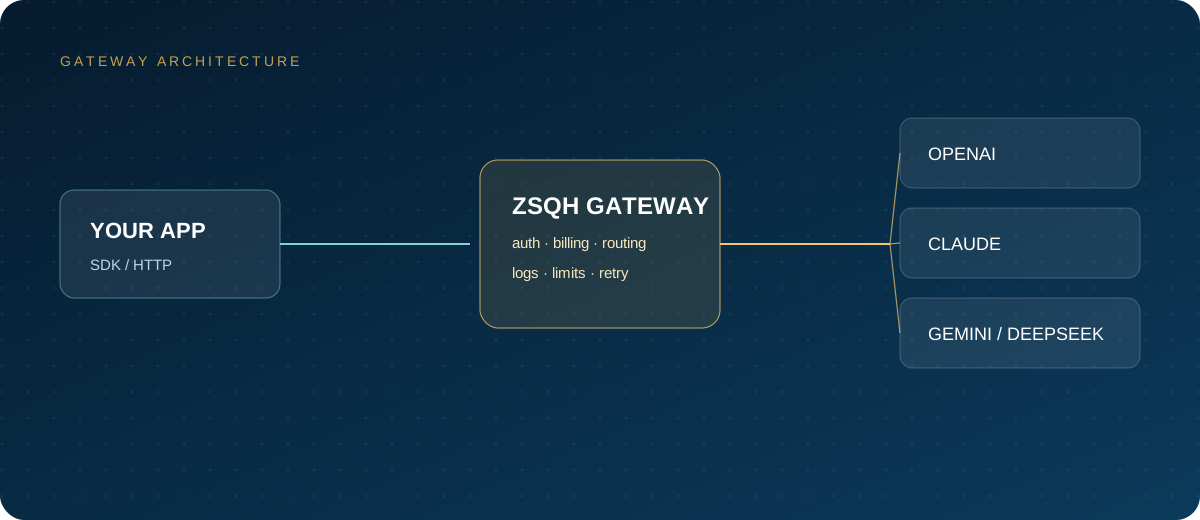
The Doubao API is provided by Volcengine Ark, with service nodes in mainland China, so domestic teams usually do not have to worry about whether they can connect at all. The questions that matter in production are different: whether account verification and the contract entity match, whether top-up and invoicing run smoothly, how models and inference endpoints are managed, whether peak-hour rate limits are acceptable, and whether traffic can be moved elsewhere when the primary route has problems. This article compares three routes (direct access, a self-hosted relay, and a unified gateway) and provides a one-week verification checklist.
Note: Doubao, Volcengine Ark, and Volcengine are trademarks or product names of ByteDance and its affiliates. This article is for technical discussion only and implies no affiliation, agency, or endorsement. Product capabilities and rules may change; refer to the official documentation and console.
1. Doubao API, Volcengine Ark, and the real "domestic access" question
Doubao is a model family, and Volcengine Ark is Volcengine's model service platform. It provides an OpenAI-style interface, with the common Base URL https://ark.cn-beijing.volces.com/api/v3. In calls, the model parameter can be a model ID or an inference endpoint ID (usually starting with ep-); the console and documentation are authoritative.
So the difficulty with "domestic access" to the Doubao API is usually not cross-border networking but access-layer management: enterprise verification and contract entity, corporate top-up and invoices, model versions and endpoints, account-level quotas, and a unified entry point for multi-model scenarios. Overseas offices may still experience cross-border latency and need to test their route separately.
| Dimension | Volcengine Ark direct | Self-hosted relay | Unified AI gateway |
|---|---|---|---|
| Entry point | Volcengine Ark API address | Reverse proxy on your own server | OpenAI-compatible unified entry |
| Account and verification | Complete Volcengine verification yourself | Still depends on your upstream account | On-site account, rules per page |
| Payment and invoices | Volcengine billing center | You bear the server cost | On-site top-up and billing |
| Model range | Doubao models open on Volcengine Ark | Depends on proxy configuration | Multiple vendors, subject to availability |
| Rate limits and quota | Account, model, or endpoint level | Still limited by upstream quota | Depends on gateway rules and plan |
| Operations cost | Low | High | Medium |
| Best for | Single platform, stable calls, self-managed top-up and invoicing | Fixed egress and operations capability | Multiple models, unified billing and failover |
No single route suits everyone. The order of judgment is: first whether the business can tolerate interruption, then whether multiple models and invoices are needed, and finally whether the team has operations staff.
2. Direct Volcengine Ark access: who it suits and how to connect
Direct access suits teams that call only Doubao, have stable call volume, can complete enterprise verification and top-up, and can accept peak-hour fluctuations. The integration is not complicated:
- Register a Volcengine account and complete identity verification; enterprise use should use the company entity so contracts, top-up, and invoices stay consistent.
- Open the Volcengine Ark console, enable the service, and confirm the Doubao models you need are available in the current account and region.
- Create a key on the API Key management page and name it by environment, for example dev, staging, and prod.
- Confirm the model ID; if using an inference endpoint, record the endpoint ID starting with
ep-and confirm the model version it is bound to. - Put the key in a server-side environment variable and run a minimal request with curl or the OpenAI SDK.
- Set connect timeouts, read timeouts, and a retry cap, and write error codes to logs.
export ARK_API_KEY="your Volcengine Ark API key"
export ARK_MODEL_ID="your model ID or inference endpoint ID"

curl "https://ark.cn-beijing.volces.com/api/v3/chat/completions" \
  -H "Authorization: Bearer $ARK_API_KEY" \
  -H "Content-Type: application/json" \
  -d "{
    \"model\": \"$ARK_MODEL_ID\",
    \"messages\": [{\"role\": \"user\", \"content\": \"Reply with OK only\"}],
    \"max_tokens\": 16
  }"
If the minimal request times out intermittently, change the network and DNS before drawing conclusions; do not mistake a network problem for an invalid key. A 401 is usually a key or permission issue, a 404 often means a wrong model ID or endpoint, and a 429 should send you to quotas and traffic spikes.
3. Self-hosted relay: solves egress and auditing, not quota
A self-hosted relay suits teams with a fixed egress IP, auditing requirements, or a need to keep keys on the server side. A common approach is to deploy a reverse proxy on a server that can reach Volcengine Ark, with unified authentication, rate limiting, and logging.
It solves egress and auditing, not upstream quota. Requests still reach Volcengine Ark in the end, and account- or endpoint-level RPM/TPM limits, model availability, and terms of service are unchanged. The proxy server itself is also a single point of failure: an expired certificate, a full disk, or a process exit can take down every service at once. Without on-call staff, a self-hosted relay easily turns from a transitional solution into long-term technical debt.
4. Unified gateway: converge multiple models and billing into one entry
A unified gateway puts multiple models, multiple keys, billing, and failure handling behind one entry point. Business code only knows the OpenAI-compatible address, so switching models becomes a configuration change rather than a code change; unified billing also reduces reconciliation work.
When evaluating a gateway, confirm: whether it covers the Doubao models and versions you need, how model maps to model IDs or endpoint IDs, whether billing is clearly documented, whether usage can be viewed by project and key, how failures are reported, and whether the data terms meet requirements. Do not judge by whether a single request goes through.
export ZSQH_API_KEY="sk-your-key"
export ZSQH_MODEL="Doubao model name from the on-site model list"

curl "https://ai.zhongshangqihang.com/v1/chat/completions" \
  -H "Authorization: Bearer $ZSQH_API_KEY" \
  -H "Content-Type: application/json" \
  -d "{
    \"model\": \"$ZSQH_MODEL\",
    \"messages\": [{\"role\": \"user\", \"content\": \"Explain the role of a gateway in one sentence\"}],
    \"max_tokens\": 128
  }"
5. Stability: rate limits, timeouts, retries, and degradation
Volcengine Ark rate limits are usually set at the account, model, or endpoint level in RPM and TPM; default quotas and how to request increases are governed by the quota page in the console. Quota requests and load tests belong before launch, not after 429s appear.
The client should do at least five things:
- Set connect and read timeouts separately, with dedicated settings for long-form and reasoning tasks.
- Retry only on 429, 5xx, and timeouts, using exponential backoff with jitter and a maximum attempt count.
- Smooth batch jobs with a queue so they do not all fire at the top of the hour.
- Prepare a fallback model or channel, and accept output differences after switching.
- Trip a circuit breaker after consecutive failures reach a threshold to avoid a retry storm.
Business operations with side effects also need idempotency: check state first, then decide whether to resend. A degraded model needs quality spot checks in advance; do not switch for the first time during an incident.
6. Payment, invoices, and compliance
- Volcengine top-up and invoice rules are governed by the billing center pages; confirm corporate payment, invoice type, and arrival time in advance.
- Enterprise accounts should complete company-entity verification, keeping the contract entity, payment entity, and invoice header consistent.
- Split keys by environment; production keys must not enter frontends, public repositories, or client installers.
- Keep call logs and bills for reconciliation and auditing.
- Read the data terms and confirm whether inputs and outputs are retained, for how long, and whether they are used to improve the service.
- When personal information, cross-border transfer, or a heavily regulated industry is involved, assess according to local regulations and the company's compliance process.
7. A one-week pre-launch verification checklist
Testing one route over a week is more informative than a single load test. Run the same batch of requests at fixed times each day, covering at least one weekday peak and one overnight low, and record these seven items:
- Success rate: the share of non-200 responses, and whether they cluster during peak hours.
- Latency: P50, P95, and time to first token, and whether tail latency hurts the experience.
- Rate limiting: the number of 429s, when they occur, and how long they last.
- Network: the distribution of DNS, TLS, and connection timeouts, to judge whether the local egress is the problem.
- Usage and billing: whether
usagein responses matches backend statistics. - Failover drill: manually stop the primary route and confirm the fallback really takes over.
- Quality: manually spot-check a fixed task set to see whether output is consistent after switching routes.
FAQ
Does the Doubao API need a proxy in China?
Most domestic networks can reach Volcengine Ark directly without an extra proxy. If you have unified egress or cross-border links, a self-hosted relay may be needed; test with a minimal request first, then determine whether the problem is DNS, TLS, or upstream.
Should Doubao API model be a model ID or an endpoint ID?
Both may be accepted, depending on the account and console configuration. An inference endpoint usually starts with ep- and is bound to a specific model version; a model ID is more direct. Follow the Volcengine Ark console and documentation, and document the mapping before migrating.
Which is more stable, direct access or a gateway?
There is no universal answer. Direct access has a shorter path; a gateway offers a unified entry and failover but adds a dependency. Test the same batch of requests against both, measuring success rate and P95, and observe for a week before deciding.
What should I do when Volcengine Ark rate-limits me?
First determine whether the limit is at account, model, or endpoint level, then check the quota in the console and request an increase. In the short term, use queue smoothing, backoff retries, and a fallback model; do not open multiple accounts to bypass limits, which may violate the terms of service.
How are invoices and corporate top-up handled?
Follow the instructions on the Volcengine billing center page, and confirm company verification, payment entity, and invoice header in advance. Specific arrival times, invoice types, and invoicing cycles are governed by the platform pages.
Next step
Create a test key on ZSQH AI Gateway, then compare success rate and latency against direct access using the same batch of requests; models and prices are governed by model pricing.
Related reading: