Buying an embedding API for an enterprise is not quite like buying a chat model. A chat model can be swapped at any time; embeddings often require vectorizing the entire corpus at once, then generate ongoing query costs, and once the model and dimensions are set they are hard to change.
So a purchase order cannot just say "how much quota per month, what is the unit price." It needs to cover usage estimation, billing and invoicing, data processing, model lock-in, permissions, fallback, and acceptance. The checklist below can be used directly with a supplier, item by item.
Note: OpenAI and other names are trademarks of their respective owners. This article is a technical procurement guide only. Product terms, prices, and available models may change; the signed contract and official pages prevail.
1. Checklist Overview
| Module | Key questions | Materials to request |
|---|---|---|
| Usage and quota | How many tokens in the corpus, what query volume, what rate limits | Capacity estimate, stress-test records |
| Billing and invoices | Billing unit, contracting entity, invoice type | Quotation, contract, invoices |
| Data processing | Retention, training use, deletion process | DPA, terms, security report |
| Models and dimensions | Dimensions, languages, versions, deprecation policy | Model list, evaluation report |
| Permissions and keys | Project isolation, rotation, auditing | Key register, permission matrix |
| Fallback and acceptance | Backup models, rollback, acceptance metrics | Drill records, acceptance form |
If any item rests only on verbal confirmation, rework is likely later; data processing and invoicing usually require internal processes to start early.
2. Usage and Quota: Estimate by Tokens, Not Document Count
Embedding usage has two parts: document vectorization is a one-time, large-batch cost, while user queries are an ongoing, small-volume cost. Estimate them separately before purchasing, and do not be misled by descriptions like "we only have a few tens of thousands of documents."
Keep four things in mind when estimating:
- Sample real documents and count tokens with the tokenizer or a trial API; do not simply convert from character counts.
- Confirm whether rate limits are per-minute requests, per-minute tokens, or both.
- Large batch jobs must support splitting, retries, and resuming from checkpoints, so rate limiting does not force a restart from the beginning.
- Higher dimensions mean more memory and disk usage in the vector database, and this must be included in total cost.
A capacity estimate can be written as a short table:
One-time cost ≈ full-corpus document tokens × embedding unit price
Ongoing cost ≈ monthly query tokens × query unit price + vector storage and bandwidth
Headroom ≈ 20%–30% for index rebuilds, retries, and business growth
For specific unit prices, refer to model pricing and the contract quotation. Prices change, so do not hard-code a point-in-time number into an annual budget.
3. Billing, Contracts, and Invoices
Enterprise procurement should align on billing definitions first. Confirm at least: whether billing is by input tokens or by requests; whether batch calls have tiers or committed-volume terms; whether unused balance is refundable; and whether service is suspended or degraded when payment is overdue or limits are exceeded.
For contracts and invoices, confirm the entity, currency, payment method, invoice type, and invoicing cycle. Using a domestic AI gateway usually allows RMB corporate payment and VAT invoices; connecting directly to an overseas vendor involves cross-border payment, exchange rates, and different invoice forms. Each approach has trade-offs; walk through the finance process before choosing.
4. Data Processing and Privacy: Six Types of Materials to Archive
Embedding inputs are raw text and may contain customer data, contract clauses, and internal documents. Do not accept "we are secure" at face value during procurement; obtain materials that can be archived:
- A data processing agreement (DPA) that defines each party's responsibilities and the scope of processing.
- A data retention and deletion statement, including the response time for deletion requests.
- Explicit terms on whether data is used for model training; review free and paid versions separately.
- A list of subprocessors and whether changes are notified in advance.
- Security questionnaire responses or an independent audit report.
- A statement on data residency, cross-border transfer, and regional choice.
Vectors themselves can leak semantic information. Whether vectors are deleted when the source text is deleted, who can query the vector database, and how long backups are retained should all be written into the checklist.
5. Dimensions and Model Lock-In
Higher dimensions are not automatically better. Higher dimensions may improve discrimination but also increase storage, retrieval latency, and cost; lower dimensions save resources but may lose fine-grained semantics. Some models support custom dimensions or dimensionality reduction; refer to model documentation for specifics.
More troublesome than dimensions is model lock-in. Different models have incompatible vector spaces, and changing models usually means rebuilding the entire index. During procurement, confirm: whether model versions are updated silently; when old versions are deprecated; how much advance notice is given; and whether stable version identifiers are provided. The contract should ideally specify the model version policy and notice period.
6. Access Control and Key Management
- Register with a corporate domain email and company entity; do not run company business on a personal account.
- Use different keys for production, testing, and development, with separate billing by project.
- Store keys only in server-side environment variables or a secrets manager; never in front-end code or the code repository.
- Grant least privilege, exposing only the models and endpoints the business needs.
- Establish rotation and revocation processes, executed immediately when staff leave or a project is retired.
- Enable call log auditing, and mask source text in logs or retain metadata only.
When using a unified gateway, also confirm key custody, log retention, sub-accounts, and usage limits; each additional service layer adds another boundary.
7. Fallback and Backup Plans
When an embedding service fails, the business may see empty search results or a sharp drop in RAG answer quality rather than an explicit error. Design fallback in advance:
- Choose primary and backup models with compatible interfaces where possible to reduce code changes.
- If the backup model has different dimensions, maintain dual indexes or complete a rebuild plan in advance.
- Use backoff retries for rate limits and timeouts, and queue batch jobs instead of failing outright.
- Run switchover drills regularly and confirm that the backup path's latency and quality are acceptable.
8. Pilot Acceptance: Let the Data Speak
Do not accept a system based on a demo alone. Choose a real business scenario for a small pilot and proceed as follows:
- Sample 5% to 10% of the corpus, covering the main formats, languages, and business types.
- Prepare at least 50 real queries with human-labeled relevant results as a baseline.
- Run both primary and backup models, recording hit rate, latency, failure rate, and rate-limit triggers.
- Reconcile platform bills against internal statistics and confirm that billing definitions match.
- Verify permission isolation, usage alerts, deletion procedures, and log masking behave as expected.
- Produce an acceptance report that states pass criteria and open issues.
Before launch, verify the key, model name, and returned dimensions with a minimal request:
curl "https://ai.zhongshangqihang.com/v1/embeddings" \
  -H "Authorization: Bearer $EMBEDDING_API_KEY" \
  -H "Content-Type: application/json" \
  -d '{"model":"text-embedding-3-small","input":["enterprise acceptance test text"]}'
The returned vector dimensions should match the vector database schema; if they do not, fix the configuration first and do not write directly to the production database. The example model name is for demonstration only; available models are subject to the in-site documentation.
9. Cost Monitoring and Monthly Review
Embedding costs are characterized by a large upfront expense followed by steady ongoing spend; index rebuilds and repeated queries are the most easily overlooked items. Review four things monthly: token consumption by project, query embedding counts, index rebuild counts, and bill variance.
Optimization measures include caching vectors for frequent queries, merging batch requests, and filtering meaningless calls. Confirm that any optimization does not hurt retrieval quality first.
10. Frequently Asked Questions
How is an embedding API usually billed?
Most platforms bill by input tokens, and some offer different tiers for batch jobs or committed usage. Specific billing units and prices are subject to the official pages or contract; during procurement, estimate queries and document vectorization separately.
Are vectors considered sensitive data?
They should be treated as sensitive data. Vectors can be used to infer original semantics, so access permissions, encryption, and backup policies for the vector database should be managed at the same level as the source text.
Does changing embedding models always require rebuilding the index?
Usually yes. Different models have incompatible vector spaces, and even the same dimensions do not guarantee compatibility. Before changing models, reserve time and budget for a rebuild and prepare a rollback plan.
Do enterprises need a separate contract to use embeddings?
Whenever company data, corporate reimbursement, or external services are involved, a contract and corporate payment are advisable. Online terms can supplement the contract, but data processing responsibilities, service levels, and invoicing requirements should be written into a signed agreement.
Can free quota be used for an enterprise pilot?
It can be used to validate interfaces and quality with anonymized samples, but do not submit production data or sensitive documents to a public free tier. After the pilot passes, production traffic should move to a paid service with clear data processing terms.
Next Steps
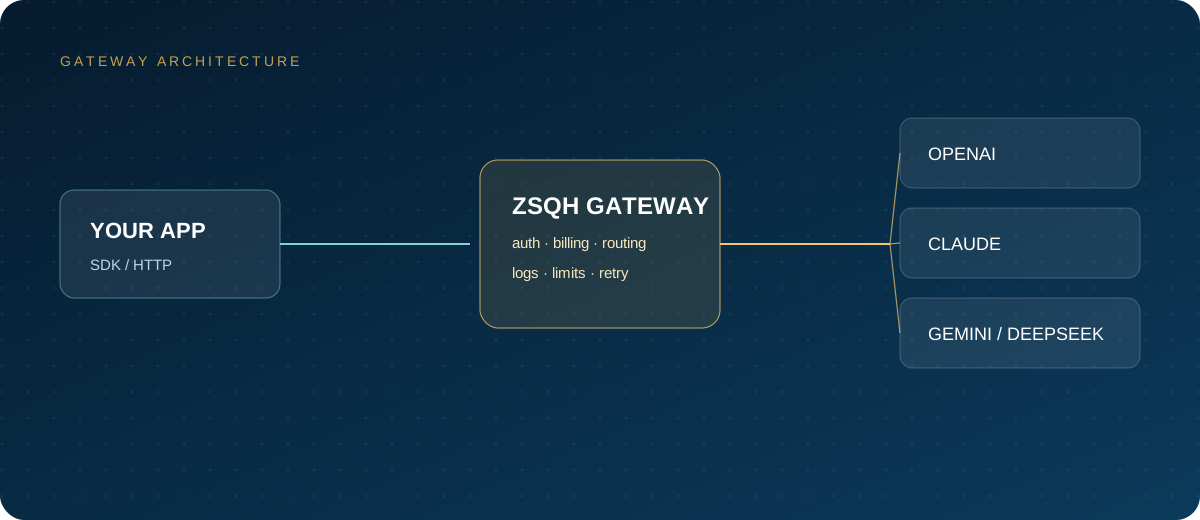
If you need to manage embedding calls across multiple models in one place and split keys and budgets by project, sign up for ZSQH AI Gateway, run a small document batch through the key items in the acceptance checklist, and then decide on procurement scale. Available models and prices are subject to model pricing.
Related reading: