Calling Gemini API from China is rarely a coding problem; it is a connectivity problem. Can requests leave reliably, is latency acceptable, is the quota sufficient, and who handles incidents when something breaks? Many teams prototype through a personal proxy and then carry the same configuration into production, only to rework concurrency, rate limiting, and compliance one after another.
This article splits common approaches into three categories — direct access, a self-hosted proxy, and a China-based AI gateway — and covers when each applies, how to handle quotas, and how to roll out. The short version: prototype with whatever is convenient, but choose production infrastructure that is monitorable, degradable, and explainable to compliance.
Note: Google and Gemini are trademarks of their respective owners. This article reflects common network and API conditions as of October 2026. Service regions, quotas, and terms follow official pages; comply with local laws and platform terms of use.
1. Comparing the three approaches
| Dimension | Direct official | Self-hosted proxy | China-based AI gateway |
|---|---|---|---|
| Typical availability | Heavily affected by network and region | Depends on egress quality | Backed by the provider, with a status page |
| Latency | Noticeable variance | Tunable, but adds a hop | Usually stable |
| Operational cost | Low, but hard to troubleshoot | High; servers and egress to maintain | Low; just use the endpoint |
| Quota | Subject to official rate and regional limits | Does not change official quota | Allocated and throttled by the gateway |
| Billing | USD, usage-based invoicing | Official fees plus server costs | CNY, prepaid |
| Compliance story | You explain the cross-border path yourself | You own egress and log responsibilities | Domestic contract and defined service boundary |
| Best for | Personal validation, low-sensitivity tasks | Internal systems with a network team | Customer-facing production workloads |
This table is not here to make the decision for you; it is a reminder that a proxy only solves connectivity, not quota, billing, or compliance. Treating a proxy as a long-term production solution leaves uncertainty embedded in the path.
2. Direct access: first determine whether it is the network or permissions
Direct connections usually fail in one of three ways; troubleshoot in order:
- Region unavailable: in regions the official service does not cover, requests may time out or be rejected outright. A new key will not fix this.
- Network unreachable: DNS resolution, TLS handshake, and egress routing can all fail. Use
curl -vto see where it stalls. - Authentication or project errors: 401 means the key; 403 usually means the project, an API that is not enabled, or model permissions.
export GEMINI_API_KEY="your-key"

curl -v "https://generativelanguage.googleapis.com/v1beta/models" \
  -H "x-goog-api-key: $GEMINI_API_KEY" \
  --max-time 15
If the connection phase already times out, tuning parameters is pointless. If it connects but returns 4xx, work through the status codes. Record the phase, duration, and status code of every failure so you can tell transient volatility from structural unavailability.
3. Self-hosted proxy: fixes connectivity, not quota
A typical setup is: application server → overseas egress → Gemini API. It suits teams with network operations skills and controllable data sensitivity, but four things belong in the runbook:
- Is the egress IP stable, and will the target service flag it as abnormal traffic?
- Does the proxy log request content? How long are logs kept, and who can access them?
- How are certificates, domains, and ports managed, and how do you alert when they expire?
- What about the proxy server's own bandwidth, concurrency, and failover?
A proxy does not raise official quota. Free or low-tier RPM and TPM limits still apply, and peak hours still queue. A more common problem is every workload sharing one egress: one runaway script drags down the whole path. Split egress by workload and apply rate limits per workload.
4. Gateway integration: usually three changes
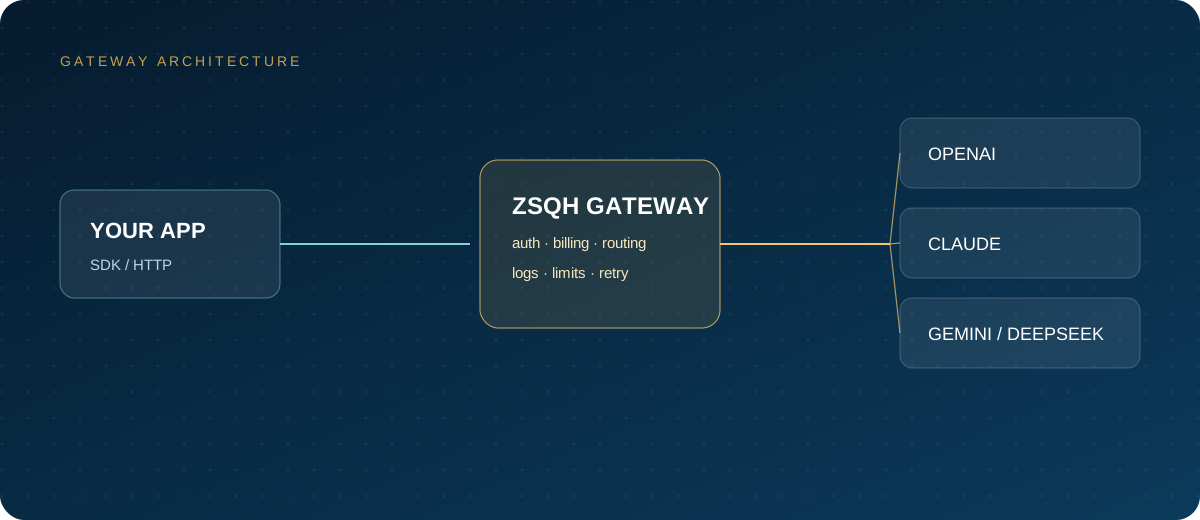
A China-based AI gateway typically exposes an OpenAI-compatible endpoint, so existing code only needs a new base URL, key, and model name:
import os
from openai import OpenAI

client = OpenAI(
    api_key=os.environ["ZSQH_API_KEY"],
    base_url="https://ai.zhongshangqihang.com/v1",
)

resp = client.chat.completions.create(
    model="<Gemini model name from the pricing page>",
    messages=[{"role": "user", "content": "Reply with OK only"}],
    max_tokens=64,
)
print(resp.choices[0].message.content)
print(resp.usage)
Model names follow the model pricing page; don't copy the placeholder. After integration, run one minimal request, then a batch of real tasks. Watch three things: time to first token, failure rate, and whether responses have been degraded. A gateway is a service boundary; before choosing one, confirm the status page, support channels, refund policy, and data terms.
5. Quotas and 429s: get retries right
Gemini quotas are usually calculated per model, project, and time window, commonly as requests per minute, tokens per minute, and requests per day. Hitting a limit usually returns 429, and how you handle it determines whether the incident grows:
- Exponential backoff with jitter, so clients don't retry at the same instant.
- Set a maximum retry count and overall timeout; degrade beyond that rather than retrying forever.
- Queue by business priority: interactive requests before offline batch jobs.
- Make write operations idempotent so retries don't duplicate side effects.
- Monitor the time distribution of 429s to distinguish per-minute throttling from daily quota exhaustion.
- Keep a fallback model or channel and switch automatically when the primary is throttled.
If the daily quota is exhausted, retries are useless: downgrade, cut non-critical calls, or adjust the quota. If concurrency spiked, rate-limit first, then scale; doing it in reverse only slows the whole path further.
6. Compliance and data: three questions you must answer
- Do requests contain personal information, customer contracts, source code, or financial data?
- Which nodes does the data pass through, in which regions does it land, and how long are logs kept?
- In a security incident, who can provide records, and how quickly can they notify?
The longer the cross-border path, the higher the cost of explanation. For customer-facing production systems, classify and grade data and redact sensitive fields first; when logs must be retained, define access permissions and deletion procedures. Don't skip compliance review because "it's just an API call."
7. Rollout steps
- Load-test with real tasks for a week, covering peak and off-peak hours.
- Record success rate, p50 and p95 latency, 429 distribution, and cost per task.
- Compare quota ceilings with business peaks and leave headroom.
- Connect monitoring and alerts for error rate, latency, balance, and throttling.
- Rehearse primary/fallback switching and confirm that degradation is acceptable to the business.
- Archive contracts, invoices, data terms, and security documentation.
- Shift a small share of traffic, observe for a week, then go full.
FAQ
Can Gemini API be called directly from China?
Whether a direct connection works depends on the official service region, network egress, and account status; the actual result may be a timeout, a connection reset, or a 4xx. Don't draw conclusions from a single success or failure — judge by a week of failure rates and latency distribution.
Is access through a proxy stable?
A proxy can improve connectivity, but stability depends on egress quality, concurrency, and operational discipline. It does not change official quota and does not automatically solve compliance or logging; production use needs full monitoring and a degradation plan.
Why do we keep getting 429s?
It could be a per-minute rate limit, daily quota exhaustion, or a concurrency spike. Check the response headers and usage page to identify the type; retries do nothing once the daily quota is exhausted, so adjust quota or cut non-critical calls instead.
Does a gateway change model capabilities?
A gateway mainly handles authentication, routing, throttling, and billing; under normal operation it does not change the model itself. But different channels may expose different model ranges, parameter support, and versions. Run the same batch of tasks through both before going live.
What compliance issues matter for access from China?
At minimum, confirm whether data crosses borders, whether it contains personal information, how long logs are retained, and whether the provider offers a contract and security documentation. Redact sensitive data first and complete the company's review process.
Next steps
If you would rather not maintain a proxy and egress yourself, run one Gemini request through ZSQH AI Gateway, then split keys by project and set budgets. Available models and pricing follow the model pricing page.
Related reading: