Discussions about accessing Grok API from mainland China often fall into one trap: testing only whether a request can get through. A single 200 response does not mean the connection can support a production service. What actually shapes the user experience is success rate, latency jitter, timeout ratio, and recovery speed, not the result of one curl command.
This article compares three approaches, direct access, a self-hosted proxy, and a managed gateway, and provides a layer-by-layer diagnostic method plus a stability acceptance checklist. Model availability and prices are subject to model pricing on this site.
Note: xAI and Grok are trademarks of their respective owners. This article is for technical reference only. Cross-border access and outbound data transfer should comply with company policy and applicable regulations. Interfaces and prices are subject to xAI's official documentation and model pricing on this site.
1. Locate which layer the problem is in
"Unable to access" is a result, not a cause. Classify the symptom by layer first, then decide whether to change DNS, change the egress, change the proxy, or change the code.
| Symptom | Likely layer | Check first |
|---|---|---|
| Domain resolution fails or returns something unexpected | DNS | DNS configuration and records on the host and in the container |
| TLS handshake times out | Network path | Egress policy, destination port, certificate chain |
| Connection times out | Routing or firewall | Connectivity to the destination, proxy configuration |
| Response returns but the first byte is slow | Cross-border path quality | TTFB and packet loss across multiple samples |
| 401 or 403 | Credentials or permissions | Key, base URL, account permissions |
| 429 | Rate limiting | Concurrency, request rate, token quota |
| 502 or 504 | Proxy or gateway | Upstream status, proxy timeout settings |
First determine whether the problem is at the network layer, the credential layer, or the upstream service layer. If you change code before identifying the layer, you usually just express the same error in a different way.
2. Choosing among three approaches
| Approach | Suitable scenario | Advantages | Trade-offs |
|---|---|---|---|
| Direct official access | Stable egress, Grok only, overseas payment method | Short path, clear billing entity | Affected by cross-border links; troubleshooting is costly when something fails |
| Self-hosted proxy | You have an overseas server and operations capability | Controllable; custom timeouts and forwarding | Requires maintenance, monitoring, and security management |
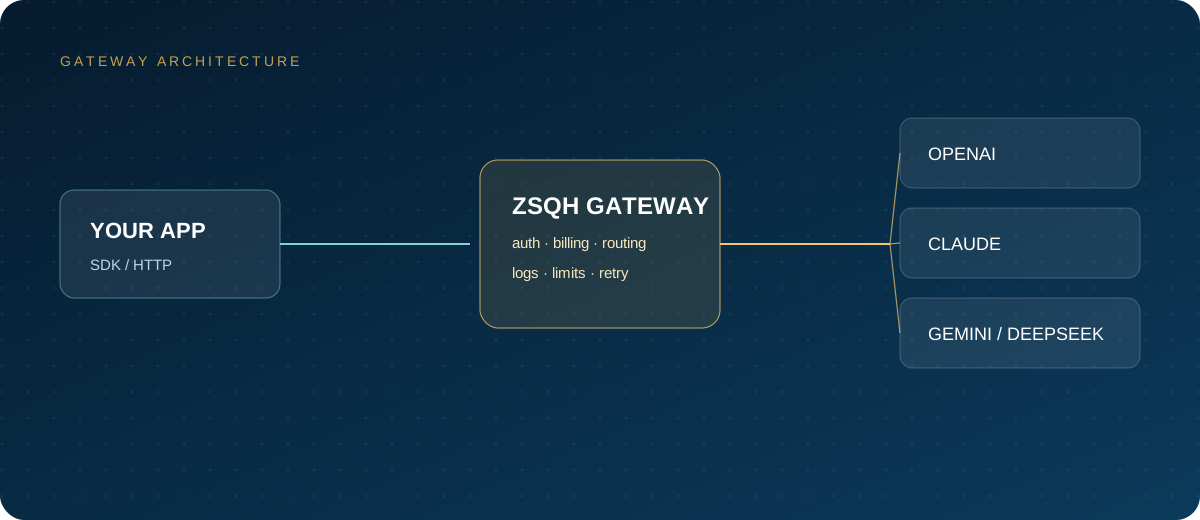
| Managed gateway | Mainland teams, multiple models, RMB billing required | Fast onboarding, unified keys and billing | Depends on the provider; confirm terms and data policy |
Do not choose based only on "can it connect?" Ask at least five questions: can it handle peak concurrency, is streaming stable, who owns timeout and retry behavior, what gets logged, and how quickly does the provider respond to incidents?
From a compliance standpoint, cross-border access and outbound data transfer must comply with company policy and applicable regulations. Do not hand business data to a shared proxy of unknown origin, and do not log keys or request content in plaintext at the proxy layer.
3. How to test direct access meaningfully
A single successful request tells you nothing useful. Take multiple samples and record DNS, TLS, first byte, and total time:
export GROK_API_KEY="sk-your-key"

for i in 1 2 3 4 5; do
  curl -o /dev/null -s \
    -w "code=%{http_code} dns=%{time_namelookup} tls=%{time_appconnect} ttfb=%{time_starttransfer} total=%{time_total}\n" \
    "https://api.x.ai/v1/chat/completions" \
    -H "Authorization: Bearer $GROK_API_KEY" \
    -H "Content-Type: application/json" \
    -d '{"model":"grok-4","messages":[{"role":"user","content":"Reply with OK only"}],"max_tokens":8}'
  sleep 2
done
Look at three metrics: success rate, the distribution of time to first byte, and the long tail of total time. A good average with a bad long tail means the path is unstable. Normal during the day but timing out at night points to egress congestion or changing upstream pressure. Test for several consecutive days and cover business peak hours.
Direct access suits teams with stable egress, predictable call volume, and the ability to diagnose network problems themselves. If every incident turns into guesswork, the hidden cost of direct access will exceed its apparent simplicity.
4. Two proxy patterns
Forward proxy
Configure HTTPS_PROXY on a server or container so requests leave through the proxy. The advantage is a low implementation cost. The drawback is a shared egress with a wide failure impact, and the proxy's own bandwidth and stability become a new bottleneck. When using one: route only the necessary domains rather than forwarding everything, and do not log request bodies or authentication headers.
Reverse proxy or self-hosted relay
Deploy a forwarding service overseas. Domestic services call it, and it calls xAI. This unifies egress, enables retries and rate limiting, and can hide the upstream address. The cost is that you must handle streaming forwarding, timeouts, certificates, authentication, and monitoring yourself; any weak point becomes a new failure source.
Whichever pattern you choose, confirm four things: whether streaming is supported, how connect and read timeouts are set, whether failed retries have an upper bound, and whether sensitive information appears in logs.
5. Connecting through a managed gateway
A managed gateway usually provides an OpenAI-compatible endpoint, so an existing OpenAI SDK only needs a new key and base URL:
import os
from openai import OpenAI

client = OpenAI(
    api_key=os.environ["GROK_API_KEY"],
    base_url="https://ai.zhongshangqihang.com/v1",
    timeout=60,
)

resp = client.chat.completions.create(
    model="grok-4",
    messages=[{"role": "user", "content": "Explain the stability metrics for cross-border APIs in three sentences."}],
    max_tokens=256,
)
print(resp.choices[0].message.content)
Before integrating, confirm with the provider: which models are supported, whether streaming is stable, the timeout and retry policy, how long logs are retained, whether keys are isolated, how incidents are announced, and whether invoices are available. After integrating, do not stop at "the request succeeded." Run the acceptance checklist below.
6. Stability acceptance checklist
- Success rate. Measure the share of 2xx responses over seven consecutive days, separating peak and off-peak periods.
- Latency distribution. Record P50, P95, and P99; do not look only at the average.
- Timeout ratio. Track connect timeouts and read timeouts separately.
- Rate-limit ratio. Measure the share of 429s and the concurrency and token usage when they occur.
- Error composition. Break down 401, 404, 429, and 5xx. Do not count configuration errors as network failures.
- Fallback capability. Prepare a backup model or channel and define how quality changes after fallback.
- Monitoring and alerts. Track success rate and latency per project, and be able to identify the specific key and request during an incident.
- Monthly review. Compare billing, usage, and incident records, then adjust quotas and timeouts.
Stability does not mean "no incidents." It means incidents are detected quickly, traffic can switch quickly, and root causes can be located quickly. An unmonitored direct connection and an unmonitored proxy are equally uncontrollable in practice.
FAQ
Can Grok API be accessed directly from mainland China?
It depends on the network environment, account conditions, and local restrictions; there is no universal answer. Use the multi-sample method in this article and judge by success rate and long-tail latency, not by whether one request gets through.
What is the difference between a proxy and a gateway?
A proxy mainly solves the network egress problem; authentication, billing, and multi-model management remain your responsibility. A gateway usually provides the endpoint, key management, billing, and model routing together. The former offers more control, while the latter reduces operational burden.
What should I do if streaming responses keep breaking?
First distinguish a client read timeout, a proxy idle timeout, and an upstream interruption. Set connect and read timeouts separately, disable buffering at the proxy layer, and record the time and request ID of each interruption.
How can I tell a network problem from rate limiting?
Look at the status code and error type. A 429 usually points to rate limiting or quota; connection timeouts and 502/504 responses are more likely path or proxy problems. Then send the same request through a different entry point to narrow it down quickly.
What if my business needs RMB invoices?
Choose a gateway that offers RMB top-ups and invoices, and confirm the invoicing entity, amount basis, and timing. Specific rules are subject to model pricing and the platform terms.
Next steps
If you would rather not maintain a separate proxy while keeping the ability to switch models, create a test key at the ZSQH AI Gateway, run real traffic for a week, and then evaluate it against the stability checklist. Model availability and prices are subject to model pricing.
Related reading: