Buying Kimi API for an enterprise is not the same as topping up a personal account. Individuals care about "does it work and is it cheap"; enterprises also need to confirm the contracting entity, enterprise verification, corporate payment, invoicing, quotas and SLAs, data compliance, model lifecycle, and cost allocation. Any item left out of the contract can turn into an operations problem after launch.
This article provides an actionable procurement checklist and deliberately avoids fixed prices. Specific unit prices, discounts, and terms follow the official quote, your contract, and the model pricing page.
Note: Moonshot and Kimi are trademarks of their respective owners. Enterprise plans, verification processes, and commercial terms may change. This article reflects common conditions as of October 2026; before purchasing, defer to the official pages and the contract.
1. Distinguish the Two Products First
| Product | Audience | Billing model | Credentials | Best for |
|---|---|---|---|---|
| Kimi API | Developers and enterprise systems | Usage-based, per token | API key | Product integration, batch processing, agents |
| Kimi Business | Teams using the Kimi assistant | Membership subscription | Account | Office collaboration, individual use |
These are not the same thing. If an enterprise wants to embed Kimi in customer support, document, or code systems, it is buying the API; if it wants to give employees Kimi assistant memberships, it is buying Business. Confirm the requirement before purchasing to avoid buying the wrong product.
2. Enterprise Procurement Checklist
| Item | Questions to confirm | Why it matters |
|---|---|---|
| Contracting entity | Do the contract, payment, and invoice entities match? | Affects verification, payment, and reimbursement |
| Enterprise verification | Is corporate identity verification required, and how is it done? | A prerequisite for corporate payment and contracts |
| Top-up and payment | Is corporate transfer supported, and how long does it take to clear? | Affects cash planning |
| Invoicing | Invoice type, tax rate, billing category, and title rules | Affects financial booking |
| Quotas and rate limits | What are the concurrency, RPM, TPM, and TPD limits? | Determines whether peak traffic holds |
| SLA and support | Is there an availability commitment and a response-time target? | Determines accountability and recovery during incidents |
| Data and compliance | Data retention, training use, and cross-border path | Involves personal information and customer data |
| Model lifecycle | When are older models retired, and how do you migrate? | Avoids sudden unavailability |
| Keys and permissions | Can keys be split by project, with least privilege? | Reduces leakage and misuse risk |
| Exit mechanism | How are balance, data, and logs handled? | Leaves no loose ends when changing vendors |
Take this table directly into sales conversations. Anything the vendor can answer in writing should go into the contract or an appendix; anything that is only a verbal promise should be treated as a risk.
3. How to Negotiate Quotas and Rate Limits
The rate tiers on the Kimi open platform are tied to cumulative account top-ups, and vouchers typically do not count toward cumulative top-ups. The lowest tier has the tightest limits, including a daily token cap; higher tiers raise concurrency, RPM, and TPM. Paid tiers are usually no longer subject to the daily token cap but still face concurrency and per-minute limits.
Enterprises can apply through commercial channels for higher rates and concurrency, dedicated support, and a custom SLA. When negotiating, provide estimated monthly usage, peak concurrency, main scenarios, and growth plans; otherwise the vendor cannot offer a matching quota.
Two more points deserve attention: the platform may apply temporary throttling when the cluster is under heavy load, and risk-control throttling triggered by abnormal behavior may not be lifted automatically. Architecturally, then, never assume that "buying a high quota means no rate limits ever again." Still build queuing, backoff, key splitting, and a fallback channel.
4. Which Compliance Documents to Review
- Model filing information. Confirm that the service has completed the applicable algorithm filing or generative AI service filing, and request supporting evidence.
- Data processing agreement. Where data is stored, for how long, who can access it, and whether it is used for training must all be stated clearly.
- Privacy policy and user terms. API and consumer-product terms may differ and cannot be used interchangeably.
- Cross-border data. When using the international site or overseas nodes, first assess whether the flow constitutes cross-border data transfer.
- Accounts and permissions. Enterprise-verified accounts, project-level keys, least privilege, and an offboarding revocation process.
- Logs and audit. Retain call logs, error logs, and billing records to satisfy internal audit requirements.
- Content safety. Public-facing services need content moderation and a complaint-handling mechanism.
For personal information, important data, or customer contract text, have legal and security teams review before launch rather than patching afterward.
5. How to Govern Costs
| Measure | Practice | Effect |
|---|---|---|
| Caching | Fix system prompts, tool definitions, and knowledge-base prefixes | Raises cache hits and lowers input cost |
| Context governance | Retrieval, history summaries, trimmed tool output | Reduces wasted input |
| Model routing | K2.6 for general tasks, K2.7 for code, evaluate K3 only for very long material | Avoids model mismatch |
| Output caps | Set max_completion_tokens and require structured output |
Controls long outputs |
| Project budgets | Set daily budgets and alerts per project | Prevents one workload from consuming the allowance |
| Monthly reconciliation | Review by project, model, and scenario | Finds the fastest-growing consumption |
import os
from collections import defaultdict

# Read rates from the contract or pricing page; this example hardcodes no numbers.
PRICE = {
    "input_miss": float(os.environ["KIMI_INPUT_MISS_PRICE"]),
    "input_hit": float(os.environ["KIMI_INPUT_HIT_PRICE"]),
    "output": float(os.environ["KIMI_OUTPUT_PRICE"]),
}

# Each row: project, cache-miss input, cache-hit input, output
rows = [
    ("customer support", 120000, 80000, 30000),
    ("document extraction", 90000, 20000, 12000),
]

cost = defaultdict(float)
for project, miss, hit, out in rows:
    cost[project] = (
        miss * PRICE["input_miss"]
        + hit * PRICE["input_hit"]
        + out * PRICE["output"]
    )

for project, amount in sorted(cost.items(), key=lambda x: -x[1]):
    print(project, round(amount, 2))
This code is only an allocation example; the rates must come from the actual contract and cannot be carried over from a screenshot or a verbal quote. If K3 has cache-write charges, account for cache writes separately.
6. Procurement Process
- Map the scenarios, peak concurrency, average daily tokens, and growth expectations.
- Complete enterprise verification, preparing the business license, bank account, and unified social credit code.
- Test quality, latency, rate limits, and error rates with small traffic.
- Negotiate the contract: quota, SLA, support response, data processing, and exit terms.
- Pay by corporate transfer or credit, and confirm the clearing and invoicing process.
- Launch: project-level keys, budgets, monitoring, alerts, and a fallback channel.
- Review usage, cost, incidents, and alternatives every quarter.
FAQ
How is enterprise verification completed?
It usually requires submitting the company name, a bank account under the same name, and the unified social credit code. The platform deposits a random amount into the company account; finance verifies it and enters the amount. The exact process follows the official pages.
Can we pay by corporate transfer and receive invoices?
After enterprise verification, you can usually choose online top-up or corporate remittance; the invoice title generally must match the enterprise-verified entity. Invoice type, tax rate, and billing category follow the platform rules and the contract.
Can enterprises get an SLA?
Support levels may differ between the standard API and enterprise plans. If you need an availability commitment, dedicated support, or a higher quota, raise it explicitly in commercial discussions and write it into the contract.
Will our data be used for training?
Do not rely on the marketing page alone. Data terms may differ between the API and consumer products. Read the privacy policy and data processing agreement before signing, and write retention, training, and deletion rules into the contract.
Can a personal account handle company workloads?
It is not recommended. Personal accounts are incomplete for enterprise verification, corporate payment, invoicing, permission management, and auditing, and responsibility is unclear when something goes wrong.
Next Steps
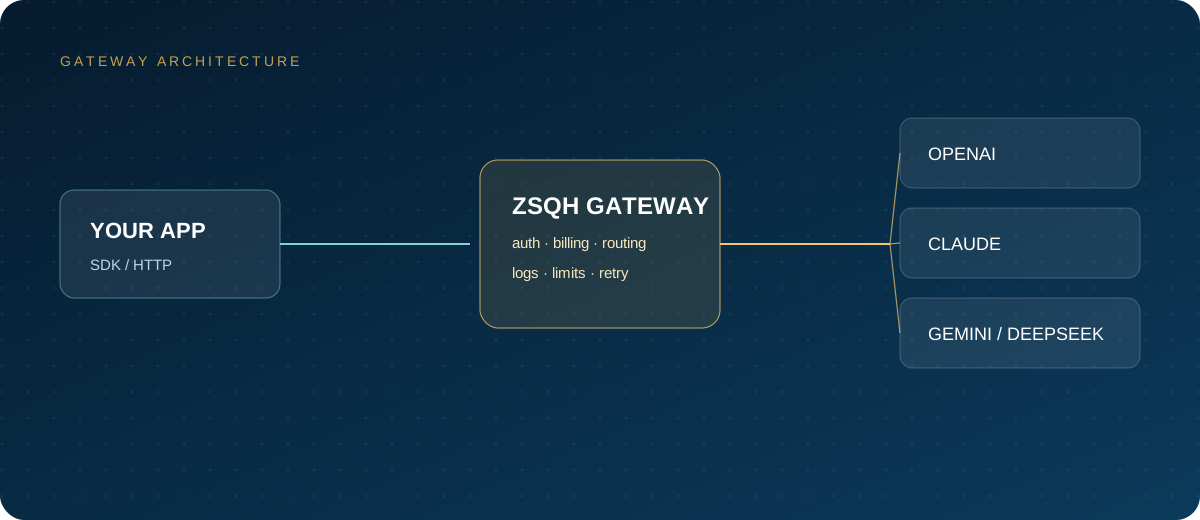
Start by running a round of real scenarios on the ZSQH AI Gateway with a test key, capture usage, latency, and error rates, and then take that data into quota and contract negotiations. Models, prices, and enterprise plans follow the model pricing page.
Related reading: