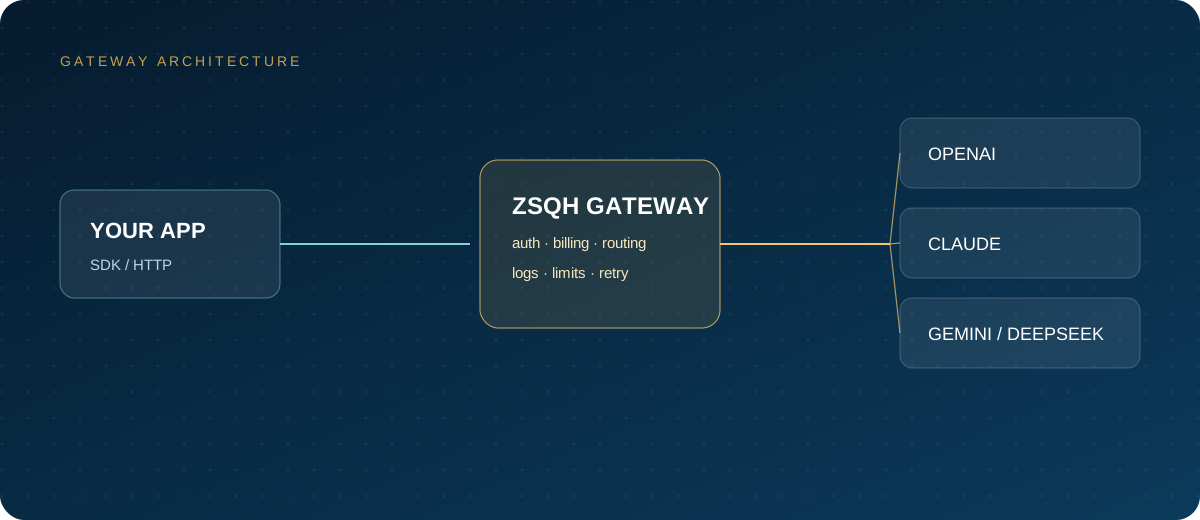
A Kimi API relay is essentially a gateway layer between your application and the model. It may solve domestic access, unified keys, multi-model switching, and RMB billing, but it may also introduce new failure points, a billing black box, and data risk. The question is not whether a relay is good or bad, but who maintains this layer, whether its rules are transparent, and whether problems can be investigated.
This article compares three paths: direct access, a self-hosted proxy, and a managed relay, focusing on stability, billing, and migration acceptance. Models and prices follow the in-site model pricing page.
Note: Moonshot and Kimi are trademarks of their respective owners. This article is for technical discussion only. The qualifications, terms, and billing rules of relay services are provided by each service provider; verify them independently before signing.
1. Three Paths, Side by Side
| Dimension | Official direct access | Self-hosted proxy | Managed relay or gateway |
|---|---|---|---|
| Entry point | api.moonshot.cn or api.moonshot.ai |
Your own domain, reverse proxy | Unified entry provided by the vendor |
| Key ownership | Your own official key | Your own official key | Vendor account or sub-key |
| Billing | Official per-token billing | Official bill plus server cost | Vendor billing by token, package, or multiplier |
| Incident investigation | Official status page and request_id |
You own the entire path | Depends on vendor logs and responses |
| Best for | Single model, smooth access | Teams with operations capability and a unified egress | Multi-model, domestic payment, less operations work |
The three paths are not mutually exclusive. A common pattern is direct access for core workloads, gateway for testing and non-core workloads, and a self-hosted proxy only for unified egress and auditing.
2. Direct Access: Simplest, With Boundaries
Direct official access has the shortest path and the clearest responsibility. The China site uses https://api.moonshot.cn/v1, the international site uses https://api.moonshot.ai/v1, and the key must match the site. When a request fails, the error.type and request_id in the official response are the most direct troubleshooting clues.
Direct access has four main boundaries:
- Network quality from mainland China to the international site is unstable, and long connections and streaming are more likely to drop.
- The official platform assigns rate-limit tiers by cumulative top-up, and new accounts usually have tight concurrency.
- Invoicing, contracts, and procurement must follow official rules.
- It covers only Kimi; multi-model workloads require maintaining several sets of keys and bills.
If none of these is a problem, direct access is the default. Do not add a layer just to make the architecture look good.
3. Self-Hosted Proxy: More Than a Reverse Proxy
Many people assume a self-hosted proxy is just Nginx forwarding. In production, it has to handle at least the following:
- Key custody: keys must not be written into the frontend or a repository; the proxy layer needs secret injection and rotation.
- Streaming forwarding: disable buffering so SSE arrives chunk by chunk; otherwise streaming degrades into a single response at the end.
- Timeout settings: set connect and read timeouts separately; long generation cannot use a short read timeout.
- Retry policy: retry only transient errors; do not retry insufficient balance or content-safety errors.
- Usage accounting: record the model, input and output tokens,
request_id, and latency, or reconciliation is impossible. - Egress and rate limiting: when several workloads share egress, prevent one workload from consuming all concurrency.
- High availability: the proxy itself can fail, so run multiple instances and health checks.
A self-hosted proxy does not increase upstream quota. Official rate limits still apply; the proxy can only queue, slow down, and switch, not create concurrency out of thin air. Labor cost also counts: one person maintaining a proxy and a managed service can have very different long-term costs.
4. What Transparency to Demand from a Managed Relay
When choosing a managed relay, do not look only at the words "stable" and "cheap". Clarify the following before signing:
- Who operates the service, and who issues the contract and invoice.
- Whether the upstream is official direct access, a cloud provider, or another reseller, and how model names are mapped.
- What the billing unit is, whether input and output are priced separately or by multiplier, and whether there is a minimum spend.
- Whether request logs can be exported, how long they are retained, and which fields they contain.
- Whether data is retained, used for training, or forwarded to third parties.
- What the rate-limit rules, concurrency caps, and burst policy are.
- Whether there is a status page, an SLA, and outage compensation terms.
- How keys are stored, and whether sub-keys, IP allowlists, and immediate revocation are supported.
- How data is deleted on exit, and how unused balance is handled.
There are no standard answers to these questions, but there must be written answers. A service that can only promise verbally that it is "very stable" is not suitable for core workloads.
5. Billing: Put the Rules in the Contract
Relay billing commonly takes three forms: a markup on token prices, prepaid token packages, and the official price multiplied by a rate. No form is inherently better; what matters is that the rules are clear and verifiable.
For reconciliation, look at at least four numbers:
| Metric | Purpose | Common source of discrepancy |
|---|---|---|
| Input tokens | Verify cache hits and misses | Whether cached input is billed at full price |
| Output tokens | Verify the cost of long output | Whether reasoning content is counted |
| Request count | Verify minimum spend or per-request fees | Whether retries are billed again |
| Failed requests | Decide whether they are billable | How 429s, timeouts, and disconnects are handled |
Confirm before signing: whether cache hits are discounted, whether reasoning content counts as output, whether failed requests are billed, and what the refund and credit rules are. If the price is below official, ask whether it comes from subsidy, bulk purchasing, or shared quota; do not look only at the number.
6. Stability: Rate Limits, Timeouts, and Failover
When Kimi applies rate limiting, it returns 429 with X-RateLimit-Limit, X-RateLimit-Remaining, and X-RateLimit-Reset. Handle 429s in three categories:
engine_overloaded_error: the server is overloaded; back off and retry.rate_limit_reached_error: concurrency, RPM, TPM, or TPD exceeded; slow down or wait for the reset.exceeded_current_quota_error: unpaid balance or insufficient quota; do not retry, top up first.
A non-streaming request that waits more than 900 seconds may return a 504, so long tasks should use streaming. A client-initiated disconnect may appear as a 499; check the proxy and timeout configuration.
Failover only makes sense for transient errors:
import os
from openai import OpenAI, RateLimitError

primary = OpenAI(
    api_key=os.environ["PRIMARY_KEY"],
    base_url=os.environ["PRIMARY_BASE"],
    max_retries=0,
)
backup = OpenAI(
    api_key=os.environ["BACKUP_KEY"],
    base_url=os.environ["BACKUP_BASE"],
    max_retries=0,
)

def ask(prompt: str) -> str:
    for client in (primary, backup):
        try:
            resp = client.chat.completions.create(
                model=os.environ["MODEL"],
                messages=[{"role": "user", "content": prompt}],
                max_completion_tokens=512,
            )
            return resp.choices[0].message.content
        except RateLimitError as exc:
            if "quota" in str(exc).lower():
                raise
    raise RuntimeError("Both primary and backup are unavailable")
The example only illustrates the structure. In production, branch on error.type and add circuit breaking, half-open probing, and alerting. Insufficient balance, bad parameters, and content-safety errors should not trigger failover; switching paths will not fix them.
7. Migration and Acceptance Checklist
- Fix a set of test requests covering short Q&A, long documents, streaming, and tool calls.
- Send the same requests to direct access and the relay, and compare
model,usage, andrequest_idin the responses. - Check whether streaming arrives chunk by chunk, ends with
[DONE], and includes a complete usage chunk. - Deliberately trigger 401, 404, and 429, and compare error types and message readability.
- Observe p50 and p95 latency and error rates for a full week, not just a single test.
- Reconcile real bills against
usage, confirming how caching, retries, and failed requests are billed. - Review the data terms, log fields, and key custody.
- Roll out to low-risk workloads first and keep a switch to fall back to direct access.
If acceptance fails, do not move core workloads. The value of a relay layer is reducing complexity, not hiding invisible risk.
8. Security, Compliance, and Exit Mechanism
A relay operator can see request content; that is a property of the architecture, not a trust issue. For requests involving personal information, contracts, secrets, and internal code, confirm the data terms and retention policy first, and redact or handle them on the direct path where necessary.
Design the exit mechanism in advance too: whether keys can be revoked at any time, whether logs can be exported, whether unused balance can be returned, and how soon data is deleted. Only a low migration cost keeps you from being locked in by a single vendor.
FAQ
Is a relay more stable than official direct access?
Not necessarily. A relay can provide a unified entry, retries, and failover, but it also adds a failure point. Stability depends on the vendor's operations capability, upstream quality, and your timeout configuration; validate it with at least a week of real traffic.
Is a relay price below official normal?
It may come from bulk purchasing, subsidy, or shared quota, or it may reflect creative billing rules. Clarify the billing unit, cache rules, and whether failed requests are billed, then reconcile against the bill rather than trusting the marketing page.
Can a self-hosted proxy solve 429 errors?
It cannot create upstream quota. A proxy can queue, slow down, retry, and switch, but if the official account's concurrency or TPD is maxed out, you still have to wait for a reset or upgrade the tier.
How can I tell whether a relay is really serving Kimi?
Look at the model field, the structure of usage, and request_id, then compare direct-access results on a fixed evaluation set. A single signal cannot prove it; combined verification is more reliable. If you have doubts about the source, prefer direct access.
How much code has to change to switch to a relay?
OpenAI-compatible projects usually need only the base URL, key, and model name changed. Also check streaming, timeouts, error-type mapping, and usage accounting; these are the areas most likely to break after a switch.
Next Steps
Run the acceptance checklist on the ZSQH AI Gateway with a test key, then decide which workloads should use direct access and which should use the gateway. Available models and billing rules follow the model pricing page.
Related reading: