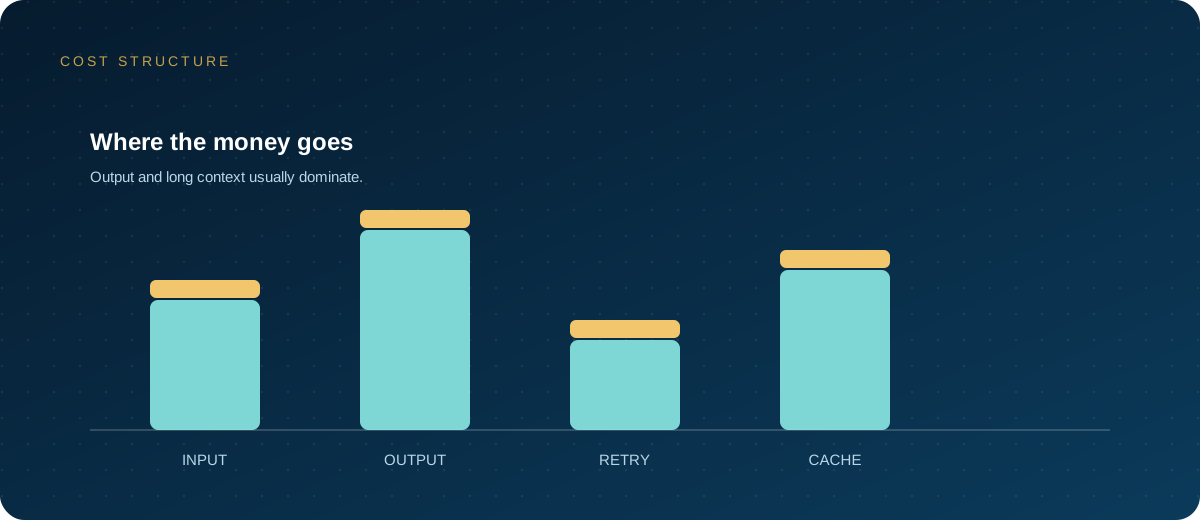
People who search for "LangChain pricing" usually want a single unit price. But LangChain is an open-source framework; the bills actually come from model APIs, embedding services, vector databases, and observability platforms. Looking at them together leads to two inaccurate conclusions: "the framework is free, so it is cheap" or "once you add agents, costs spiral."
This article does not list unit prices that will expire. Instead, it provides a method for breaking down the bill, estimating costs, and setting limits. Model prices follow the model pricing page, and commercial plans follow each vendor's own page.
Note: LangChain is a trademark of LangChain, Inc. This article discusses costs only and is not affiliated with, or partnered with, LangChain, Inc. Open-source licenses, commercial products, and prices may change; follow the official repository and product pages.
1. "LangChain pricing" actually has four parts
Broken down, the bill usually includes the framework and libraries, model calls, retrieval and storage, and observability and deployment. Each is billed differently:
| Cost item | Billing method | When it occurs | Easy to miss |
|---|---|---|---|
| Framework and libraries | Open source, usually no license fee | Installation and upgrades | Commercial observability, evaluation, or deployment products are billed separately |
| Model calls | Per input and output token | Every request | Retries and multi-step calls are billed repeatedly |
| Embeddings | Usually per input token | Index building and every query | Changing models often requires rebuilding the index |
| Vector database and servers | Subscription or resource usage | Continuous operation | Idle instances can still generate charges |
| Observability and evaluation | Plan, seat, or usage | After tracing is enabled | Sampling and retention policies affect cost |
Most teams spend mainly on model calls, but watching unit price alone is not enough. A project with low call volume that keeps a vector database and always-on services running may find infrastructure costs more visible.
2. A free framework does not mean a low total cost
The LangChain open-source framework usually charges no license fee, but "free" describes the license, not the operating cost. Spending also includes model tokens, embeddings, vector databases, servers, observability platforms, and maintenance labor. The first two grow with call volume.
To judge whether something is cheaper, compare the total cost of completing the same task, not the framework's sticker price. Self-built orchestration saves platform fees but adds maintenance time; a managed platform reduces operations work but the bill varies with usage.
3. Chains and agents multiply tokens
A plain conversation costs roughly "input plus output." Chains and agents are different: each step may carry the system prompt, history, tool descriptions, and the previous step's result again.
Assume a single step uses 4,000 input tokens and 600 output tokens, and a task averages six steps. The input is then close to six copies of the context, not one. If history grows with each step, later steps are even longer. Three common multipliers:
- Tool-calling loops: call a tool, read the result, call the model again. More iterations mean more repeated context.
- Multi-agent collaboration: each sub-agent has its own prompt and context, and results are copied again when aggregated.
- Failed retries: timeouts, rate limits, and format errors trigger retries, and failed requests may still be billed.
The fix is not to avoid agents but to put a ceiling on loops: maximum steps, timeouts, trimmed tool output, and stable instructions placed in the prefix so caching can hit. LangGraph's recursion_limit and the agent executor's maximum iteration count should be set explicitly in production configuration.
4. RAG: embeddings and context injection
RAG costs split into two phases. During index building, documents are chunked and each chunk is embedded; cost depends on the number of chunks, chunk size, and overlap ratio. During query time, the question itself is embedded, and several retrieved chunks are inserted into the prompt as context.
Three things are easy to underestimate:
- Index rebuilds: changing the embedding model, adjusting the chunking strategy, or cleaning data may require recomputing every vector.
- Context inflation: raising
top_kfor recall brings more source text into every turn, and input tokens rise with it. - Reranking models: an extra reranking layer often improves relevance, but adds calls and latency.
A cheaper approach is to optimize retrieval quality before quantity: improve chunking, deduplicate, add metadata filters, and use reranking to remove low-relevance chunks, and only then consider a cheaper model. Embedding and RAG billing are covered in the related reading at the end.
5. Caching: savings come from repeated prefixes
There are two layers of caching with different purposes.
The first is the model provider's prefix cache. When the beginning of a request matches, cached reads are usually cheaper than fresh input, but support, discount, and retention time vary by provider. The key points: put system prompts, role settings, and fixed documents first, and the current question and temporary data last. Frequently editing early messages or switching models invalidates the cache.
The second is application-level caching. LangChain provides mechanisms such as set_llm_cache that can store identical request results in memory, SQLite, or Redis; support varies by integration and version, especially for chat models, so check the documentation. It suits scenarios with stable, highly repeated answers, not strongly personalized or real-time requests. Whether it pays off depends on the hit rate, not on whether it is enabled.
6. Turn estimates into a reproducible formula
Do not budget by feel. Build a cost model in six steps:
- List every model-call path in the application, including the main flow, retries, summaries, and title generation.
- Use callbacks or the usage fields in responses to measure input and output tokens at each step.
- Count the average number of steps per successful task and the share of failed retries.
- Read unit prices from the model pricing page and convert everything to "per million tokens."
- Add embedding, vector database, server, and observability costs.
- Calibrate against the real bill from the first month after launch, correcting assumptions about steps and retries.
The function below only does arithmetic; you supply the unit prices:
import os

# Read unit prices from the pricing page and store them in environment variables, per million tokens
IN = float(os.environ["PRICE_IN_PER_MTOK"])
OUT = float(os.environ["PRICE_OUT_PER_MTOK"])

def task_cost(input_per_step: int, output_per_step: int, steps: int,
              retry_rate: float = 0.1) -> float:
    calls = steps * (1 + retry_rate)
    return (input_per_step * calls * IN + output_per_step * calls * OUT) / 1_000_000

# Example: 4,000 input and 600 output per step, six steps on average, 10% retry rate
print(round(task_cost(4000, 600, 6), 4))
Watch the unit conversion: most pricing pages quote per million tokens, so multiply by the unit price and divide by one million in code to avoid mixing it up with "per thousand tokens."
7. Budget ceilings: stop overspending before it happens
Estimates only forecast; limits provide the backstop. Set them at both the gateway and application layers:
- On the gateway, set a budget, model allowlist, and rate limit for each key, and split keys by project or environment.
- In the application, set
max_tokens, request timeouts, and retry limits.max_tokensonly limits output; long context still needs separate control. - Set maximum steps and recursion limits for agents so tool calls cannot loop indefinitely.
- Set daily quotas per user or tenant so one abnormal request cannot drain the whole budget.
- Configure usage alerts that notify the owner when a threshold is reached.
Budget ceilings are not a sign of distrust; they turn an unpredictable bill into a predictable boundary. Trial keys and CI keys need them most.
8. Observability and review: unit cost per task
The total bill shows how much was spent, not where. Break it down by task, model, and call chain:
- LangChain response messages usually include
usage_metadata, which can record input, output, and total tokens; field names may differ by provider. - Callback handlers can record latency, model name, and usage around each model call, which fits well with existing logging systems.
- Observability platforms such as LangSmith can display the full call chain, but whether to enable them, how to sample, and how the plan is billed should be evaluated against team needs.
When reviewing, focus on "average cost per successful task" rather than "cost per call." The former includes failed retries and human intervention, which is closer to a real unit economics model. At high volume, sample traces so observability does not become a new cost item.
FAQ
Does LangChain itself charge a fee?
The open-source framework usually charges no license fee and is released under the MIT license. Commercial products such as LangSmith and deployment platforms are billed separately. Specific licenses and plans follow the official repository and product pages.
Why is local testing cheap while the bill grows quickly after launch?
Local testing has low call volume, short context, and few failures. After launch, concurrency rises, and retries, long sessions, tool loops, and retrieved context all multiply tokens. Measure real usage per task, then multiply by post-launch call volume; this usually explains the difference.
How should I estimate agent costs?
Measure input and output for one step, then count the average steps per task and the retry rate, and estimate with "steps × per-step usage." When history accumulates, actual input is higher. Cap the loop and calibrate with real trace data.
Where does RAG mainly get expensive?
Usually in the context tokens during generation, followed by embeddings during index building. Retrieval and the vector database also cost money, but are often not the largest share. Adjusting top_k, chunking, and reranking usually shows results faster than switching models.
Does enabling caching always save money?
Not necessarily. The benefit depends on the share of repeated requests and prefix stability. When requests are scattered, need real-time updates, or are highly personalized, the hit rate will be low. Estimate the hit rate from logs first, then decide whether to add caching.
Next steps
LangChain costs break into four accounts: the framework is usually free, models are billed per token, retrieval and infrastructure run continuously, and observability and deployment depend on the plan. The control order is measure, estimate, cap, then calibrate with the real bill. If you need a unified multi-model entry point with per-key usage statistics and budget management, you can sign up for ZSQH AI Gateway; models and prices are listed on the model pricing page.
Related reading: