When discussing "Llama API access in China" in 2026, the first question is not which route to pick. It is which layer you mean: Meta's own hosted interface, or "an API that calls Llama models." The former has been shut down; the latter still has several viable paths. That distinction directly affects procurement, migration, and compliance decisions.
This article compares network, payment and invoicing, compliance, hardware, and failover, and provides a pre-launch verification checklist.
Note: Meta, Llama, and Llama 4 are trademarks of Meta Platforms, Inc.; AWS, Azure, Google Cloud, Oracle, and other names are trademarks of their respective owners. This article is a technical discussion only. It implies no affiliation or partnership with the companies above and does not constitute legal advice. Models, regions, and prices are governed by each platform's official documentation and the pricing page; prices change.
1. Clarify first: what "Llama API" means in 2026
Meta launched the Llama API public preview in 2025, offering a first-party hosted interface for Llama models. That preview was retired on July 6, 2026, and requests to the old address receive a discontinuation notice. What was retired is Meta's first-party hosted interface, not the model itself.
Llama model weights remain available from the Meta Llama download page and Hugging Face under the Llama Community License. Cloud platforms such as AWS, Azure, and Google Cloud, along with many inference providers, continue to offer Llama models. Meta also has a separate Model API for the Muse Spark family, which is not the same product line as Llama; do not conflate the names during procurement.
So when a China-based team says "integrate the Llama API" today, it is usually choosing among three roles: cloud hosting, an inference provider or China-based gateway, and self-hosting. The sections below take them one by one.
2. Route one: cloud hosting
The mainstream choices are AWS Bedrock, Azure AI Foundry, Google Cloud Vertex AI Model Garden, and for some teams Oracle OCI Generative AI. Their common trait is that accounts, permissions, audit, and billing all sit under the cloud account, which suits teams that already have a cloud contract and usage commitment.
Three things need attention. First, regions and model variants are not synchronized everywhere; which regions offer Llama 4 Scout, Maverick, and other models depends on each cloud's regional model list. Second, interface shapes are not uniform: Bedrock commonly uses Converse or InvokeModel, Azure and Vertex each have their own SDKs, and an OpenAI-compatible layer often has to be added by you or provided through a gateway. Third, payment is usually settled in foreign currency, and the invoicing entity, currency, and payment terms depend on how the contract is signed.
Cloud providers offer relatively complete compliance materials, private network access, and enterprise support. The cost is a long onboarding process and the need to confirm cross-region data arrangements in advance.
3. Route two: inference providers and China-based AI gateways
Inference providers include Groq, Together AI, Fireworks, DeepInfra, and OpenRouter. Groq is known for low latency; Together AI, Fireworks, and DeepInfra offer usage-based or dedicated deployments; OpenRouter aggregates multiple upstreams. Most providers offer OpenAI-compatible interfaces, so migration usually means changing only the base URL, key, and model ID.
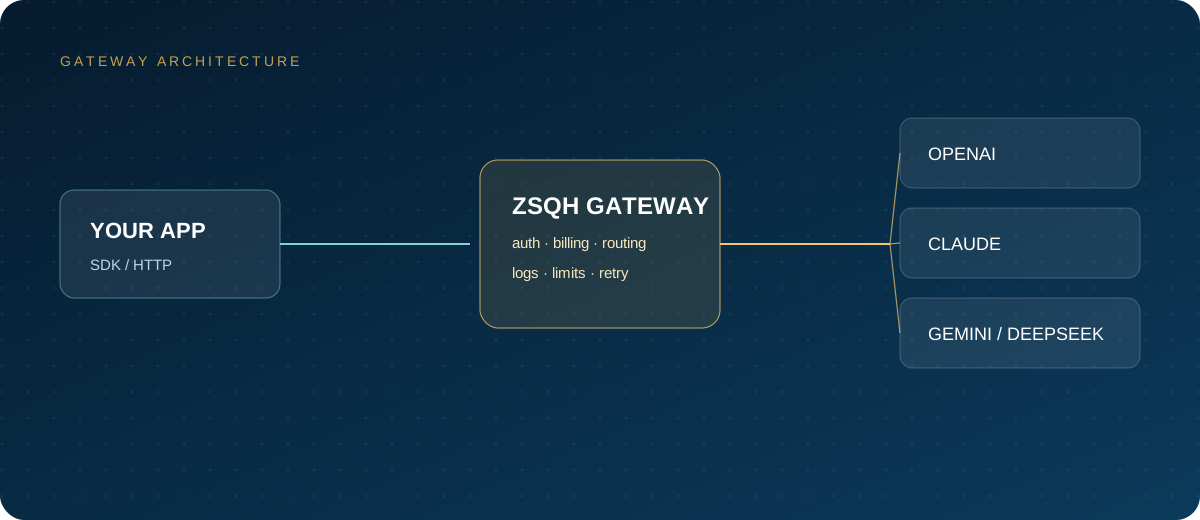
China-based AI gateways consolidate these upstreams behind one entry point, with RMB top-ups and on-site key management. ZSQH AI Gateway belongs to this category; the registration entry point is the sign-up page. Available models, context lengths, and billing follow the site's model list and pricing page. When choosing a gateway, ask more questions: who the upstream is, whether the model is quantized, how failed requests are billed, and how long data is retained.
4. Route three: self-hosting
The upstream for self-hosting is the model weights, not a particular API. Weights come from the Meta Llama download page or Hugging Face. Common inference frameworks include vLLM, SGLang, TGI, llama.cpp, and Ollama. After a new model is released, framework support usually takes one or two versions to catch up, so read the release notes before deploying.
A rough hardware estimate uses two rules of thumb: BF16 weights take about 2 GB per billion parameters, and INT4 quantization takes about 0.5 to 0.6 GB per billion parameters, with extra room for KV cache, framework overhead, and concurrency. Meta's reference for Llama 4 Scout is a single H100 running INT4, while Maverick requires a multi-GPU H100 node; Llama 3.3 70B also needs multiple GPUs under BF16. Verify against the model card and inference framework documentation.
Self-hosting solves the problems of keeping data in your own data center, controlling versions, and serving a stable load. The cost is that GPUs, drivers, framework maintenance, monitoring, scaling, and security all become your responsibility.
5. One table comparing the three routes
| Dimension | Cloud hosting | Inference provider / China-based gateway | Self-hosting |
|---|---|---|---|
| Network entry | Cloud regional endpoint, private networking available | Provider endpoint; China-based gateways are usually reachable domestically | Your own data center or cloud host |
| Onboarding and payment | Cloud account, foreign-currency settlement, or enterprise contract | Register and top up; RMB is common | Buy or rent GPUs, plus power and operations |
| Invoicing | Per the cloud contracting entity | Per the provider's rules | Handled by you |
| Data and compliance | Regions, audit, and contract materials are relatively complete | Depends on the provider; verify item by item | Clearest data boundary |
| Version control | The platform decides what is listed and retired | The upstream decides; confirm mapping | You pin the weight version |
| Operations cost | Low | Low to medium | High |
| Elasticity | Good, subject to quota | Good, subject to upstream rate limits | Depends on your own GPUs |
| Suitable teams | Existing cloud contract, compliance-heavy | Small and mid-sized China-based teams integrating several models | Data-sensitive, stable load, GPU capability |
6. How to verify network, payment, and invoices
"Reachable" does not mean "reliable under load." Cross-border links tend to show higher latency at peak hours, occasional timeouts, and interrupted streaming. Measure time to first byte, p95 total latency, timeout rate, and streaming interruption rate, not a single ping.
export LLAMA_BASE_URL="https://your-gateway.example.com/v1"
export LLAMA_API_KEY="sk-..."

curl -o /dev/null -sS \
  -w "dns=%{time_namelookup}s tcp=%{time_connect}s tls=%{time_appconnect}s ttfb=%{time_starttransfer}s total=%{time_total}s code=%{http_code}\n" \
  "$LLAMA_BASE_URL/models" \
  -H "Authorization: Bearer $LLAMA_API_KEY"
Run a set in the morning, midday, and evening over several consecutive days. Slow DNS points to resolution, slow TCP points to the route, slow TLS points to the handshake, and slow time to first byte usually means upstream queuing.
Ask about payment and invoicing in advance: currency, card types, balance refunds, invoice header, payment terms, and minimum spend. Record these in the procurement file so the finance process does not turn out to be a blocker after launch.
7. Compliance and licensing: three separate questions
The first is service compliance. Providing generative AI services to the domestic public may involve filing or security assessment requirements under rules such as the Interim Measures for the Management of Generative AI Services. Internal research and development differs from external operations; follow the regulator's guidance and legal advice.
The second is data compliance. Cross-border calls send prompts and outputs outside the country. Whether personal information or important data is involved, and whether contract clauses or an outbound transfer assessment are needed, should be judged under rules such as the Personal Information Protection Law. Self-hosting keeps data in your own data center, but that does not make it automatically compliant.
The third is model licensing. The Llama Community License permits commercial use but includes an acceptable-use policy and naming and attribution requirements. If monthly active users reach a certain scale (the Llama 4 license states 700 million), a separate license is required. Terms differ between versions, so have legal counsel read the original before commercial use.
8. Failover: do not treat one link as the only entry
A single upstream will inevitably have maintenance, rate limits, and regional failures. A workable approach: prepare a primary and a backup upstream for each task type and keep a unified model mapping table; switch to the backup when health checks fail; set reasonable timeouts, exponential backoff with jitter; use circuit breakers to prevent retry storms; degrade to a smaller model when necessary; and record the upstream name and request ID for every request to simplify reconciliation and troubleshooting.
Note that retries can be billed twice, write operations must be idempotent, and streaming requests should record the portion already emitted. Rehearse the switchover process before an incident, not during one.
9. Pre-launch verification checklist
- List the Llama variants, context lengths, tool-calling, and streaming requirements your business needs.
- Confirm the target upstream is available in the required region, and record the model ID and version.
- Check the interface protocol: OpenAI-compatible, a proprietary SDK, or a cloud-specific protocol.
- Run an evaluation with real business samples, recording accuracy, p95 latency, and failure rate.
- Verify quantization level, maximum output, system prompt, and content-filtering differences.
- Confirm payment, invoicing, refunds, rate limits, and billing rules for failed requests.
- Confirm data retention, logging, cross-border transfer, and contract terms.
- Configure primary/backup switching, timeout retries, budget alerts, and request logs.
- Run a small-traffic canary for one to two weeks before scaling gradually.
10. Frequently asked questions
Can Meta's Llama API still be called directly?
No. Meta's first-party Llama API public preview was retired on July 6, 2026. Llama weights can still be downloaded and called through third-party cloud platforms, inference providers, or self-hosting.
Does a China-based team need to file when calling Llama?
It depends on the purpose. Internal research, internal tools, and services offered to the domestic public face different requirements; the last may involve filing or a security assessment. Have legal counsel confirm during the selection stage.
What is the minimum number of GPUs for self-hosting Llama?
There is no universal answer; it depends on model size, quantization, context length, and concurrency. Start with "about 2 GB per billion parameters at BF16 and 0.5 to 0.6 GB at INT4," then add KV cache and framework overhead. The model card and framework memory documentation are authoritative.
How do I choose among cloud, gateway, and self-hosting?
With an existing cloud contract and a focus on compliance materials, prioritize cloud providers. If you need RMB billing and fast access to multiple models, evaluate a China-based gateway. If data is sensitive, load is stable, and you have GPU operations capability, consider self-hosting. Combinations are also possible.
Is the Llama in a gateway different from the original?
It may be. The same model name across upstreams may mean different quantization levels, different context lengths, or even additional fine-tuning or content filtering. Verify with an evaluation set and interface metadata before integration; do not rely on the model name alone.
Summary
Llama integration in 2026 is about managing cloud hosting, gateways, and self-hosting as three supply chains. Test the network, confirm payment and invoicing in advance, judge compliance and licensing separately, and rehearse failover. Validate with small traffic first, then commit to a long-term route.
Related reading: ChatGPT API Access from China: Direct, Gateway, and Self-Hosted, DeepSeek API Access from China, and How to Choose an LLM API Platform. For a unified entry point, start at the sign-up page; prices are governed by the pricing page.