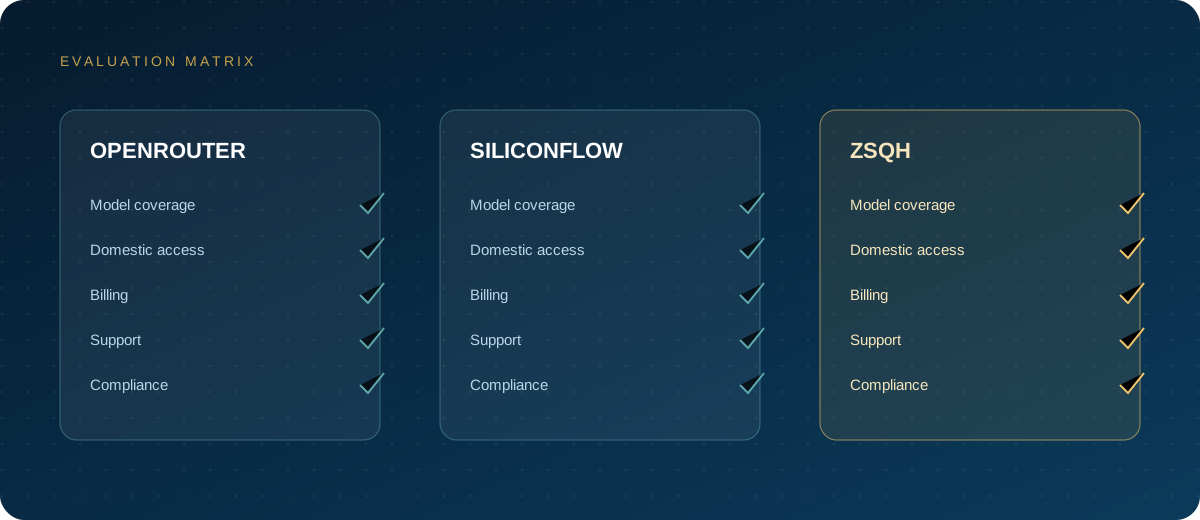
When considering a switch away from the MiniMax API, the most common mistake is to compare unit prices alone and then move the whole workload to a single model. A safer approach starts by defining the scope of the replacement. If your business only uses text chat, Kimi, GLM, and DeepSeek can all be reached through OpenAI-compatible interfaces, and migration mostly means changing the Base URL, the key, and the model name. If the business depends on speech synthesis or video generation, the replacement is not a simple text-model swap: task-based interfaces, file formats, and polling logic all have to be rebuilt.
This article breaks the decision down by scenario: which route fits which workload, how to choose between direct access and a gateway, how to compare pricing, and what to check before migrating. It does not list unit prices, because prices and promotions change quickly across providers; use official documentation and the in-site model pricing page as the reference.
Note: MiniMax, Kimi, GLM, DeepSeek, and other names are trademarks of their respective owners. This article is a technical selection reference only. Model names, context lengths, prices, and quotas are subject to each platform's official documentation and the in-site pricing page; examples reflect the common situation as of October 2026.
1. First Decide: Text or Multimodal
Start with an inventory of the call surface, not the model names. Group by interface:
- Pure text
chat/completions: the most replaceable category. Changing three configuration points is often enough. - Speech synthesis, speech recognition, and video generation: mostly separate task-based interfaces that cannot be driven directly through a chat SDK.
- Agents and tool calling: check
tool_calls, JSON output, and multi-turn message replay. - Long context: verify the context ceiling, maximum output, and the real latency of very long requests together.
- Batch and asynchronous jobs: confirm task IDs, polling, callbacks, and how long results remain downloadable.
Group existing calls by interface and mark them "replaceable", "needs rework", or "keep for now". MiniMax text models can be replaced; the speech and video capabilities cannot be swapped one-for-one with the three text-focused vendors discussed here. Accepting that reality is the first step in the decision.
2. How the Three Routes Divide the Work
Kimi: long context and coding
The current Kimi API model list includes kimi-k3 (officially listed at 1M context), kimi-k2.6 (256K), and kimi-k2.7-code (256K, aimed at coding). The API offers OpenAI Chat Completions, Responses, and Anthropic Messages shapes, so teams already using an OpenAI or Anthropic SDK face a lower migration cost. It suits long documents, codebase Q&A, and agent-style tasks. Note that some Kimi models fix parameters such as temperature and top_p; explicitly passing other values returns an error, so clean up parameters during migration.
GLM: Chinese writing and enterprise scenarios
The GLM-5 family has long offered an OpenAI-compatible interface, with a common Base URL of https://open.bigmodel.cn/api/paas/v4. Chinese writing, structured extraction, knowledge-base Q&A, and domestic enterprise procurement are typical landing points. Whether it fits your business still needs to be validated with your own sample set and evaluation suite, not leaderboard rankings alone.
DeepSeek: reasoning, code, and batch work
The DeepSeek V4 family also provides an OpenAI-compatible interface, with a common Base URL of https://api.deepseek.com. Code, mathematical reasoning, batch content processing, and cost-sensitive tasks are frequently compared on this platform. Reasoning models vary more in output tokens and latency, so measure them separately under load rather than relying on average response time.
These three are not fully interchangeable with each other. Narrowing the candidates to two and scoring them on the same evaluation set is more effective than integrating four at once.
3. Choosing by Scenario: One Table
| Scenario | Test first | Why | Migration note |
|---|---|---|---|
| Million-token documents, codebase Q&A | Kimi K3, MiniMax M3 | Officially listed 1M context can reduce chunking | Measure billing and first-token latency at length |
| Chinese writing, content rewriting | GLM-5, DeepSeek V4, MiniMax M3 | Similar Chinese corpora; style differences need sample comparison | Use a fixed evaluation set, not single outputs |
| Coding and agents | Kimi K2.7 Code, GLM-5, DeepSeek V4 | Tool calling and code generation are the focus | Check thinking fields and multi-turn replay |
| Speech synthesis, video generation | MiniMax speech, MiniMax H3 | The other three are text-first, not like-for-like replacements | Task interfaces, file formats, and polling must be rewritten |
| Batch processing, cost-sensitive | DeepSeek V4, GLM-5 | Suited to large batches and async queues | Compare effective cost, not list price |
| Unified multi-model access | ZSQH AI Gateway | One key, unified billing and logs | Model names follow the in-site pricing page |
This table is a starting point, not a conclusion. What really decides success is your prompts, data distribution, and concurrency shape.
4. Access Path: Direct or Gateway
Neither path is inherently better:
- Direct official access: more straightforward when you use a single model, the official endpoint is reachable, and you need official console features; the cost is managing keys, balances, and invoices separately for each vendor.
- Unified gateway: less work when you need model switching, shared quotas, and unified logs; the cost is one more dependency, so confirm the model list and error mapping.
If you are only replacing one text model, the direct route is shorter. If you already switch between multiple models, a gateway reduces repeated integration. The ZSQH AI Gateway provides an OpenAI-compatible endpoint at https://ai.zhongshangqihang.com/v1; registration and the model list are on the sign-up page and model pricing.
Also note that domestic and international endpoints differ. MiniMax's domestic documentation lists https://api.minimax.cn/v1 as its OpenAI-compatible Base URL, while Kimi uses https://api.moonshot.cn/v1. Do not mix addresses, keys, and balances across sites; this is a common source of 401 and 404 errors.
5. Comparing Prices Without Being Misled by Unit Price
Do not ask only for the unit price. Compare at least seven items:
- Input-to-output ratio: output-heavy workloads are more sensitive to output pricing.
- Surcharges for long context and long output: very long requests may have separate billing rules.
- Cache hits: whether repeated system prompts and knowledge-base prefixes can be reused.
- Reasoning tokens: whether hidden output from thinking models is billed.
- Subscription versus pay-as-you-go: MiniMax M Plan subscription keys and pay-as-you-go keys are independent; do not treat subscription quota as a pay-as-you-go balance.
- Retries and failures: retries caused by rate limits and timeouts are also a cost.
- Invoices, currency, and settlement: team procurement needs to factor these in.
Use one week of real traffic as the sample: total requests, input/output token distribution, retry rate, and P95 latency, converted on the same basis. Do not extrapolate an entire business from the price of one short prompt.
6. Migration Checklist: Moving from MiniMax to Kimi, GLM, or DeepSeek
- Freeze an evaluation set: take 50 to 200 samples from real business traffic, covering normal, edge, and failure cases.
- Verify model names: use the official model list and the in-site pricing page; do not carry over retired MiniMax M2.x names.
- Confirm protocol and address: OpenAI-compatible, Anthropic-compatible, or native, and whether the Base URL needs
/v1. - Clean parameters: check support ranges for
temperature,top_p,thinking,reasoning_effort, andmax_tokens. - Validate tool calling and structured output: test JSON mode, function calling, and streaming deltas separately.
- Test long context: not only whether the input fits, but also mid-document recall and latency.
- Load-test rate limits: run at realistic peak concurrency and record 429s, timeouts, and retry counts.
- Roll out gradually with rollback: shift 5% to 10% of traffic first, keep the old model for at least a week, and monitor quality and cost.
Keep a record of every step so that, if migration goes wrong, you can distinguish model differences from parameter differences or network differences.
7. Minimal Migration Code: One Entry Point, Switchable Providers
import os
from openai import OpenAI

PROVIDERS = {
    "kimi": "https://api.moonshot.cn/v1",
    "glm": "https://open.bigmodel.cn/api/paas/v4",
    "deepseek": "https://api.deepseek.com",
    "gateway": "https://ai.zhongshangqihang.com/v1",
}

def build_client(provider: str) -> OpenAI:
    return OpenAI(
        api_key=os.environ["AI_API_KEY"],
        base_url=PROVIDERS[provider],
        timeout=60,
        max_retries=2,
    )

client = build_client(os.environ.get("API_PROVIDER", "gateway"))
resp = client.chat.completions.create(
    model=os.environ["MODEL_NAME"],  # Follow the in-site pricing page or official docs
    messages=[{"role": "user", "content": "Summarize this requirement in three points"}],
)
print(resp.choices[0].message.content)
This code solves only the entry-point switch, not quality differences. Pass the model name through an environment variable so a test model name does not reach production; available models follow the in-site model pricing page.
8. FAQ
Can the MiniMax API be replaced directly with Kimi, GLM, or DeepSeek?
For text chat, usually yes: all three offer OpenAI-compatible interfaces, and the main changes are the Base URL, key, and model name. Task-based interfaces such as speech and video cannot be replaced directly; submission, polling, and result-download logic must be rewritten.
Is a larger context window always better?
No. A larger context usually raises input cost and first-token latency, and mid-document information is not always used reliably. Confirm that the business truly needs million-token context, then run recall tests with your own long documents.
Which of Kimi, GLM, and DeepSeek writes better Chinese?
There is no answer that applies to every business. All three can write Chinese, but style, punctuation habits, and long-form structure differ. Blind evaluation on the same sample set is more reliable than marketing material.
Can the old MiniMax key still be used after switching?
No. Keys are independent per platform, and gateway keys are not interchangeable either. Create new keys per environment, set quotas, and keep the old key for a while as a rollback path.
How do I manage multiple models in one place?
Use a unified gateway to consolidate the Base URL, keys, quotas, and logs. Split keys by project and tag costs by model. You can run a small traffic test on the ZSQH AI Gateway first.
Next Steps
If you do not want to maintain a separate integration for every provider, create a test key on the ZSQH AI Gateway and run Kimi, GLM, DeepSeek, and MiniMax through the same evaluation. See model pricing for budget and available models.
Related reading: