When teams in mainland China integrate the Mistral API, the first instinct is usually to find an address that works. But for production systems, "it works" is only the starting point: whether the network is stable, whether the bill can be paid, whether invoices can be reimbursed, how the business backs off under rate limits, and who diagnoses failures — those determine whether the integration is viable long term.
This article compares three routes — direct official access, a self-hosted proxy, and a domestic AI gateway — and covers rate limiting, retries, degradation, and pre-launch verification. Models and billing are governed by the model pricing page and official pages.
Note: Mistral and Mistral AI are trademarks of their respective owners, and this article is not affiliated with Mistral. Cross-border networking, data export, and payment settlement must comply with applicable laws, regulations, and platform terms. This article does not constitute legal or compliance advice.
1. Conclusion first: choose by constraint
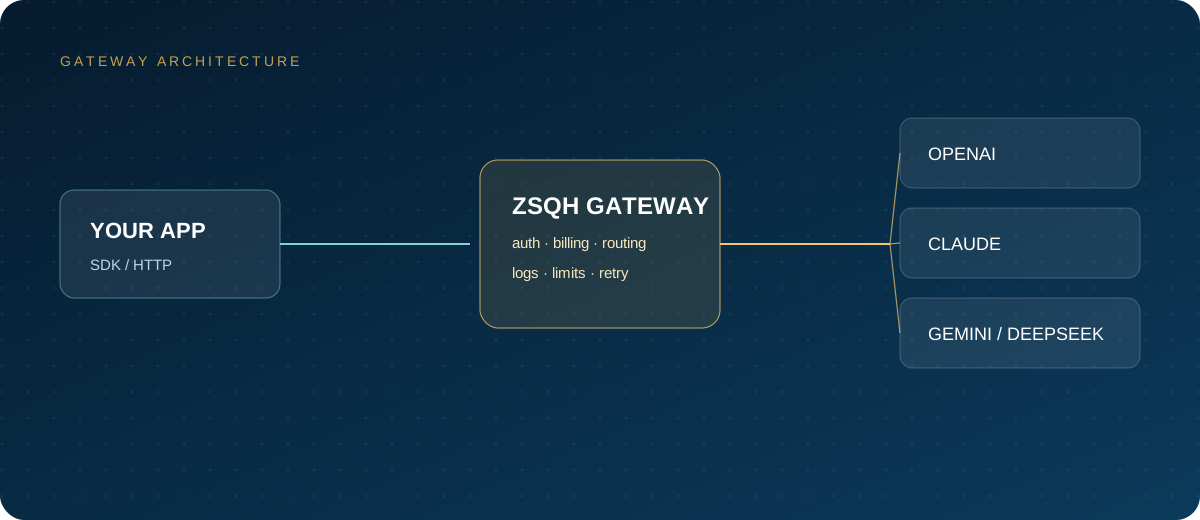
If you only call Mistral, have stable volume, and already have a compliant cross-border network and an overseas payment channel, direct official access is the most straightforward. If you need a fixed egress, unified auditing, or multi-upstream routing, and the team has operations capability, evaluate a self-hosted proxy. If you need a unified entry point for multiple models, RMB billing, and invoices, focus on a domestic AI gateway.
The comparison table makes the responsibility boundaries clear:
| Dimension | Official direct | Self-hosted proxy | Domestic AI gateway |
|---|---|---|---|
| Endpoint | Official Mistral address | Self-built reverse proxy or open-source gateway | OpenAI-compatible endpoint |
| Network | Affected by local egress and cross-border routes | Depends on server location and routes | Depends on gateway routes and upstream |
| Payment and invoices | Governed by the official checkout | Server and bandwidth costs are yours | Site rules; confirm invoicing capability in advance |
| Operations cost | Low | High | Medium |
| Suitable for | Single model, compliant cross-border link already in place | Fixed egress and unified auditing required | Multiple models, unified billing and invoices required |
The three routes can be combined, but every extra link adds another set of keys, bills, and monitoring. Do not raise complexity just for redundancy.
2. Official direct: simple address, plenty of surrounding work
As of October 2026, Mistral's public API endpoint is https://api.mistral.ai, the chat interface is /v1/chat/completions, and authentication uses a Bearer key. The official model page lists Mistral Large 4, Mistral Small 4, Mistral Medium 3.5, and families such as Ministral, Codestral, and Voxtral. Model names change; use the official model page and our pricing page when integrating.
The direct link is the shortest, and new models and parameters usually appear there first. Three things need advance handling:
- Network: cross-border links may fluctuate at peak hours, and DNS, TLS, and egress can all become failure points.
- Payment and invoices: overseas payment and foreign-currency bills mean reimbursement evidence and accounting treatment should be confirmed with finance in advance.
- Account security: split keys by environment, and keep production keys out of frontends and public repositories.
Public documentation makes no commitment about network quality for mainland China, and real performance depends on local egress and time of day. A single successful curl does not prove production readiness.
3. Self-hosted proxy: solves egress, not capacity
A self-hosted proxy usually means a reverse proxy on a compliant overseas server, or key management, rate limiting, and logging on an open-source gateway. It suits teams that need a fixed egress IP, unified auditing, and keys kept in their own hands.
Count the costs: servers, bandwidth, certificates, upgrades, and on-call time all add up; the proxy is itself a single point of failure, and a poor configuration can leak keys. A proxy also cannot bypass upstream rate limits or terms of service; when the upstream account has a problem, the proxy layer cannot fix it.
Without sustained maintenance capacity, a self-hosted proxy easily turns from a stopgap into long-term debt. It can serve as a backup channel, but it should not be the only entry point.
4. Domestic AI gateway: consolidate models and billing
A domestic AI gateway provides an OpenAI-compatible endpoint, so business code usually only changes base_url and api_key to switch among models. Its practical value usually comes down to three things: RMB top-ups and billing, usage detail in a console, and support tickets plus backup routes during incidents.
Do not choose a gateway only because it connects. At minimum, confirm: whether it covers the Mistral models you need; whether billing documents input, output, cache, and failed requests; whether usage can be split by key or project; how incidents are communicated; and whether the data terms allow business data to cross borders.
Available models and billing follow the model pricing page. Before onboarding, run real prompts with a test key; do not just send "hello."
5. Network, payment, and invoices: verify together
Network acceptance is not just whether the homepage opens. Run real prompts at peak and off-peak times, recording success rate, P50/P95 latency, and time to first token. Test streaming separately; slow first token and generally slow responses point to different investigations.
Official direct access involves overseas payment and foreign-currency bills; a gateway tops up under its own rules. Confirm refunds, balance validity, and arrears rules first.
Confirm invoice type, title, exchange rate, and invoicing cycle in advance. For monthly reconciliation, also confirm whether bills can be exported and split by project.
6. Rate limits, retries, and failover
Mistral applies rate and usage limits per account or workspace; the exact numbers vary by plan, model, and account status, and the console is authoritative. Production systems must not assume 429 will never happen; treat rate limiting as a normal event.
- Set connect timeouts and read timeouts separately, and configure long-context and reasoning tasks independently.
- Retry only on 429, 5xx, and timeouts, using exponential backoff with jitter and a maximum attempt count; use queues to smooth batch work.
- Open the circuit after consecutive failures reach a threshold to avoid retry storms.
- For operations with side effects, check status before resending to ensure idempotency.
- Prepare a fallback model or backup route, but accept output differences and evaluate them in advance.
Change one variable at a time when switching routes. Changing model, prompt, and gateway together makes incidents impossible to attribute.
7. Pre-launch verification checklist
Running this sequence once is more informative than an ad hoc load test:
- Use a minimal request to confirm the base URL, model name, auth header, and response structure.
- Replay real prompts covering streaming, long context, JSON output, and tool calls.
- Record success rate, P50/P95, time to first token, and the share of 429 and 5xx for seven consecutive days.
- Compare
usagefields and backend bills between direct access and the candidate route to confirm billing rules match. - Check the error mapping for 401, 402, 429, 5xx, and timeouts, and confirm retries do not amplify incidents.
- Canary 5%–10% of traffic, keep a rollback switch, and rehearse a rollback once.
- Confirm keys are split by environment, permissions are minimized, and production keys stay out of frontends and repositories.
- Confirm data terms, invoices, incident contacts, and exit mechanisms.
The command below works as a minimal probe, recording HTTP status and total time:
export MISTRAL_API_KEY="your-key-here"
export MISTRAL_BASE_URL="https://api.mistral.ai/v1"
export MISTRAL_MODEL="model-id-copied-from-the-official-model-page"

curl -sS -o /tmp/mistral-response.json \
  -w "http=%{http_code} total=%{time_total}s\n" \
  "$MISTRAL_BASE_URL/chat/completions" \
  -H "Authorization: Bearer $MISTRAL_API_KEY" \
  -H "Content-Type: application/json" \
  -d "{\"model\":\"$MISTRAL_MODEL\",\"messages\":[{\"role\":\"user\",\"content\":\"Reply with OK only\"}],\"max_tokens\":16}"
Put the command in a loop and record http_code and time_total each time; that is more informative than a single success. Do not write the key into the script or repository.
8. Compliance boundaries: ask where data goes
Calling a model API across borders involves networking, data export, industry regulation, and platform terms. Strongly regulated sectors such as finance, healthcare, and government should go through legal and compliance review first to confirm whether data export is allowed, whether separate consent is required, and whether anonymization is needed.
Whether you use direct access or a gateway, read the data terms: whether input is retained, whether it is used for model improvement, how long logs are kept, and who the sub-processors are. Do not send requests containing personal information, contract text, or keys to a provider that cannot explain where the data goes. Choose a network route within the limits of the law and the terms of service, and avoid shared keys of unknown origin. Compliance cost belongs in the selection criteria.
FAQ
Can the Mistral API be called directly from mainland China?
It depends on the local network, time of day, and cross-border route. Public documentation makes no commitment about network quality in mainland China. Do not rely on a single test in production; prepare timeouts, retries, and a backup channel.
Which is more stable: official direct, a self-hosted proxy, or a gateway?
No route is absolutely more stable. Direct access has the shortest link but is affected by local egress; a self-hosted proxy is controllable but all operations are yours; a gateway offers backup routes and a console but depends on the provider. Run the same requests for seven days and compare success rate and P95 latency.
Does using a gateway require many code changes?
Most OpenAI SDK projects only change base_url and api_key, with model names adjusted to the gateway pricing page. If you use Mistral-specific parameters, tool calling, or particular response fields, run compatibility tests separately and do not assume the fields are identical.
How should 429 rate limits be handled?
First determine whether it is a quota issue or a traffic spike. Use exponential backoff with jitter for 429 and cap retries; smooth batch jobs with a queue; if it persists, re-evaluate quota or split traffic.
What should I check about payment and invoices?
Confirm settlement currency, payment method, refund rules, balance validity, and invoicing cycle in advance. For monthly reconciliation, also confirm whether bills can be exported and split by project. Specific rules follow the provider's pages and contract.
Next step
Create a test key at ZSQH AI Gateway, compare direct access and the gateway on success rate, latency, and billing rules using real prompts, then choose the production route. Models and billing are on the model pricing page.
Related reading: