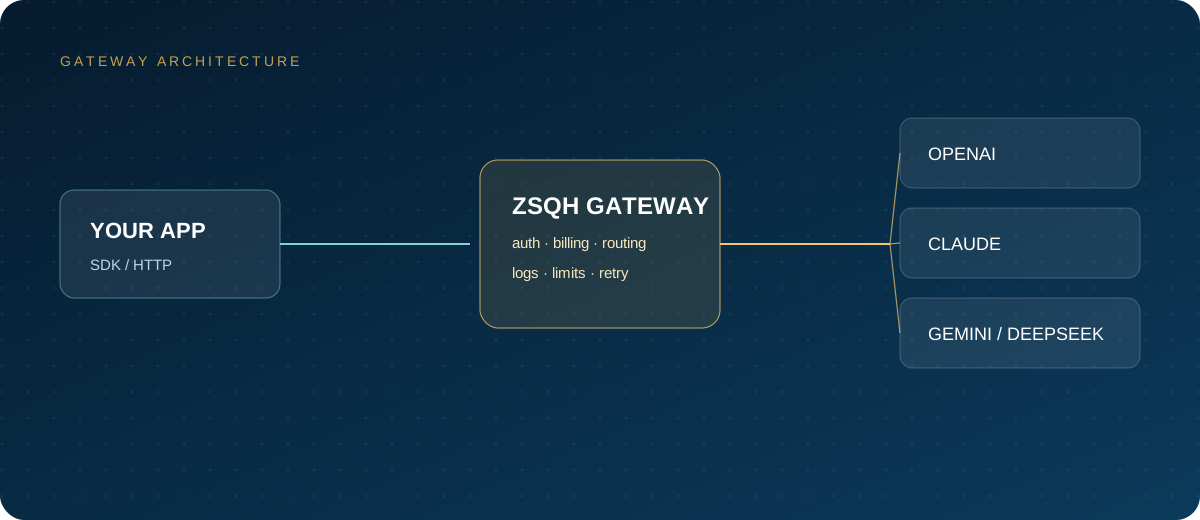
For teams in China, there are essentially three ways to reach the OpenAI API: official direct access, a self-hosted proxy, and a domestic AI gateway. The choice is not simply "good versus bad"; each option puts the cost in a different place. Direct access puts it in networking and payment, a proxy puts it in operations, and a gateway puts it in service dependency and terms review.
This article compares network stability, payment and invoicing, compliance, maintenance, model coverage, and incident handling, then provides practical timeout, retry, and failover configurations plus a launch checklist. It is a technical comparison, not legal advice; actual availability and compliance requirements are subject to local laws, regulations, and provider terms.
Note: OpenAI, ChatGPT, and GPT are trademarks of OpenAI. This article reflects common conditions as of October 2026. Prices and model lists are subject to the pricing page and provider documentation, and prices change.
1. What the three routes are
Official direct access: use an OpenAI account and the official API, with networking, payment, and billing all inside the official system. The premise is that the team meets the registration and payment conditions supported by OpenAI, and that local law and platform terms permit the use.
Self-hosted proxy: the team rents an overseas server and deploys a reverse proxy or forwarding program. Requests go to the team's own server first, then upstream. The proxy solves connectivity and a unified egress, but the account, key, and payment still need to be arranged separately.
Domestic AI gateway: a provider offers an OpenAI-compatible endpoint, and the team tops up in RMB and manages keys on the provider's site. The gateway handles upstream access, forwarding, and part of incident handling; the team usually only needs to change the Base URL. The ZSQH AI Gateway belongs to this category; the registration entry point is the sign-up page.
2. The differences at a glance
| Dimension | Official direct | Self-hosted proxy | Domestic AI gateway |
|---|---|---|---|
| Network stability | Depends on cross-border links; fluctuations are yours to diagnose | Depends on the server's route and proxy quality | Maintained by the provider; usually reachable domestically |
| Setup barrier | Requires an official account and a working payment method | Requires a server, domain, certificate, and operations | Register and go; lowest barrier |
| Payment and invoices | Official currencies and methods | Server costs and upstream costs paid separately | RMB top-ups; invoices per provider rules |
| Compliance and terms | Directly bound by official terms | Must satisfy both local law and upstream terms | Requires checking provider qualifications and data requirements |
| Maintenance cost | Low, but network issues are yours | High: certificates, monitoring, upgrades all need staff | Low; troubleshooting depends on the provider |
| Model coverage | OpenAI's own models | Depends on the upstream account; usually a single vendor | Often aggregates multiple vendors; see the pricing page |
| Incident handling | Official support channels | You locate and recover it yourself | Provider handles upstream; users keep request IDs |
| Suitable teams | Payment and network conditions in place; OpenAI only | Teams with ops capability that need unified egress | Domestic small and mid-size teams, multiple models, RMB billing |
This table is only for an initial screening. What really determines the experience is latency, failure rate, and incident response at peak hours. Run real business requests for one to two weeks before deciding.
3. Network stability: look at jitter, not just reachability
"Reachable" does not mean "reliably callable". Watch time to first byte, total latency, timeout rate, and streaming interruption rate. Cross-border links tend to show higher latency and packet loss during evening peak hours, which appears as occasional timeouts, connection resets, or interrupted streams rather than consistent failure.
A self-hosted proxy does not automatically fix route problems: the server's region, the return path, and whether it is throttled all affect stability. The value of a domestic gateway is a domestic entry point with links maintained by the provider, but latency still has to be measured.
Do not rely on ping alone. Send real requests continuously for a period and record the success rate, P95 latency, and timeout count. The command below shows the time spent at each stage:
curl -o /dev/null -sS \
  -w "dns=%{time_namelookup}s tcp=%{time_connect}s tls=%{time_appconnect}s ttfb=%{time_starttransfer}s total=%{time_total}s code=%{http_code}\n" \
  "$OPENAI_BASE_URL/models" \
  -H "Authorization: Bearer $OPENAI_API_KEY"
Slow DNS points to resolution, slow TCP points to the route, slow TLS points to the handshake and certificate, and slow first byte usually means upstream queuing. Run one set in the morning, one at midday, and one in the evening; that is more informative than a single result.
4. Payment, invoices, and budgets
Official direct access requires an officially supported payment method, with currency, billing cycle, and invoice rules all inside the official system. A self-hosted proxy does not bypass payment: you pay for the server and for the upstream account, just as two separate bills. A domestic gateway usually supports RMB top-ups and on-site billing, with invoices issued under the provider's rules — suitable for teams that need local reimbursement.
Whichever route you choose, set budget caps and usage alerts. Prices change; this article avoids specific unit prices and points to the pricing page. On the finance side, confirm three things: whether a top-up yields a compliant receipt, whether the balance is refundable, and whether service is degraded or simply cut off when the account is in arrears.
5. Compliance and terms: draw the boundaries first
This section covers judgment methods only, not workarounds. Teams should check at least four points:
- Whether the usage complies with local laws and regulatory requirements;
- Whether it complies with the terms of OpenAI and upstream providers;
- Whether cross-border data transfer has been assessed, and whether it involves personal or sensitive data;
- Whether the provider requires real-name verification, and whether it offers a data processing agreement and a complaint channel.
Compliance is not a row in a selection matrix; it is an entry threshold. If any single point fails, the service should not go live no matter how attractive the price. When in doubt, consult legal counsel or a professional firm; do not substitute technical workarounds for judgment.
6. Maintenance cost: a proxy is not finished once installed
Launching a self-hosted proxy is only the beginning. After that come certificate renewal, program upgrades, logs and disk space, access control, IP changes, rate limiting, and monitoring alerts. The key lives on the proxy, so you also have to prevent leaks and scanning. For teams without on-call arrangements, failures tend to happen in the middle of the night.
A gateway shifts this layer to the provider, but the team still needs three capabilities: viewing usage, keeping request IDs, and switching to a backup route during an incident. Relying entirely on a single entry point hands availability to someone else; building everything in-house hands it to your own staffing. The choice depends on which risk the team is more willing to carry.
7. Model coverage and incident handling
For teams that use only OpenAI, model coverage is not an issue. For teams using several vendors at once, the gateway advantage is clearer: one Base URL, one set of keys, one bill. But "compatible" usually means request-format compatibility; different models support parameters, tool calling, and streaming formats inconsistently, so verify each item before switching.
On incident handling, direct access and proxies are diagnosed by the team itself, while a gateway provider locates the upstream problem. Either way, the user side should keep the status code, response body, and request ID. Do not retry 5xx indefinitely; set a maximum number of attempts and a total timeout. When a stream is interrupted, first determine whether partial output was produced and billed.
8. Timeout, retry, and failover configuration
Below is a practical Python configuration: retry the primary route on qualifying errors, then switch to a fallback address. The model name is read from an environment variable rather than hard-coded.
import os
import random
import time
from openai import OpenAI

PRIMARY = OpenAI(
    api_key=os.environ["PRIMARY_API_KEY"],
    base_url=os.environ["PRIMARY_BASE_URL"],
    timeout=45.0,
    max_retries=0,
)
FALLBACK = OpenAI(
    api_key=os.environ["FALLBACK_API_KEY"],
    base_url=os.environ["FALLBACK_BASE_URL"],
    timeout=45.0,
    max_retries=0,
)
RETRYABLE = {408, 409, 429, 500, 502, 503, 504}

def call(prompt: str) -> str:
    clients = [PRIMARY, FALLBACK]
    last_error = None
    for client in clients:
        for attempt in range(3):
            try:
                resp = client.responses.create(
                    model=os.environ["OPENAI_MODEL"],
                    input=prompt,
                )
                return resp.output_text
            except Exception as exc:
                last_error = exc
                status = getattr(exc, "status_code", None)
                if status not in RETRYABLE:
                    break
                wait = min(2 ** attempt, 8) + random.random()
                time.sleep(wait)
    raise RuntimeError("Both primary and fallback routes failed") from last_error
Key points: the timeout should be shorter than the wait your business can tolerate; back off only on retryable errors; configure the fallback route in advance and rehearse it regularly; keep the retry count small, or an outage will pile requests into an avalanche.
9. Launch checklist
Confirm in order, and tick every item before scaling traffic:
- The route has been measured, with morning, midday, and evening success rates and P95 latency recorded.
- The payment method works, and budget alerts and balance warnings are configured.
- Keys are split by environment and stored in a server-side secret manager.
- The Base URL contains only one
/v1, and model names are copied from the pricing page. - Timeouts, retries, and failover are configured and have been rehearsed.
- Logs include request ID, model, latency, and status code, with no full keys.
- Compliance and data-handling requirements have been checked, with internal approval completed where necessary.
- The fallback route works, and the switching steps are documented with an owner.
10. FAQ
Is direct access from China always unstable?
Not necessarily. Link quality varies greatly by region, carrier, and time of day, so measure it with your own business requests. Stability is a matter of probability.
Does a self-hosted proxy require maintaining an upstream account?
Yes. The proxy only handles forwarding and unified egress; the upstream account, key, payment, and terms compliance still need to be handled separately, and it does not automatically provide usable quota.
Which is less work: a gateway or a proxy?
Usually a gateway. Servers, certificates, upgrades, and part of upstream incident handling are borne by the provider. The trade-off is dependency on the provider, so keep a backup route and the ability to export usage data.
Does switching to a gateway require many code changes?
Most compatible gateways require only a new Base URL and key, plus model names replaced according to the pricing page. Non-standard parameters or private endpoints need item-by-item regression testing.
What should I look at first when an incident occurs?
Start with the status code and response body, then the request ID, and only then distinguish between the local network, the entry service, and the upstream. Without a request ID, communication and diagnosis both slow down.
Next steps
None of the three routes is inherently superior. Work out payment, compliance, and incident handling first, then validate with real traffic. For RMB top-ups and a unified multi-model entry point, start by registering for the ZSQH AI Gateway; prices and models are subject to the pricing page.
Related reading: