For teams in mainland China, one practical advantage of Qwen API is that the service entry point is domestic: calling through Alibaba Cloud Model Studio usually does not require a separate cross-border network design. But "can access" and "can run production stably" are two different things. The latter depends on engineering details such as region selection, rate limits, retries, billing, and failover.
This article compares direct connection to Model Studio with going through an API gateway, and gives concrete practices for network troubleshooting, capacity planning, payment and invoicing, and pre-launch verification. The conclusion is not predetermined: using a single model and integrating multiple models at the same time call for different choices.
Note: Qwen, Tongyi Qianwen, Alibaba Cloud, Model Studio (Bailian), and DashScope are trademarks of Alibaba Group and its affiliates. This article is for technical explanation only and implies no affiliation or agency relationship with Alibaba Group. Endpoint addresses, model scope, rate-limit rules, and billing methods are subject to the official Alibaba Cloud Model Studio documentation and console.
1. Confirm the entry point first: Model Studio, DashScope, and region
Alibaba Cloud Model Studio is the model service platform, and DashScope is the API actually called. The platform offers both OpenAI-compatible mode and native DashScope mode: compatible mode lets you reuse the OpenAI SDK directly, while native mode preserves platform-specific parameters. The commonly used entry point in mainland China is https://dashscope.aliyuncs.com/compatible-mode/v1 in the Beijing region; native mode uses /api/v1 under the same domain.
Regions cannot be switched casually. The official documentation states that API keys are bound to a region and billing plan, and cross-region calls return 401; production environments are also advised to use workspace-specific domains. When choosing a region, consider data location, model availability, and billing currency together, not just whether the network connects. Model IDs also change with versions, so use the console model list before integration.
2. When direct connection makes sense
Direct connection means the business calls Model Studio endpoints directly. It suits teams that use only the Qwen family; want new models and parameters as soon as they are available; already have solid monitoring, retries, and alerting; and can settle directly with Alibaba Cloud financially.
The advantage of direct connection is a short path and clear responsibility boundaries. When something goes wrong, the call chain has only three segments — business, network, and platform — so the troubleshooting scope is small. New capabilities also usually appear on the official endpoint first.
The cost is single-point dependency. Account-level rate limits, insufficient balance, and platform congestion all directly affect the business. If you also need DeepSeek, GLM, and other models, the team must maintain multiple keys, multiple Base URLs, and multiple bills. Small teams often underestimate this management cost.
3. Which capability a gateway adds
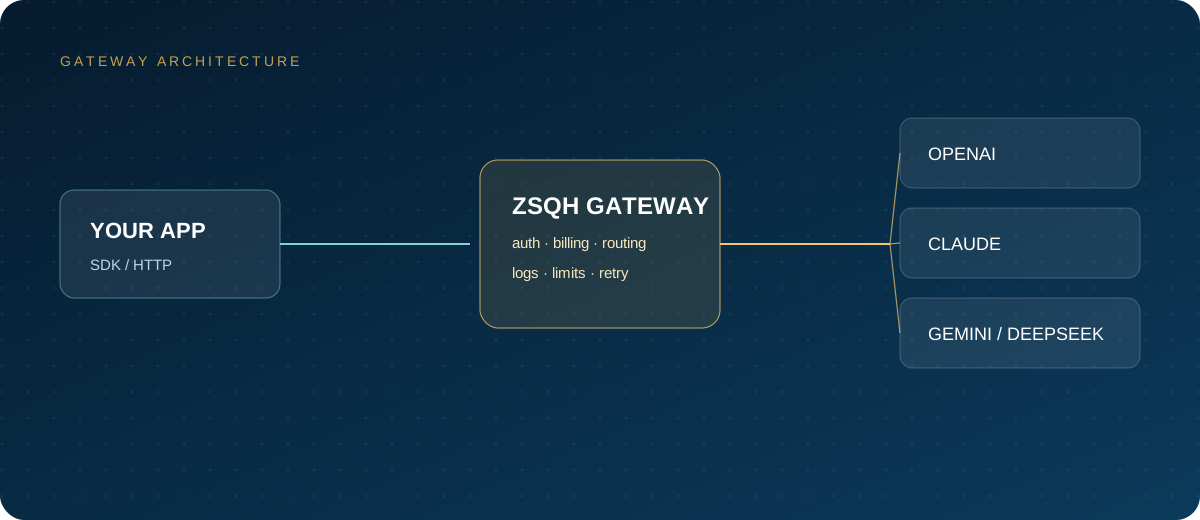
An API gateway converges multiple providers into one OpenAI-compatible entry point. Its common value has four parts: a unified Base URL, unified keys, unified balance and billing, and unified monitoring. Teams using Qwen, DeepSeek, Claude, and other models together do not need to write a separate adapter for each vendor.
After registering on the ZSQH AI Gateway, you can call enabled models with one key; the specific Qwen model scope, billing method, and rate-limit rules are subject to the model pricing page and console documentation. Confirm before integration whether automatic failover is supported and how the failover order is configured; do not assume that "having a gateway means automatic high availability."
A gateway also brings new dependencies: an extra network hop, an extra rate-limiting layer, and an extra service to monitor. Choose it because it lowers management cost, not because it eliminates all failures.
| Dimension | Direct Model Studio | API gateway |
|---|---|---|
| Network path | Business to the Model Studio entry point | Business to the gateway, then upstream |
| Model scope | Qwen and models available on Model Studio | Multiple models enabled on the gateway |
| Rate limits and failures | Account-level RPM/TPM, single-point dependency | Gateway rate limits, configurable switching |
| Billing and invoices | Alibaba Cloud bills and invoices | Unified gateway bills and invoices |
| Suitable scenario | Single model, deep usage | Multiple models, unified billing |
4. How to locate network problems
First break "network problems" into four layers: DNS resolution, TCP connection, TLS handshake, and HTTP response. Below is a minimal diagnostic command; QWEN_MODEL is read from an environment variable so the model name is not hard-coded in the script:
curl -v --connect-timeout 5 --max-time 30 \
  https://dashscope.aliyuncs.com/compatible-mode/v1/chat/completions \
  -H "Authorization: Bearer $DASHSCOPE_API_KEY" \
  -H "Content-Type: application/json" \
  -d "{\"model\":\"$QWEN_MODEL\",\"messages\":[{\"role\":\"user\",\"content\":\"ping\"}]}"
Focus on three metrics: an abnormal time_namelookup usually indicates a DNS problem; an excessive time_appconnect indicates a TLS or link problem; and time_starttransfer far beyond expectations indicates server-side queuing or network congestion. If you receive 401, first check whether the key and region match rather than continuing to investigate the network.
Production environments should also check proxy variables, container DNS, connection pool limits, and Keep-Alive configuration. Many "intermittent timeouts" are not platform problems but client connection pool exhaustion or inconsistent proxy configuration.
5. Rate limits and capacity planning
Model Studio rate limits apply at the Alibaba Cloud primary account level. RAM sub-accounts, workspaces, and API keys under the same account share the quota; different models have separate RPM and TPM quotas, some scenarios also apply short-term burst control by RPS and TPS, and some newer models apply dynamic rate limits based on monthly consumption tiers. In other words, creating more keys does not bypass the account-wide quota.
Exceeding the limit usually returns 429, but the messages differ: RPM overruns, TPM overruns, and "request rate rising too fast" require different handling. When free quota is exhausted and the corresponding switch is enabled, a 403 may be returned. The official documentation states clearly that topping up affects only arrears status and does not raise RPM/TPM; contact a business manager for a higher quota.
Do not plan capacity using daily averages alone. Design for peak concurrency, then leave headroom for retries and bursts; use queues to shave peaks so scheduled jobs do not saturate capacity at the top of the hour; send offline jobs through the Batch interface and reserve online concurrency for real-time requests. On 429, use exponential backoff rather than high-frequency retries.
6. Payment, invoices, and data compliance
Payment and invoicing often determine the choice more than technical metrics do. Mainland China Alibaba Cloud accounts usually settle in RMB and are invoiced by Alibaba Cloud; international-site accounts have different currencies, contracting entities, and invoicing rules. Gateway top-ups are invoiced according to the gateway bill. Before procurement, confirm the contracting entity, invoice type, tax rate, and payment terms, and make sure the payment path and invoice issuer are consistent.
Data compliance must be assessed separately. Classify data first: public content, internal materials, personal information, and sensitive business data. Before using any third-party API, read the data processing terms and confirm whether data is used for training, how long it is retained, and which region it is stored in. When personal information is involved, assess under the applicable personal information protection regulations; when regulated industry data is involved, have legal and security teams review first rather than supplying materials after launch.
7. How to do failover
Failover is not as simple as "filling in another Base URL." First define trigger conditions, such as consecutive timeouts, a rising proportion of 5xx responses, or first-byte latency persistently exceeding a threshold. Then prepare a backup model that has been evaluated to avoid a sudden quality drop after switching. The switching process needs circuit breaking and half-open probing so that recovery traffic does not overwhelm the service at the moment it returns.
When using Qwen, pay attention to region binding: keys from different regions cannot be mixed, so cross-region disaster recovery requires separate keys and a fresh assessment of data-location requirements. Multi-model disaster recovery is similar; the backup model's capability boundaries, context length, and billing standard must all be tested in advance.
In engineering terms, make the Base URL, key, and model name configurable so switching requires no code changes; keep official direct connection as a fallback path; and record recovery time and the handling results of failed requests in every drill.
8. Pre-launch verification checklist
- Run DNS, TLS, and first-byte latency tests from the production network.
- Compare output quality and token usage between direct connection and the gateway using real prompts.
- Stress-test at peak concurrency and observe when 429 appears and how long recovery takes.
- Verify that timeouts, retries, backoff, idempotency, and queue peak-shaving work.
- Drill a primary-to-backup switch and record recovery time and data consistency.
- Check the billing basis and confirm invoices, cost allocation, and budget alerts.
- Complete data classification and compliance review, and retain audit logs.
- Confirm key rotation, revocation, and permission boundaries.
9. Frequently asked questions (FAQ)
Does accessing Qwen API in China require a cross-border network?
Using the Beijing-region Model Studio entry point usually does not. If the corporate network has proxies, allowlists, or DNS restrictions, have operations allow domains such as dashscope.aliyuncs.com. When using other regions, both the domain and the key must be adjusted accordingly.
Which is more stable, direct connection or a gateway?
There is no absolute answer. Direct connection has a shorter path but stronger single-point dependency; a gateway provides a unified entry point and switching capability but adds another dependency layer. Stability comes from retries, queues, monitoring, and drills, not from any single entry point.
Are Model Studio rate limits account-level or key-level?
According to the official documentation, rate limits apply at the Alibaba Cloud primary account level. RAM users, workspaces, and API keys under the same account share the quota, and different models have their own RPM/TPM quotas. Specific values are subject to the console and rate-limit documentation.
Does topping up increase the rate limit?
No. The official documentation states that top-up affects only arrears status and does not change RPM/TPM limits. A higher quota requires contacting a business manager, and the review period is subject to the platform's explanation.
How should invoices and contracts be handled?
Direct connection is invoiced by Alibaba Cloud, while gateway usage is invoiced by the gateway operator; the contracting entity, invoice type, and payment terms differ. Confirm clearly before procurement to avoid a mismatch between the paying entity and the invoicing entity.