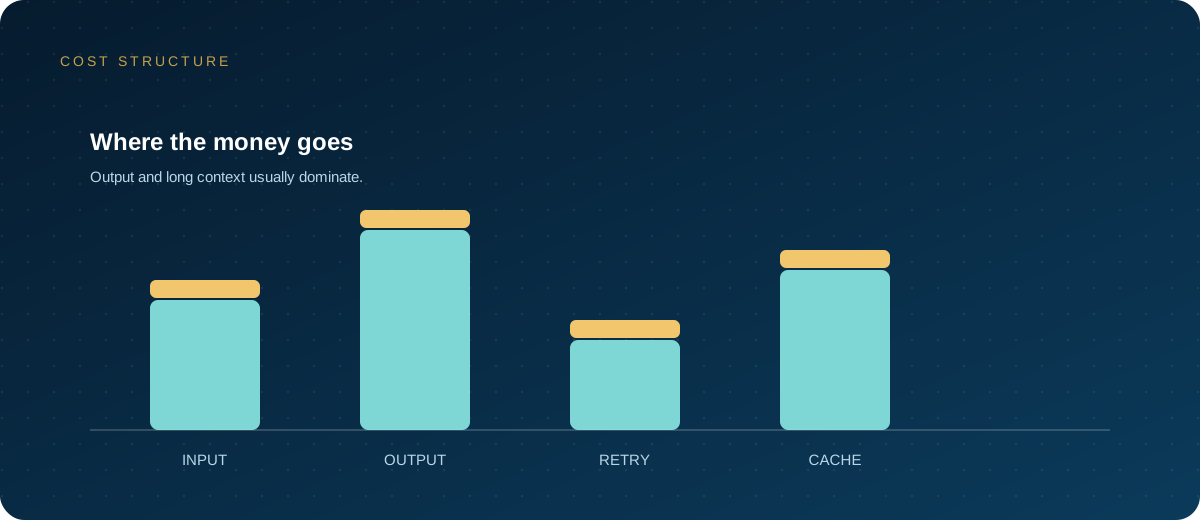
People searching for "Roo Code pricing" often find a contradiction: the extension is free, yet the bill can be higher than a subscription tool. The reason is not complicated. Roo Code uses BYOK, so the software is free and models are billed per token, and a coding agent is a heavy token consumer.
This article does not list fixed prices. It covers the cost structure, a calculation method, and control measures; rates are governed by the on-site model pricing and each product's official website.
Note: Roo Code is a trademark of its owner, and names such as Cursor, Claude, and GitHub Copilot belong to their respective owners. This article is a technical note and implies no affiliation with the vendors. The Roo Code extension stopped maintenance on May 15, 2026, and the repository was archived; the community fork Zoo Code continues development. Defer to the official repository for current status.
1. Cost structure: free software, paid models
Roo Code is an open-source VS Code extension. It does not charge per seat and has no built-in model quota. You enter your own key, requests go to a provider or gateway, and costs settle per token. It does not resell tokens.
Distinguish the extension from the Roo Code company's cloud product, which may have its own subscription and quota; this article covers only the local extension's BYOK. The extension stopped maintenance on May 15, 2026, and the repository was archived; the community fork Zoo Code follows the same model, so the calculation below applies to both.
So "Roo Code pricing" consists of input tokens, output tokens, and add-ons such as caching and reasoning. The tool price is zero, and usage determines the total bill.
2. Subscriptions versus pay-as-you-go
A subscription bundles editor features, agent capability, and a certain model quota into a fixed monthly fee; BYOK separates software from models and charges for what you use. Neither is simply cheaper or more expensive; they differ in how risk is carried.
| Dimension | Subscription | BYOK pay-as-you-go |
|---|---|---|
| Payment rhythm | Fixed cycle, easy to budget | Varies with usage |
| Cost ceiling | Usually limited by quota or request count | Determined by the key cap |
| Model choice | Whatever the product supports | Switch providers and models yourself |
| Idle cost | You pay even when unused | No model fee when unused |
| Peak cost | No extra charge within quota | The larger the usage, the higher the bill |
| Best fit | Daily, high-frequency, low-maintenance use | Uneven usage, specific models, or central control |
The hidden cost of a subscription is throttling, queuing, or overage after the quota runs out; the hidden cost of pay-as-you-go is losing control. Decide which one you can tolerate better before choosing.
3. Where a coding agent spends tokens
A chatbot mainly asks one question and gets one answer. A coding agent resends the system prompt, tool definitions, mode instructions, conversation history, files already read, terminal output, and diffs every turn, so input tokens accumulate across the task.
A medium task commonly produces a dozen to several dozen requests. Output is usually smaller than input, but most models charge more per output token; reasoning tokens may also be billed as output. The bulk is often not the final code but the context that is resent repeatedly.
Other easily overlooked consumption includes retries after tool failures; context compaction, which itself calls the model; subtasks and Orchestrator adding request count; long sessions making each turn's history longer; and full ordinary-input pricing when the cache misses.
To judge whether something is expensive, look at request count and context size for the whole task, not a single exchange.
4. Get the math right: formula and steps
The cost of a single task can be split into four parts. Plug in the unit prices from the pricing page to get a reproducible result:
Cost per task =
  uncached input tokens × input price
+ cache-write tokens × cache-write price
+ cache-read tokens × cache-read price
+ output tokens × output price
The procedure has six steps:
- Choose three representative tasks: a small single-file edit, a multi-file feature, and cross-file debugging.
- Record request count, input, output, cache reads, and cache writes for each task in the gateway log.
- Get current unit prices from model pricing, noting that the four token classes may be priced separately.
- Calculate cost per task with the formula, then multiply by daily task count and monthly working days.
- Add consumption from retries, compaction, and subtasks, and keep a buffer; do not estimate the ideal path.
- Compare the result with the subscription's total price, quota, and overage rules, not just the list price.
An example illustrates the method but is not a measurement: suppose a task makes 40 requests with an average input of 15,000 tokens, 70% cache hits, and 8,000 output tokens in total. Multiply each token class by its unit price to get the real cost. If the log has no cache field, assume all input missed the cache.
5. Caching is leverage, not magic
A coding agent's context is highly repetitive: the system prompt, tool definitions, mode instructions, project rules, and early conversation are nearly identical on every turn. Providers that support caching store these prefixes and charge later reads at the cache rate, usually well below ordinary input.
Several conditions must hold for caching to work: a stable prefix, with no timestamp or random ID inserted at the front; the same model, since switching midway rebills; a matching interval, because a long gap invalidates the cache; channel support, since not every compatible endpoint implements caching; and a cost to compaction, because rewriting history rebuilds the cache.
In practice, first make similar tasks use the same profile, the same model, and the same rules, and only then discuss optimization. Treat caching as a "possible discount", not a "fixed ratio". Use real data when the log distinguishes it; otherwise estimate conservatively.
6. Budget caps: make savings controllable
The biggest risk of pay-as-you-go is not the unit price but the absence of brakes.
On the gateway side: one key per person and separate keys per project; set daily and monthly quotas and usage alerts; if allowlists are supported, restrict each key's model scope; export usage regularly for reconciliation. Even if a task runs away, the loss stays within a single key.
On the Roo Code side: use API Configuration Profiles to bind different models to different modes, with strong models for planning and lightweight models for Q&A and bulk edits; set a Rate Limit on high-consumption profiles; use auto-approve cautiously, especially for operations that run terminal commands, delete files, or install dependencies; Orchestrator subtasks inherit the parent profile, so plan them separately.
On the habits side: split large tasks into verifiable small steps and close unrelated sessions promptly; when a model fails repeatedly, stop and check tool calls and paths instead of retrying blindly. Checkpoints can roll back code but do not refund tokens.
7. When a subscription wins, and when pay-as-you-go saves more
No single model is cheaper for every team; the question is fit.
A subscription suits people who use the tool daily, have stable tasks, do not want to manage keys, and accept a fixed model set and quota. Its value is turning cost into a fixed item and removing budgeting and auditing; but when the quota is often exhausted, or some members barely use it, the unit cost rises.
BYOK suits teams with uneven usage, a need for specific models, a preference for routing through a gateway, and a desire to see costs by member and project. It is friendlier for light use, with zero model cost when idle; but high-frequency, long-context, multi-subtask work is not necessarily cheap.
Hybrid arrangements are common too: a subscription for daily editing, and BYOK for bulk refactors, automation, and specific-model tasks. Also note that Roo Code is no longer maintained, so the time cost of migrating to Zoo Code or another tool should be included.
8. Run a 30-day validation
- Week 1: keep the current setup, record tokens and request counts for three representative tasks, and establish a baseline.
- Week 2: fix the system prompt and mode configuration, reduce model switching, and observe cache hits.
- Week 3: add quotas and alerts to keys, and switch high-consumption modes to lightweight models.
- Week 4: compare the cumulative monthly cost with the subscription, and check whether the quota is sufficient.
Do not change too many variables at once, or you will not know which one worked. In the end, look at three numbers: total monthly cost, task completion rate, and the rate of overage or retries. Being cheap but frequently failing is not saving.
FAQ
Does Roo Code itself charge a fee?
The local extension does not charge per seat and uses BYOK; model calls are billed per token through your key. The cloud product is a separate billing system and should not be confused with it. The extension stopped maintenance in May 2026, and Zoo Code continues development.
Is pay-as-you-go always cheaper than a subscription?
Not necessarily. Light, intermittent use usually costs less; heavy use with high frequency, long context, and many subtasks may be more controllable under a subscription. Calculate with your own logs and current unit prices.
Why is the actual bill much higher than estimated?
A common cause is underestimating input tokens: history, files, and tool output are resent every turn; retries, compaction, subtasks, and reasoning tokens add more. Look at request count and input composition first, then decide whether the issue is unit price or usage.
How much can caching save?
It depends on prefix stability, the model, cache lifetime, and the channel implementation. The more stable the prefix and the more concentrated the session, the higher the cache-read share; frequent model switching or prompt rewriting invalidates the cache. Calculate from the cache fields in the log and do not assume a fixed discount.
How can a team prevent runaway bills?
One key per person and separate keys per project; set daily and monthly quotas at the gateway with alerts; restrict each key's model scope; bind high-consumption modes to lightweight models and Rate Limits in Roo Code; and audit abnormal usage regularly.
Summary
If you are ready to bring coding-agent costs under control, start by creating a test key with a quota from the sign-up page, run real tasks for a week with logging, and then apply the formula in this article. Model unit prices, caching rules, and quota policies change; rely on the live information on model pricing.
Related reading: