When enterprises buy speech transcription, it is easy to compare only "price per minute." What really determines long-term viability is whether audio volume is estimated accurately, whether recordings pass privacy review, whether key permissions stay under control, and whether billing and invoicing close the loop. Whisper is often used as shorthand for OpenAI's speech transcription endpoint; by 2026, this endpoint family includes both whisper-1 and newer transcription models, so do not select by a single name.
Below is a checklist organized around the procurement process: usage, privacy, permissions, billing, acceptance, selection, and cost monitoring. Prices and available models follow the on-site model pricing page and official documentation.
Note: OpenAI, Whisper, and GPT are trademarks of their respective owners. This article is for technical procurement discussion only and implies no affiliation with or agency for those vendors. Terms, models, and prices may change; the official documentation and signed contract govern.
1. Calculate audio volume before discussing quota
The first line should not be the unit price but the monthly transcription duration: average daily audio hours × working days, plus ad hoc interviews and customer service recordings, then multiply by 1.2-1.3 to leave room for retries and peaks.
| Audio source | Estimation method | Easy to miss |
|---|---|---|
| Meeting recordings | Sessions × average duration × working days | Re-uploads, post-meeting additions |
| Customer service calls | Daily call volume × average duration | Silence, hold music |
| Content material | Weekly hours × 4 | Export retries, human proofreading |
Quota should be broken into four parts: per-file limit, concurrency or rate limit, project-level quota, and behavior after exceeding quota. The official documentation currently states a maximum file size of 25 MB and support for mp3, mp4, mpeg, mpga, m4a, wav, webm, and other formats; long meetings need to be split before transcription. Rate tiers follow the official documentation and console.
2. Data privacy and retention
Audio contains customer quotes, identity documents, background conversations, and even voiceprints, making it more sensitive than text. Ask five questions during procurement:
- Is input used for training? OpenAI states that since March 1, 2023, API data is not used for training by default unless the customer actively opts in to sharing.
- How long are abuse-monitoring logs retained? The official default is up to 30 days, and may be longer where legally required or needed to prevent abuse.
- Is zero data retention possible? As of writing, the official data controls table marks abuse-monitoring retention for
/v1/audio/transcriptionsand/v1/audio/translationsas None and lists them as eligible for ZDR; ZDR must be requested separately and is configured per organization or project. - How are subprocessors, data regions, and cross-border transfers arranged? How quickly do deletion requests take effect, and is there a receipt?
- When using a gateway, are audio and transcript text written to disk, how long are logs kept, and who can access them?
File the data terms, ZDR approval, and deletion process. Uploading recordings outside the country may trigger cross-border data procedures for teams in mainland China; have legal and security confirm before discussing technical integration.
3. Accounts, permissions, and access control
The difference between an enterprise account and a personal account is not quota but the boundary of responsibility. Build it in this order:
- Register with a company-domain email, bind the organization to the corporate entity, and appoint two administrators.
- Enable two-factor authentication; prefer SSO or SCIM where the platform supports it.
- Split projects by environment so production, testing, and personal experiments do not share keys.
- Issue a separate key for each service and grant only the model and endpoint permissions it needs.
- Store keys only in server-side environment variables or a secrets manager; never in the frontend or Git.
- Maintain a key ledger recording owner, purpose, and revocation time, and review it quarterly.
When using the ZSQH AI Gateway, also confirm whether member permissions, sub-account quotas, call logs, and key revocation take effect immediately. Each additional management layer adds a data boundary, so rehearse the permission design in advance.
4. Billing, contracts, and invoices
Speech transcription is billed by audio duration, which is a different logic from token-based text billing. Before signing, confirm the billing unit, rounding method, whether silence and failed requests are charged, whether retries are double-billed, and whether there is a minimum spend. For specific rates, see model pricing and the contract; do not infer audio costs from text-model prices.
Direct billing is clear, but international payment, exchange rates, and invoicing are your responsibility. Domestic gateways usually offer RMB payment and invoices, with invoice types and issuance cycles subject to the platform. For enterprise payment, prefer corporate transfer and keep the contract, order, payment receipt, and invoice. Whether prepaid balances are refundable and whether price increases are announced in advance should both be written into the purchase order.
5. Accuracy and acceptance: let a gold set speak
Transcription accuracy is not a universal number. A quiet meeting room and a car speakerphone, a general domain and medical records full of model numbers and names, can differ greatly. Acceptance requires building your own gold set; demos are not enough.
A gold set of 50-100 clips is recommended, stratified by accent, noise, domain vocabulary, language, duration, and device, with human-proofread text for each. Keep answers from vendors during blind testing. Track at least five metrics: word error rate (CER for Chinese), punctuation and segmentation, timestamps, speaker diarization, and whether silent or music-only segments produce hallucinated text.
When timestamps are needed, the official documentation currently lists whisper-1 as the model supporting word-level or segment-level timestamps; newer transcription models are stronger on prompts and streaming output but have different boundaries. Speaker diarization has dedicated models, long audio needs a chunking strategy, and suitability for meeting scenarios must be tested separately. Model lists change quickly; the official documentation governs.
6. Direct connection, gateway, or self-hosting
| Option | Suitable scenario | Advantages | Cost |
|---|---|---|---|
| OpenAI direct | Has overseas payment and compliance channels; uses OpenAI only | Short path, clear responsibility | Cross-border network, exchange rates, invoicing are yours |
| Domestic AI gateway | Needs RMB payment, unified keys, and multi-model billing | Fast integration, consolidated billing | An extra boundary; verify audio endpoints item by item |
| Open-source self-hosting | Data cannot leave the internal network, or a fixed model version is required | Data stays in your environment | GPU operations, upgrades, and security are yours |
Self-hosting is not a free option. Open-source Whisper weights can be deployed on your own servers, but inference resources, concurrency scaling, failure recovery, and model evaluation are all your responsibility. It suits teams with very hard data boundaries, stable call volume, and operations capability; for transcribing a few meetings occasionally, a hosted endpoint is less work.
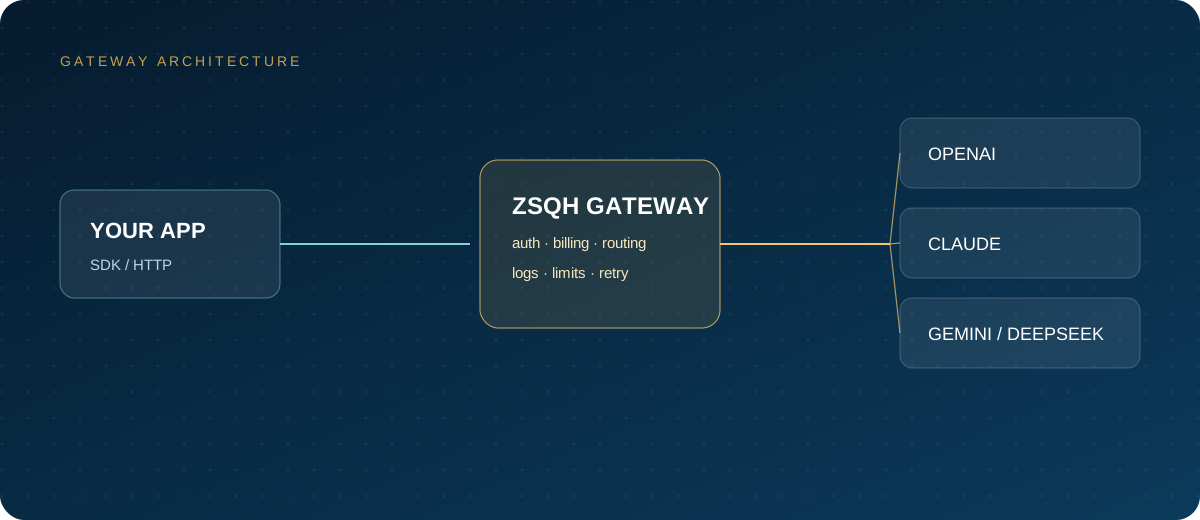
When evaluating a gateway, verify three things: whether audio transcription endpoints are fully forwarded, which models and response_format values are supported, and whether error codes are readable. Do not assume that because text endpoints work, audio endpoints must work too. Teams that need RMB payment, consolidated billing, and invoices can sign up for the ZSQH AI Gateway and start small before scaling.
7. Fault tolerance, cost monitoring, and pilot checklist
Transcription is a batch task; failure is not frightening, but failure that nobody notices is. Production should have at least four layers: deduplication before upload, backoff retries after failure, a dead-letter queue for tasks over threshold, and a fallback channel when the primary is unavailable. Split long audio at silence or fixed intervals, leaving 1-2 seconds of overlap between chunks.
Do not monitor cost only through the end-of-month invoice. Record daily processed audio minutes, failure rate, cost per session, and human review hours by project, and set alerts at 50%, 80%, and over-budget tiers. The script below totals the duration of a batch of files for comparison with the budget:
import json
import pathlib
import subprocess

total = 0.0
for path in pathlib.Path("audio").glob("*.mp3"):
    info = subprocess.check_output([
        "ffprobe", "-v", "quiet", "-print_format", "json",
        "-show_format", str(path),
    ])
    total += float(json.loads(info)["format"]["duration"])

print(f"Total duration {total / 60:.1f} minutes")
Do not run the pilot as a single successful request. Sign off item by item:
- Monthly usage estimate completed; peak and retry factors written into the budget.
- Privacy questionnaire, data terms, and ZDR conclusions filed; legal confirms cross-border handling.
- Key permissions and revocation process rehearsed successfully.
- Gold-set blind test meets the business threshold; noise and accent samples evaluated separately.
- Long audio over 25 MB passes chunking, merging, and timestamp alignment.
- Degradation paths for network loss, rate limiting, and timeouts rehearsed successfully.
- Invoices reconciled with actual usage; invoice type and issuance cycle confirmed.
- Cost alerts, human review, and owners assigned to specific people.
If any item lacks evidence, do not put it into production yet. Speech transcription connects to meetings, customer service, and content publishing, so failures have a more direct impact than text requests.
FAQ
Is Whisper API billed per minute or per token?
Usually by audio duration; the specific unit, rounding method, and minimum billable unit follow the official page. Through a gateway, see the on-site model pricing. Do not infer audio costs from text prices.
Is API audio used for training?
OpenAI states that since March 1, 2023, API data is not used for training by default unless actively shared. Abuse-monitoring logs are retained for up to 30 days by default; transcription and translation endpoints are currently marked as having no abuse-monitoring retention and as eligible for ZDR, but ZDR must be requested separately.
What should I do with a long meeting over 25 MB?
The official per-file limit is 25 MB. Split at silence or fixed intervals, leave 1-2 seconds of overlap between chunks, and merge by timestamp after transcription; you can also reduce the bitrate first. Chunking shortens context, so proper nouns and speaker consistency need extra proofreading.
Should teams in mainland China connect directly or through a gateway?
With overseas payment channels, passable compliance, and OpenAI-only usage, a direct connection has a shorter path. When RMB payment and consolidated billing are needed, a gateway is less work, but confirm audio endpoint coverage, data retention, and failover.
What if transcription accuracy falls short?
First separate audio quality, accent, domain vocabulary, and model capability. What you can change is recording equipment, noise reduction, prompts, or hotwords; if it still falls short, change models or evaluate self-hosting. Acceptance looks at overall gold-set results, not a single sample.
Related reading: