For teams in China, the challenge with the Claude API is usually not the SDK but the connection chain: where requests leave from, how bills are paid, how invoices are issued, how the business degrades under rate limits, and who investigates when something fails. Separate these questions and the options become clear.
This article compares three common routes — official direct access, self-built relays, and domestic AI gateways — and provides a practical configuration for timeouts, retries, degradation, and monitoring. Specific models and prices follow the on-site model pricing; this article is not legal or compliance advice.
Note: Anthropic, Claude, and OpenAI are trademarks of their respective owners. This article describes common product forms as of October 2026; cross-border networking, data export, and payment settlement must comply with local laws and each platform's terms of service. Consult legal and compliance staff before implementation.
1. The three routes at a glance
Official direct access calls the API provided by Anthropic directly. The path is shortest and features track the documentation most closely, making it suitable for teams that already have an overseas entity, overseas payment channels, and a mature cross-border network solution. The cost is that network quality, USD payment, exchange rates, and reimbursement documents are all your responsibility.
A self-built relay deploys a reverse proxy or gateway on a compliant overseas server, centralizing authentication, logging, rate limiting, and billing. It offers the most control, but operations, certificates, upgrades, and security hardening are yours to handle; poor server placement or data handling can actually amplify compliance risk.
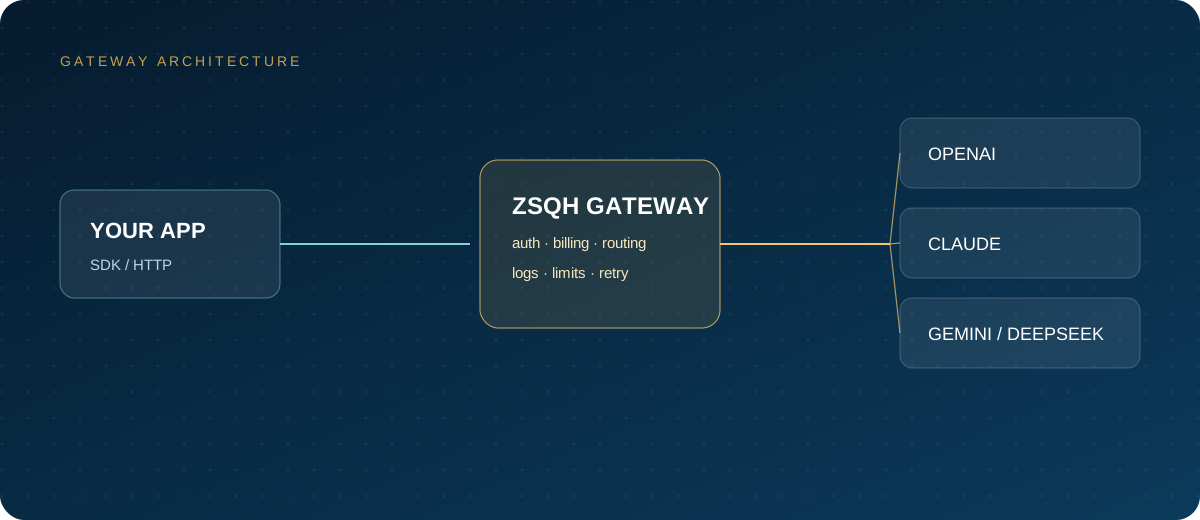
A domestic AI gateway is provided by a local service provider with an OpenAI-compatible endpoint, RMB settlement, and usually a console, usage statistics, and invoices. Integration cost is low and switching between multiple models is convenient; you need to verify the provider's qualifications, data terms, service levels, and incident response.
| Dimension | Official direct | Self-built relay | Domestic AI gateway |
|---|---|---|---|
| Network and access | Depends on cross-border links, needs optimization | Choose your own route, run your own operations | Domestic entry, usually ready to use |
| Payment and invoices | USD settlement, longer reimbursement chain | Depends on server and account entity | RMB settlement, invoices available |
| Compliance and data | Assess cross-border transfer and terms yourself | You own data location and retention | Review provider terms and qualifications |
| Operations cost | Medium, mainly network and account | High: servers, certificates, upgrades | Low, centralized console management |
| Rate limits and incidents | Retries and degradation on you | Design rate limits and health checks yourself | Provider handles part, still test yourself |
| Model coverage | Mainly Claude | Extend as needed | Usually covers multiple vendors |
2. Network and links: test before choosing
Do not just check whether it "connects." Production testing should cover four things: time to first byte, stability of long responses, packet loss at peak hours, and reconnection after disconnects. Streaming is more sensitive to the link; load-test with realistic prompt lengths rather than sending a single "hello."
Distinguish a "proxy" from a "gateway" in a self-built relay. A proxy only forwards requests; a gateway also handles authentication, rate limiting, logging, and model routing. Exposing a raw proxy on the public internet with a single fixed key is high risk; add access control, request-size limits, and anomaly alerts at minimum.
Cross-border links must comply with local laws and platform terms. Do not use shared proxies of unknown origin, and do not hand account credentials to untrusted third parties. Where personal information and important data are involved, classify the data and assess cross-border transfer first.
3. Payment, contracts, and invoices
The common sticking point for teams in China is the paying entity. Personal-card top-ups, third-party payments, and inconsistent reimbursement documents often leave finance unable to book the expense. When choosing an option, clarify: who signs the contract, what currency is used, what invoices can be issued, and what the refund rules are.
Domestic gateways usually support RMB corporate transfers and VAT invoices, and bills can be grouped by project or key, which suits teams that need consolidated multi-model spending. Official direct access suits teams with existing overseas payment capability. Whichever route you choose, write price, exchange rate, taxes, and refund terms into the purchase order; specific costs follow model pricing and the contract.
4. Compliance and data boundaries
At minimum, confirm: whether inputs and outputs are used for training, how long data is retained, where it is stored, whether a data processing agreement can be signed, which subprocessors are involved, and how security incidents are notified. Teams serving users in China should also assess personal information protection and cross-border data requirements.
A practical approach is data classification: public material can use general channels; code, contracts, and customer information should be redacted first; scenarios involving sensitive personal information or important data need separate assessment and written records. Do not replace compliance judgment with "let us get it running first."
5. Rate limits, timeouts, and degradation
Claude API rate limits are usually calculated across request count, input tokens, and output tokens. Traffic spikes, long context, and concurrent retries can all trigger 429; 529 may also appear when the service is busy. The right approach is a sensible timeout, exponential backoff with random jitter, a maximum retry count, and idempotency for write operations.
import os, random, time
from openai import OpenAI

client = OpenAI(
    api_key=os.environ["ZSQH_API_KEY"],
    base_url="https://api.zhongshangqihang.com/v1",
    timeout=60.0,
    max_retries=0,
)

def chat(messages, model, fallback):
    for name in [model, fallback]:
        for attempt in range(4):
            try:
                return client.chat.completions.create(
                    model=name,
                    messages=messages,
                    max_tokens=1024,
                    timeout=60,
                )
            except Exception as exc:
                status = getattr(exc, "status_code", None)
                if status not in (429, 500, 502, 503, 504, 529):
                    raise
                if attempt == 3:
                    break
                time.sleep(min(2 ** attempt + random.random(), 8))
    raise RuntimeError("primary and fallback both failed")
Set timeouts per task: ordinary Q&A can be shorter, while long document generation needs more room. Longer is not always better; a long hang occupies connection pool capacity. Retries only help with recoverable errors; 401, 400, and context overflows should not be retried.
A suggested degradation order: a lighter model from the same vendor, then a comparable model from another vendor, then rules or cached results. Put the degradation switch in a configuration service rather than changing code and redeploying; log the model name and reason for every degradation.
6. Key isolation and monitoring
- Use different keys for production and testing, and split further by project.
- Store keys only in server-side environment variables or a secrets manager; never in frontends, repositories, or logs.
- Set quotas or alert thresholds for every key and rotate regularly.
- Record request volume, error rate, P95 latency, token consumption, and degradation count.
- Alert separately on 401, 429, and 5xx so a single "error rate" does not hide the problem.
- Keep request IDs and model names for reconciliation and troubleshooting with the provider.
Monitoring should cover business outcomes, not just whether the API returned 200. For example, JSON parse failure rate, tool-call success rate, and empty-response ratio often reveal model or prompt problems earlier than HTTP status codes.
7. Launch checklist
- Define the access route and contracting entity; complete legal and finance review.
- Run a real-traffic load test in the target network environment.
- Configure timeouts, retries, backoff, and maximum retry counts.
- Prepare at least one usable fallback model and rehearse switching.
- Complete key tiering, quota settings, and a rotation plan.
- Connect monitoring for usage, error rate, latency, and degradation.
- Archive data terms, invoices, payment receipts, and acceptance records.
- Start with small traffic and observe for a week before scaling.
FAQ
Can the Claude API be accessed directly from China?
Availability depends on the local network environment, account eligibility, and platform terms. This article does not provide methods for circumventing restrictions; teams should choose an access method that complies with laws and terms of service, and give preference to domestic gateways with contracts and invoices.
What is the difference between a gateway and a proxy?
A proxy usually only forwards requests; a gateway also handles authentication, rate limiting, logging, billing, and model routing. For production, use a gateway as the entry point and do not expose a bare proxy to the public internet.
What should I watch with a self-built relay?
Server location, data retention, access control, certificate renewal, and incident response are all your responsibility. Complete a compliance assessment before cross-border deployment and avoid putting sensitive data on uncontrolled links.
Should I keep retrying when I hit a 429?
No. Use exponential backoff with random jitter and cap the number of attempts. Persistent 429s mean the quota or concurrency configuration is insufficient; degrade, queue, or adjust quotas instead of stacking retries.
Does a multi-model gateway reduce reliability?
An extra layer adds a failure point, but it also adds switching and degradation capability. The key is to verify the provider's service level, monitoring, incident notifications, and refund rules, and to run your own end-to-end health checks.
Next steps
Run a batch of real tasks through a test key at the ZSQH AI Gateway, validate the link, latency, and degradation, then split production keys by environment. Model coverage and costs follow model pricing.
Related reading: