A common mistake when buying Claude API for a company is comparing only model unit prices. What really determines whether a project launches smoothly is how the organization and permissions are structured, how quota and rate limits are controlled, whether the data terms pass review, whether the contracting entity and invoicing close the loop, and whether a fallback exists when something fails.
Claude is often used in production for long documents, code, and complex instruction following. Those workloads tend to involve contracts, source code, and customer data, so compliance requirements are higher than for ordinary Q&A. This article is a checklist organized around the procurement process, from account structure to go-live acceptance. For current prices and models, see the model pricing page and official documentation.
Note: Anthropic and Claude are trademarks of their respective owners. This article reflects common product patterns as of October 2026. Product terms, data policies, and prices may change; the signed contract and official pages govern.
1. The procurement checklist in five parts
| Area | Questions to settle | Deliverables |
|---|---|---|
| Organization and access | Who is the legal entity? Who holds admin rights? | Org chart, member list |
| Quota and rate | Prepaid balance, rate tier, alerts | Budget sheet, limit configuration |
| Compliance and data | Used for training? Retention period? Can a DPA be signed? | Terms, DPA, security documentation |
| Contracts and invoicing | Contracting entity, currency, invoice type | Contract, invoice, payment receipt |
| Technology and cost | Model split, caching, batch processing, degradation | Architecture diagram, cost model |
All five areas should move in parallel. Running technology and procurement in sequence usually means waiting at the contract or invoicing step.
2. Organization, workspaces, and keys: draw the boundaries first
- Register with a company-domain email and bind the organization to the corporate entity; don't carry business workloads on a personal account.
- Keep at least two organization administrators, enable two-factor authentication, and review the member list regularly.
- Create workspaces by team or environment, separating production, testing, and development, so billing can be attributed by workspace.
- Use admin keys only for managing members and workspaces, not for business calls; business workloads use workspace keys.
- Label every key with an owner, purpose, and creation date, and revoke it immediately when someone leaves or a project ends.
- Store keys in server-side environment variables or a secrets manager. Keep them out of the frontend, the repository, and chat logs.
Specific naming, quota, and permission behavior depends on the console. The principle is to separate environments first and teams second, rather than untangling a mixed bill later.
3. Quota, rate limits, and prepaid credit
Claude API typically uses prepaid credit with pay-as-you-go deduction, and rate limits are calculated per organization or workspace, commonly as requests per minute, input tokens per minute, and output tokens per minute. Different usage tiers have different ceilings; consult the official documentation for current rules.
| Control | Recommended practice | Why |
|---|---|---|
| Prepaid balance | Keep 1–2x one month of projected usage | Avoid outages without leaving a large idle deposit |
| Auto-reload | Enable as needed, with a cap | Prevent balance exhaustion from interrupting production |
| Workspace limits | Set per team or project | Stop one experiment from draining the whole group |
| Rate and concurrency | Load-test against peak traffic | Surface queuing and 429s early |
| Alerts | Balance, error rate, and latency | Intervene before users are affected |
Don't resend immediately on a 429. Use exponential backoff with jitter, cap the retry count, and make write operations idempotent. A 529 usually means the server is busy, and the same backoff strategy applies; if it persists, trigger degradation rather than retrying indefinitely.
4. Compliance and data: six questions for the purchase order
- Are API inputs and outputs used for model training by default? Do enterprise terms differ?
- How long is data retained, where is it stored, and what is the deletion process?
- Can you sign a data processing agreement (DPA), and how are responsibilities divided?
- Is zero data retention (ZDR) supported? What are the eligibility requirements and scope?
- Who are the subprocessors? Will changes be announced in advance?
- How are security-incident notification deadlines, response procedures, and service levels written into the contract?
Don't settle for verbal answers. Archive the privacy policy, data processing agreement, security documentation, and subprocessor list, and send them to legal and security for review. For contracts, code, personal information, and financial data, redact or switch to structured fields first; for scenarios that need zero data retention, confirm eligibility and the enablement process in advance.
5. Cost control: route by task, not one model everywhere
Claude models commonly come in Opus, Sonnet, and Haiku tiers, with capabilities and cost levels that differ in that order. The sensible approach is to route by task difficulty: classification, extraction, and rewriting on the lightweight tier; everyday coding and customer support on the balanced tier; complex reasoning and architecture review on the high tier.
- Fix system prompts and tool definitions, enable prompt caching, and raise the cache hit rate.
- Compress input: retrieve only relevant chunks and summarize conversation history.
- Limit output: set a sensible
max_tokensand require JSON or fixed fields. - Send offline jobs through batch processing and accept queuing and latency.
- Monitor usage by project and review the consumption ranking weekly.
- Prepare a degradation plan for peaks, switching to a lightweight tier or fallback model when needed.
import os
from anthropic import Anthropic

client = Anthropic(
    api_key=os.environ["ANTHROPIC_API_KEY"],
    base_url="https://ai.zhongshangqihang.com",
)

resp = client.messages.create(
    model="<Claude model name from the pricing page>",
    max_tokens=256,
    messages=[{"role": "user", "content": "Reply with OK only"}],
)
print(resp.usage.input_tokens, resp.usage.output_tokens)
First confirm that the key, model name, and endpoint are correct, then connect the workload. Model names follow the model pricing page; don't reuse names from old documentation.
6. Contracts, payment, and invoicing
| Item | Direct official | China-based AI gateway |
|---|---|---|
| Contracting entity | Online platform terms or overseas entity | Domestic company contract |
| Settlement currency | USD | CNY |
| Invoice | Billing documents under platform rules | Standard or special VAT invoice, platform-dependent |
| Payment | Overseas card or wire transfer | Bank transfer or online payment |
| Best for | Teams with overseas payment and reimbursement processes | Teams that need CNY invoices and one bill across models |
Corporate payment links the contract, order, receipt, and invoice into a complete evidence chain; funding from a personal account is hard to justify at audit. When selecting a gateway, verify the service level, refund policy, data terms, and support response time rather than looking only at unit price.
7. Go-live acceptance checklist
- Two organization administrators configured, with two-factor authentication enabled.
- Production, test, and development workspaces and keys separated.
- Prepaid balance, auto-reload, and alerts configured.
- One minimal request succeeds from the production network.
- Retry and degradation paths for 429, 529, and timeouts connected to monitoring.
- Data terms, DPA, and security documentation archived.
- Contract, invoice, and payment receipt handed to finance.
- A fallback model or channel has been rehearsed, and the business accepts degradation.
FAQ
Does enterprise Claude API procurement require an enterprise account?
Use a company-domain email and a corporate entity. Personal accounts create problems with offboarding, permission revocation, and billing attribution, and they make the data-compliance story harder to explain.
Can unused prepaid credit be refunded?
That depends on the contract and platform terms. Rules for unused balance, promotional credit, and consumed amounts differ; write them into the purchase order before payment rather than confirming after you stop using the service.
Is Claude API data used for training?
Terms for the API and consumer products can differ, and enterprise terms, zero data retention, and regions may vary. The signed data processing agreement and official terms govern.
Direct official access or a China-based gateway?
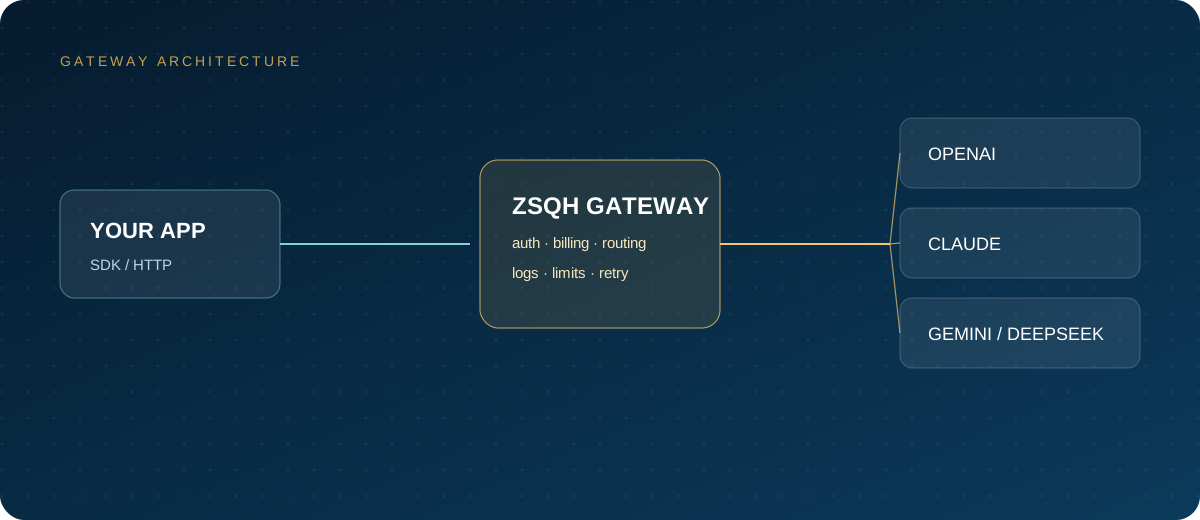
With overseas payment channels and a single model, direct access is a shorter path. If you need CNY invoices, one bill across multiple models, and domestic payment, a gateway saves effort. Fees and exchange rates follow the model pricing page.
How do we control Claude costs?
Start with caching and input governance, then route tasks across model tiers, and only then consider changing vendors. Evaluate cost per completed, accepted task rather than the list price per million tokens.
Next steps
Create a test key on ZSQH AI Gateway, validate models, latency, and cost with a batch of real tasks, then split production keys by workspace. Model availability and pricing follow the model pricing page.
Related reading: