Cross-border e-commerce AI needs are rarely as simple as "add a chat box". Product selection requires reading reviews and competitor listings. Listings must be translated into multiple languages. Customer support must respond across time zones. Advertising requires copy and creative assets in bulk. Broken apart, each of these can be implemented with APIs; joined together, they form a controllable system.
This article presents an executable plan: prioritize scenarios, define the architecture, then handle translation, customer support, review analysis, and asset generation separately, finishing with model selection, cost, compliance, and testing. The article does not hard-code unit prices; refer to the in-site pricing page.
Note: Model names, context lengths, and prices are subject to the in-site model pricing. This article describes common interface patterns as of October 2026.
1. Prioritize: which scenarios come first
Do not launch the entire chain at once. Rank by three criteria: high frequency, verifiable, and tolerant of errors. A typical order is:
- Listing translation and localization: high volume, fixed templates, easiest to quantify.
- Review and return-reason analysis: rich input, structured output, good for an initial rollout.
- Pre-sales and post-sales support: directly customer-facing, so it needs human fallback.
- Ad copy and creative assets: creative work, suitable for drafts rather than final versions.
- Product selection and trend analysis: depends on data quality, suitable for supporting decisions rather than replacing judgment.
Spend the first two to four weeks on items 1 and 2 to establish a quality baseline, then connect customer support. Once support goes live, it faces real users; without a baseline, it is hard to tell whether a problem comes from the model, the knowledge base, or the script.
2. Recommended architecture
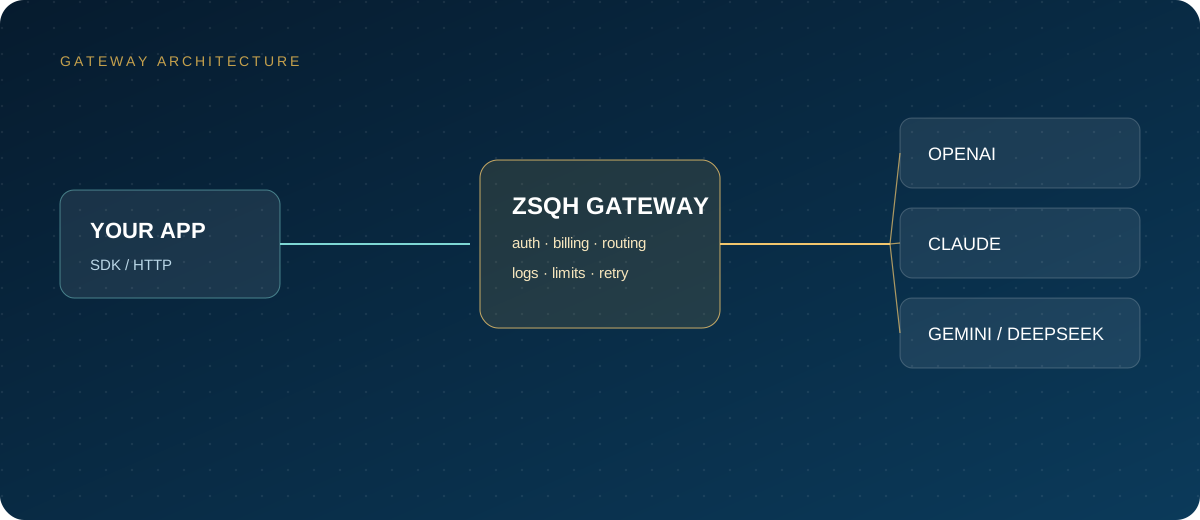
An architecture that stays maintainable usually looks like this:
Product / order / review data
   → Cleaning and masking
   → Task queue (translation / classification / generation)
   → AI gateway (auth, routing, rate limiting, logging)
   → Models (text / multimodal / embedding)
   → Result validation (glossary, sensitive words, format)
   → Business systems / human review
The key is to put model calls behind a gateway. Business code knows only one base URL and logical model names; switching models, adding fallback channels, and tracking cost all happen at the gateway. Otherwise, every new scenario scatters another set of keys, and bills and incidents become hard to trace.
3. Product research and review analysis
For review analysis, output structured JSON rather than a block of free text. Fields should include at least: issue type, affected part, sentiment, whether it relates to a return, and the source excerpt. Only structured data can feed dashboards, trend analysis, and supplier feedback.
Product research must first address data sources and sampling bias. AI is good at summarizing and categorizing, not at replacing real sales data. Separate "trend judgment" from "data facts", and require the model to say it does not know when evidence is missing, so guesses are not packaged as conclusions.
4. Listing translation and multilingual quality
Translation is not replacing Chinese sentence by sentence with English. Product titles, selling points, sizes, units, and warning labels each have their own localization requirements. Use the table below for acceptance:
| Stage | Practice | Acceptance criterion |
|---|---|---|
| Terminology | Maintain brand terms, category terms, and prohibited terms | Terminology hit rate can be measured |
| Translation | Translate in segments; preserve variables, units, and placeholders | No omissions or merged paragraphs |
| Localization | Adjust sizes, currency, and phrasing for the target market | Sampled and approved by local colleagues |
| Back-translation | Back-translate key fields for verification | Semantic deviations can be explained |
| Launch | Manual sampling plus negative-review keyword monitoring | Low-quality content can be rolled back |
The common failure of machine translation is text that is "grammatically correct but does not sound local". The fix is not to keep switching models, but to improve glossaries, style examples, and manual sampling. For multilingual quality, do not rely only on automated metrics. Have native speakers blind-review 30–50 items and record the share that are "ready to publish"; that number is more meaningful than any score.
5. Multilingual customer support
The key to support is not how smart the model is, but clear boundaries:
- Can answer: shipping times, return and exchange rules, size recommendations, invoice questions.
- Must escalate: refund disputes, legal threats, account security, highly emotional conversations.
- Must refuse: privacy requests unrelated to the product, non-compliant promises, guarantees beyond policy.
Use a three-layer structure: "knowledge-base retrieval + fixed scripts + human takeover". Put language detection at the entry point; do not assume the user writes English. For less common languages, generate with a stronger model first, then validate against the glossary and sensitive-word rules. Keep the original question, retrieved passages, and final reply for every conversation so disputes can be reviewed.
6. Ad copy and image/video assets
Copy works well as "bulk drafts plus human selection". Give the model explicit selling points, audience, restrictions, and length; generate five to ten versions at once, then let the operator choose. Do not let the model improvise freely, or the versions will diverge too much and increase the cost of choosing.
For images and video, multimodal and generation APIs can create backgrounds, scene images, short-video storyboards, and localized subtitles. Three cautions: the product itself must be accurate, features must not be exaggerated, and generated content must keep an audit trail. Copyright, likeness rights, and music licensing must be confirmed separately; "AI-generated" does not automatically mean there are no rights issues.
7. How to choose models
| Task | Recommended tier | Focus |
|---|---|---|
| Bulk translation | Medium-cost text model | Terminology consistency, throughput, concurrency |
| Review classification | Small model with structured output | JSON stability, per-item cost |
| Support conversations | Medium-to-strong model | Multilingual ability, instruction following, latency |
| Complex product research | Strong model | Long context, reasoning quality |
| Image / video | Multimodal generation model | Resolution, duration, moderation |
Prepare at least one primary and one fallback model for each task. Prices and available models are subject to model pricing; do not budget from remembered unit prices. Models change quickly, and today's cheap tier may not be the same price next month.
8. Cost control
- Run batch jobs through an async queue and avoid peak hours.
- Cache identical inputs; prefer a translation memory over repeated calls.
- Limit output length and require structured fields to reduce wasted generation.
- Run a small model over the full volume first, then upgrade low-confidence samples.
- Set budgets and alerts per business line so one script cannot exhaust the quota.
Calculate cost per SKU, per thousand reviews, and per conversation, rather than staring only at token unit prices. Retries, long context, and human review time are all part of the real cost.
9. Compliance and data
Cross-border operations span multiple jurisdictions. Confirm at least five things: where data is stored, whether it contains personal information, whether the vendor trains on it, how long logs are retained, and whether it can be deleted on request.
Do not send passport numbers, full addresses, or payment details directly to a model. If processing is genuinely required, mask them first or switch to structured fields. Automated consumer-facing replies must be explainable and appealable, and must always keep a human channel. Content related to advertising claims must also be reviewed against the target market's rules; model output cannot be treated as compliant copy by default.
10. Launch test checklist
- Build a test set of 100–300 items from real data, covering common and extreme cases.
- Compare two or three models on accuracy, format compliance, and average latency.
- Stress-test concurrency and observe rate limiting, timeouts, and retry behavior.
- Check blind-review results from native speakers of each language.
- Run checks for sensitive words, privacy, and prohibited promises.
- Run a small-traffic pilot for one to two weeks, then expand gradually.
FAQ
Does cross-border e-commerce require training your own model?
Usually not. Translation, classification, customer support, and copy generation can all use general-purpose model APIs, with industry adaptation handled through glossaries, knowledge bases, and validation rules. Consider fine-tuning only when the data volume is large, the task is highly fixed, and general models consistently fall short.
Can multilingual customer support be fully automated?
Not advisable. Common questions can go to automated replies, but refunds, disputes, account security, and highly emotional conversations must be escalated to a human. Automated replies need a clear identity disclosure and an escalation entry point.
Should listing translation use a large model or a dedicated translation API?
The two can be combined. Dedicated translation APIs suit stable, high-volume text with fixed formats; large models are better for rewriting selling points and adapting tone and local expression. The key is a unified glossary and back-translation checks for critical fields.
How do I judge whether AI product-selection advice is reliable?
Look for evidence. A reliable output should point to review samples, time ranges, and reasoning logic. Advice with only conclusions and no sources is inspiration, not a basis for decisions.
With a limited budget, which scenario should come first?
Start with listing translation or review analysis. Both have clear inputs and outputs, measurable results, and low cost of error, making them good for building the team's judgment about model quality before expanding to support and asset generation.
Next steps
If you need a unified model entry point, pay-as-you-go billing, and usage logs, you can start with a small budget and register for the ZSQH AI Gateway, beginning with a verifiable task such as translation or review analysis. Models and prices are subject to model pricing.
Related reading: