A common pattern in enterprise buying of Doubao API is to get everything working on a personal account first and add contracts and invoices later. That is fine for a prototype, but once the integration reaches business workloads, three problems surface: the account entity is not the company, keys have no permission boundaries, and nobody has reviewed the data terms. Doubao API is delivered through Volcano Ark, and what you procure is a combination of "model service + account + contract."
Note: Doubao, Volcano Ark, and Volcano Engine are trademarks of ByteDance and its affiliates. This article is a technical procurement reference only; it does not constitute legal advice and does not imply any affiliation, agency, or partnership with the trademark owners. Prices, quotas, and terms are governed by the official pages, the signed contract, and model pricing.
1. The procurement checklist in five parts
| Area | Questions to settle | Deliverables |
|---|---|---|
| Entity and accounts | Contract entity, administrators | Verification materials, account register |
| Permissions and keys | One key per application | IAM users, policies, key inventory |
| Quota and rate limits | Free quota, peak load | Usage model, alert configuration |
| Data and content safety | Training and review responsibilities | Terms, agreements, response procedures |
| Cost and invoices | Billing method, invoicing | Budget sheet, contract, invoices |
2. Entity and accounts: do not run enterprise workloads on a personal account
- Register with a company-domain email, complete real-name verification, and bind the account to the corporate entity.
- Use the main account only for finance and administration; create IAM sub-users for each application.
- Give sub-users only the minimum permissions, and never share an administrator.
- Create, rotate, and revoke keys centrally in the IAM console, and act immediately when an employee leaves or a service is retired.
- Enable multi-factor authentication and retain audit logs.
Volcano Ark IAM documentation distinguishes two kinds of keys: keys created in the IAM console belong to a sub-user and require the Ark policy to be attached manually; keys created in the Ark console carry a preset policy automatically. The former is better suited to permission governance. Either way, keys must never enter the frontend, the code repository, or chat records.
3. Quota and rate limits: free quota is not procurement capacity
The new-user free quota is suitable for validation, not capacity planning. Procurement should distinguish four categories of numbers. The free quota is calculated per model, shared between the main account and sub-accounts, covers only online inference tokens, and excludes plugins, knowledge bases, batch processing, and cache storage. Model-level rate limits include RPM, TPM, TPD, IPM, and in-flight concurrency; the platform sets them, and raising them requires a ticket. Endpoint-level limits can be adjusted on the details page. When the usage cap is reached, service pauses, and it is mutually exclusive with some caching and low-latency capabilities.
Before procurement, ask the business side for peak RPM, TPM, and maximum input and output lengths. After launch, monitor 429s closely: ServerOverloaded calls for backoff, RequestBurstTooFast calls for slowing the ramp-up, and SetLimitExceeded means quota is exhausted. Volcano Ark supports X-Ark-Max-Wait-Timeout-Ms to queue requests, which suits non-real-time jobs, but the timeout must be raised accordingly.
4. Data and compliance: turn verbal explanations into clauses
The Volcano Ark platform-specific terms state that, without separate consent, the platform will not store or use customer data to train or optimize models; data may be processed for compliance review, troubleshooting, and abnormal-call alerts; the platform performs aggregate statistics but does not retain raw customer data. Enterprises still need to confirm six points:
- Whether the high-security sandbox is enabled and whether data is passed to the model provider.
- Whether the model is proprietary, open-source, or fine-tuned, and which terms apply to each.
- Ownership, scope of use, retention, and deletion mechanisms for fine-tuning data.
- Whether cross-border transfer is involved and whether a separate assessment is required.
- Whether an enterprise contract, data processing agreement, and confidentiality agreement can be signed.
- The notification deadline and response process for security incidents, and whether audit reports are available.
Two points deserve special attention. First, a fine-tuned model does not mean "the model belongs to the enterprise": the terms usually grant exclusive use after payment, but the model still has to be deployed on the platform, and source code and parameters are not provided. Second, the terms contain no universal retention period, so enterprises must keep their own logs and write deletion obligations into the contract. Redact sensitive data first.
5. Content safety: separate platform capability from application responsibility
Doubao models include basic safety mechanisms, and Volcano Ark also provides content-safety guardrails that can be configured at the endpoint to review input and output. The default option uses the platform's standard mechanism; enterprises needing finer policies can connect Volcano Engine's content risk-control service. Blocked requests return an error carrying a Detection marker, along with a review label and request ID.
But "the platform has guardrails" does not mean "the enterprise has no review responsibility." As of the documentation reviewed for this article, custom guardrails mainly cover image, video, and 3D generation; text workloads still need sensitive-word checks, structural validation, and human review at the application layer. Procurement should specify who maintains the review policy, how false positives are appealed, how long logs are kept, and who handles violating content.
6. Cost, contracts, and invoices
Doubao API billing is not one unit price multiplied by tokens. Variables include separate pricing for input and output, input-length tiers for some models, separate pricing for audio input, cache-hit pricing, cache storage fees, batch inference pricing, fine-tuning training and inference pricing, model units, and low-priority inference. Some third-party models also have peak and off-peak differences.
Control cost in this order:
- Tier the models: use lightweight models for classification, extraction, and rewriting, and reserve flagship models for complex reasoning.
- Compress input and stabilize the prefix: retrieve only relevant chunks, summarize conversation history, and keep prompts fixed.
- Limit output: set a maximum output length and require structured results.
- Batch offline jobs: send labeling and summarization through batch inference, which is usually cheaper; non-real-time jobs can also use low priority.
- Set usage caps: cap both model-level and endpoint-level usage.
- Attribute bills by key: split billing by API key ID or project dimension.
For enterprise payment, use corporate transfer and retain the contract, order, payment receipt, and invoice. Invoices are issued only for successfully ordered services or billed statements; unused prepayments cannot be invoiced; refunding an invoiced amount requires the invoice-return process first; tax rates adjust with policy, while the pre-tax price usually stays the same. Rely on the billing center.
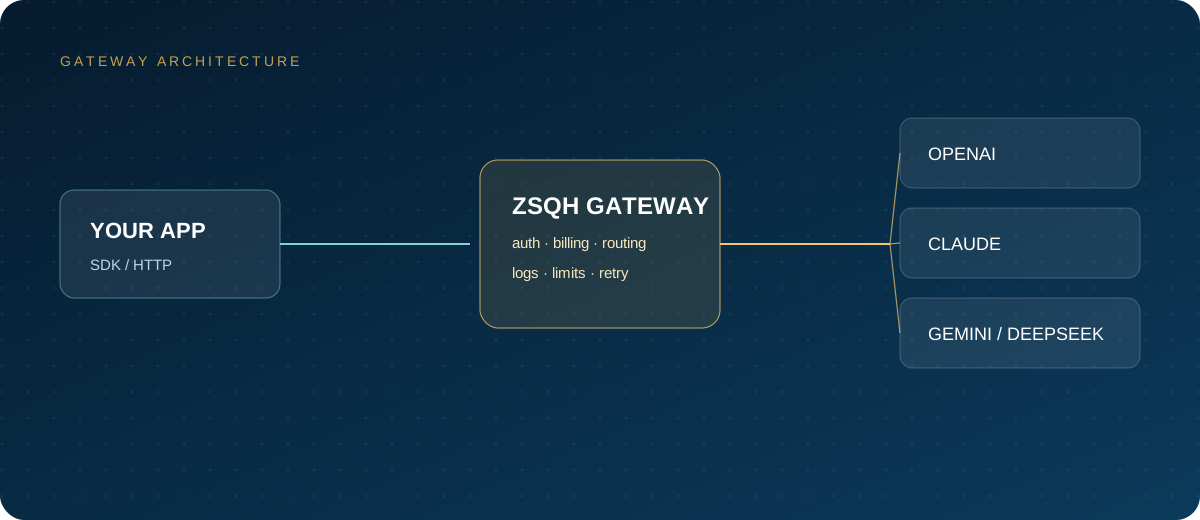
When using multiple model providers, a domestic AI gateway can consolidate RMB billing and invoices, but confirm one more layer of service dependency and data terms. Model pricing is for reference only; prices change.
7. Pilot acceptance: decide in two weeks whether to scale
- Choose a real but non-core scenario and define four metrics: task success rate, P95 latency, 429 ratio, and cost per task.
- Use the free quota or a small pay-as-you-go amount to verify authentication, streaming, and error codes.
- Shift 5%–10% of traffic in a gradual rollout, stress-test peak RPM and TPM, and confirm that rate limits and alerts work.
- Test content-safety policies with sensitive samples and record the false-positive rate and handling time.
- Have legal and security review the terms, data processing agreement, and log-retention plan, and reconcile the bill.
- Rehearse one degradation: switch to a backup model or backup gateway when the primary model is unavailable.
The script below is a pre-launch smoke test to verify the key, model name, and usage fields:
import os
from openai import OpenAI

client = OpenAI(
    api_key=os.environ["ARK_API_KEY"],
    base_url=os.environ["ARK_BASE_URL"],  # Direct or gateway address per documentation
)

resp = client.chat.completions.create(
    model=os.environ["ARK_MODEL"],
    messages=[{"role": "user", "content": "Reply with OK only"}],
    max_tokens=16,
    stream=False,
)

print(resp.model)
print(resp.choices[0].message.content)
print(resp.usage)
A smoke test proves only that "it connects," not that "it can carry the load." Real acceptance depends on the error rate, latency distribution, and bills during the gradual rollout.
FAQ
Does enterprise procurement of Doubao require a corporate verified account?
When corporate payment, contracts, and invoices are involved, a corporate verified account is recommended. A personal account is suitable for validation, not for carrying company business.
Can the free quota be used for production acceptance?
It can be used for functional validation, but it is not suitable as production capacity. The free quota has rate limits and scope restrictions and pauses when exhausted.
Will Doubao API use enterprise data for training?
The platform terms state that data will not be used for training or optimization without separate consent, but terms may differ by model type, whether the high-security sandbox is enabled, and whether fine-tuning is involved. The signed contract and official terms are authoritative.
Is content review the platform's responsibility or the enterprise's?
The platform provides basic safety mechanisms and optional guardrails, but the enterprise remains responsible for input and output, review policies, and handling violations. Text applications especially need additional review at the application layer.
How do I choose between direct official access and an AI gateway?
Teams that only need Doubao, have completed enterprise verification, and have simple finance processes will find direct access shorter. Teams that need a multi-model entry point, RMB billing, and invoices will find a gateway easier. Costs are governed by model pricing.
Next steps
Run a two-week pilot to validate task quality, rate limits, and billing, and then decide the procurement scale. To compare Doubao with other models behind the same interface, create a test key on ZSQH AI Gateway; models, prices, and terms are governed by model pricing and official documentation.