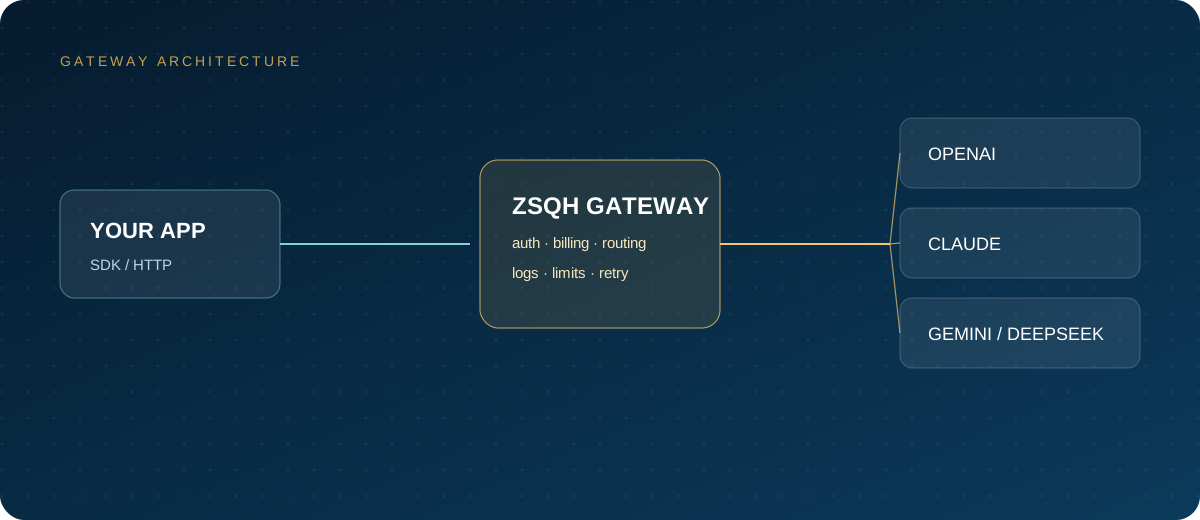
Doubao API itself runs in mainland China, so in theory it does not need a "wall-crossing" relay. What most Doubao relays on the market actually solve is something else: a single entry point for multiple providers, pooled quota, consolidated invoices, endpoint management, and failover. Once the relay layer stops being transparent, billing, model versions, and key ownership all become a black box.
This article compares direct access, self-hosted proxies, commercial relays, and unified gateways, focusing on endpoint IDs, billing transparency, key risk, failover, and migration. Prices and availability are governed by model pricing and the provider's documentation.
Note: Doubao, Volcano Ark, and Volcano Engine are trademarks or product names of ByteDance and its affiliates. This article is a technical discussion only; it implies no affiliation, agency, or endorsement relationship with these companies, and does not endorse any service provider.
1. Definitions first: relay, proxy, self-hosted forwarding, and gateway
- API relay: forwards requests to an upstream model service, possibly adding billing, quotas, and logs; some are just shared or resold keys, and reliability depends on the operator.
- Network proxy: an HTTP, SOCKS, or reverse proxy that only addresses reachability, does not change API semantics, and leaves the key in your hands.
- Self-hosted proxy: your own reverse proxy or open-source gateway, giving you control of keys, logs, and routing, while you bear the upstream account, bandwidth, and operations.
- Unified AI gateway: an OpenAI-compatible entry point that aggregates multiple models and provides a unified key, bill, and console.
The Doubao case has a specific wrinkle: calls through Volcano Ark depend on a model ID or an inference endpoint ID (usually starting with ep-). If the relay layer exposes only a vague model name, you can hardly tell which version, which endpoint, or whose quota sits behind it. Before signing, ask plainly: which layer of service is provided, and whose key is it?
2. Four options in one table
| Dimension | Volcano Ark direct | Self-hosted proxy | Commercial relay | Unified AI gateway |
|---|---|---|---|---|
| Billing transparency | Platform bill with clear rules | Upstream bill plus your own costs | Depends on the operator; reconciliation needed | Unified bill with published pricing rules |
| Network path | Domestic direct access, affected by local egress | Depends on server and line | Depends on the relay's route | Depends on gateway route and upstream |
| Endpoint management | You maintain model IDs and ep- endpoints |
You maintain the mapping | Usually maintained by the operator | Maintained by the gateway, but traceability must be confirmed |
| Rate limits and concurrency | Account- or model-level quota | Under your control, still bounded upstream | May use a shared pool; confirm | Depends on gateway rules and plan |
| Key risk | Key stays with you | Key stays with you | May use shared or resold keys | Usually issues a dedicated key |
Direct access suits a single platform, self-hosting suits teams with operations capability, and a gateway suits multi-model consolidated billing.
3. Billing transparency: do not look only at the "multiplier"
Relays commonly quote "official price times a multiplier" or "token packages." A low multiplier does not mean a low total cost. At minimum, clarify seven things:
- Are input and output priced separately, and is the multiplier the same for both?
- Are cache hits or context reuse priced separately, and how is the discount calculated?
- Do reasoning tokens from Doubao thinking models count as input or output?
- Are failed, retried, and timed-out requests billed?
- Do streaming requests return complete usage, and can the gateway bill be reconciled?
- What are the minimum top-up, validity period, and refund rules, and what about invoices, currency, and exchange rates?
- Can the bill be split by project, key, model, and endpoint?
Write these rules into a comparison table, then run the same set of real requests through direct access and through the relay and compare usage, success rate, and bills. Prices change; rely on model pricing and the provider's invoice.
4. Endpoint IDs and model mapping: the most common relay pitfall
In Volcano Ark, an inference endpoint is usually bound to a specific model and version and may carry its own quota, while a model ID points directly to a model. Relays and gateways often map between model names and upstream IDs.
This mapping layer creates three risks:
- Version drift: after an upstream model upgrade or endpoint rebuild, the version behind the same model name changes, and output style and cost change with it.
- Quota confusion: you think you bought dedicated capacity, but it is actually a shared pool and other tenants crowd you out at peak hours.
- Broken binding: an endpoint is deleted, disabled, or out of credit, and the relay does not switch in time; only then do requests start failing.
Before signing, ask: which ID does this model name map to, can the version be pinned, will changes be announced in advance, and can a specific endpoint be requested? Providers that can supply a mapping table and change log are usually easier to verify.
5. Stability: verify with data, not verbal promises
Look at at least six stability metrics: success rate, P50/P95 latency, first-token latency, timeout rate, share of 429s, and output speed. Test with prompts of realistic length, covering streaming, long context, and concurrency.
Three problems are common at the relay layer: a shared quota pool that runs out, a single forwarding node, and slow upstream switching. When selecting, confirm multi-route support, automatic failover, and incident notifications, but do not treat verbal promises as an SLA.
The client still needs its own failover. The example below tries direct access and the gateway in order and returns as soon as one succeeds:
import os
from openai import OpenAI

PROVIDERS = [
    (
        "ark-direct",
        os.environ["ARK_API_KEY"],
        "https://ark.cn-beijing.volces.com/api/v3",
        os.environ["ARK_MODEL_ID"],
    ),
    (
        "zsqh-gateway",
        os.environ["ZSQH_API_KEY"],
        "https://ai.zhongshangqihang.com/v1",
        os.environ["ZSQH_MODEL"],
    ),
]

def chat(prompt: str):
    last_error = None
    for name, api_key, base_url, model in PROVIDERS:
        try:
            client = OpenAI(api_key=api_key, base_url=base_url,
                            timeout=60, max_retries=1)
            resp = client.chat.completions.create(
                model=model,
                messages=[{"role": "user", "content": prompt}],
                max_tokens=256,
            )
            return name, resp
        except Exception as exc:
            last_error = exc
            print(name, "failed:", type(exc).__name__)
    raise last_error
This is only a minimal example. Production needs backoff, circuit breaking, tiered timeouts, and logging, plus regular drills for a primary route outage. After a switch, expect output differences.
6. Key risk and compliance: more important than price
The most easily overlooked issue with a relay is key ownership. Shared or resold keys and quota from unknown sources can cause three problems:
- If the upstream bans the account or adjusts quota, your business goes down with it, and you cannot appeal directly.
- Multiple tenants share one key, so rate limits and failures affect each other and are hard to isolate.
- Request content passes through a third party, and log and data-retention policies are opaque; the terms of service may also prohibit resale or sharing.
When choosing a provider, confirm at least the corporate entity, terms of service, privacy policy, invoicing, and an incident contact. Do not send requests containing personal information, secrets, or original contract text to a relay that cannot explain where the data goes. For heavily regulated workloads, prioritize direct access, private deployment, or a provider that can sign a data processing agreement.
7. Migration checklist: from direct access to a relay or gateway
- Record the current state: success rate, P50/P95, share of 429s, token usage, and bills.
- Inventory models and endpoints:
model,ep-IDs,max_tokens, streaming, tools, JSON, and thinking mode. - Create separate test and production keys, each with budgets, limits, and alerts.
- Change only
base_url,api_key, and the model mapping, and run a minimal request in staging. - Replay real prompts and compare output quality, latency, usage, and error codes.
- Check the mapping for 401, 402, 429, 5xx, and timeouts, and make sure retries do not amplify the incident.
- Shift 5%–10% of traffic, observe for 3–7 days, and keep direct access as a fallback.
- After full cutover, keep reconciling for a week to confirm bills, usage, and mapping agree.
During migration, do not change the model, prompts, and gateway at the same time; change one variable at a time.
8. How to verify whether a Doubao relay is trustworthy
Start with the model field in the response, but do not trust it alone, because the field can be rewritten. A combination of checks is more reliable:
| Check | Method | Warning signal |
|---|---|---|
| Latency | Send the same prompt repeatedly and compare P50/P95 | Extreme variance or consistently slower than direct access |
| Error rate | Measure the share of 429s, 5xx, and timeouts | Failures cluster at peak hours |
| Usage | Compare response usage with the backend bill | Mismatch or missing streaming usage |
| Model identity | Compare capability boundaries and output style on a fixed test set | Clear capability downgrade or shorter context |
| Endpoint mapping | Ask which ID and version the model name maps to | Refusal to explain or frequent changes |
| Key isolation | Confirm a dedicated key and whether it can be rotated | Refusal to explain the key's origin |
Red flags include: prices persistently far below direct access, refusal to provide usage details, a demand that you hand over your Volcano Ark key, inability to explain endpoints, and no terms of service. If you see these, test with a small traffic share first; do not migrate everything at once.
9. Next steps
If you need one entry point for multiple models, create a test key on ZSQH AI Gateway, get it working, and then migrate; see model pricing for prices and available models. Do not treat "cheap" as the only criterion; migration and outage costs count too.
FAQ
What is the difference between a Doubao API relay and a proxy?
A proxy only addresses network reachability; a relay also involves accounts, billing, and key distribution. Before signing, clarify the boundary and who owns the key.
Doubao API is already in mainland China, so why use a relay?
The common reasons are not network access but a multi-model entry point, consolidated billing, pooled quota, and failover. If you use only Doubao and direct access is smooth, the need is limited.
A relay is cheaper than direct access. Can I trust it?
Low prices may come from bulk purchasing, subsidies, or quota resale, and may also come with shared keys and rate limits. Check the billing rules and usage details first, then run a small live test.
How can I tell whether a relay switched the model or endpoint?
Do not rely only on the model field. Compare capability boundaries, context, and output style on a fixed test set, and ask for the underlying model ID or endpoint ID.
How much code changes when moving to a gateway?
Most OpenAI SDK projects change only base_url, api_key, and the model name. If you use thinking mode, tools, or specific fields, run compatibility tests and keep a direct-access fallback.