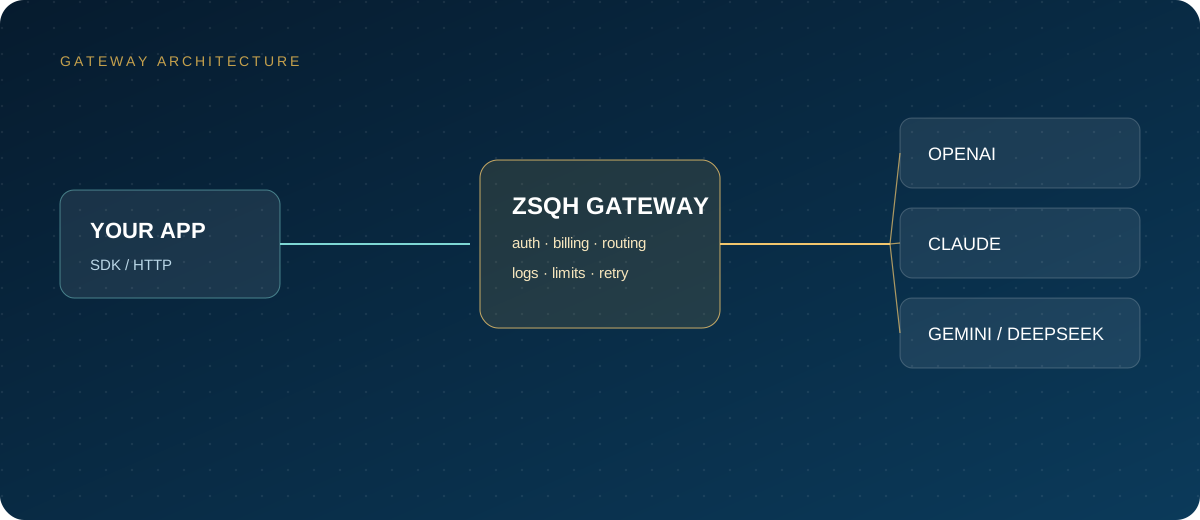
The term "LLM API proxy" is often used for two different things: technically, an API gateway or reverse proxy; commercially, an agent or reseller. The two have different concerns, but both come back to compliance, billing, and reliability.
This article explains, from an enterprise user's perspective, how to evaluate, contract, and test.
Note: This article does not constitute legal advice. Consult your legal and compliance team for specific requirements, and defer to each supplier's terms.
1. Distinguish three roles
| Role | What it does | What to confirm |
|---|---|---|
| API gateway | Unified entry, authentication, billing, routing | Technical capability, reliability |
| Agent/reseller | Resells upstream model quota | Upstream authorization, contract, invoice |
| Self-hosted proxy | Deploy the gateway yourself | Servers, upstream channels, operations |
Whether you are buying "technical service" or "model quota" determines the contract and the boundary of responsibility. A gateway vendor is responsible for the access layer; a reseller is also responsible for the legitimacy of the quota it sells.
2. What to check for compliance
- Upstream authorization: Is the provider entitled to resell or act as an agent for these models?
- Terms of service: Do they permit your use case, such as customer service, content generation, or agents?
- Data: Are requests and responses stored? For how long? Are they used for training?
- Cross-border transfer: Does data leave the country, and does that meet your industry requirements?
- Content safety: Are there review and filtering mechanisms?
- Invoices and contracts: Can you pay through a company account, receive an invoice, and sign a data processing agreement?
For enterprise procurement, do not let "cheap" override compliance. When something goes wrong, the responsibility may be yours.
3. What to check for billing
- Input, output, and cached-token prices.
- Whether there are multipliers, minimum spend, or tiered pricing.
- Whether failed and retried requests are billed.
- Refund rules.
- How price changes are announced.
Monthly cost =
  input tokens × input price
+ output tokens × output price
+ retry/failure cost
+ long-context/multimodal surcharge
Do not rely on advertised unit prices. Run real requests and reconcile the bill. A provider with a low headline rate but aggressive rate limits can cost more once retries and engineering time are included.
4. How to test reliability
- Standard and streaming requests.
- Tool calling and structured output.
- 5, 10, and 20 concurrent requests.
- Long context.
- 401/404/429/5xx error codes.
- Success rate and P95 over 3–7 consecutive days.
- Whether backup channels exist during incidents.
Test with your own prompt set, not a generic "hello world" request. The failures that matter in production usually involve long inputs, tool calls, and traffic spikes.
5. What the contract must state
- Scope of service, model list, and SLA.
- Billing method and price-change notification.
- Data retention, deletion, and training use.
- Security incident notification and compensation.
- Refund, termination, and migration terms.
- Invoice type and schedule.
If a provider cannot put these points in writing, treat that as a risk signal rather than an administrative detail.
6. Common risks
- Unclear upstream authorization; service can be cut off at any time.
- Low prices but severe rate limits, making retries expensive.
- Vague data terms and compliance exposure.
- No invoices or contracts, so the enterprise cannot book the expense.
- A single-channel failure interrupts the business.
- Loose key management and internal abuse.
7. How to reduce risk
- Keep a primary and a backup channel.
- One key per person, with per-project limits.
- Retain usage logs and bills.
- Prepare a degradation plan for critical workloads.
- Review supplier terms regularly.
- Do not hand all data to a single supplier.
These measures add some operational work, but they are far cheaper than rebuilding trust after an outage or a data incident.
FAQ
Is an API proxy legal?
It depends on upstream authorization, the terms of service, and local regulations. Enterprises should conduct a compliance review before use.
What is the difference between a proxy and a gateway?
A gateway is the technical layer; an agent or reseller is the commercial layer. Many providers do both.
Will my data be used for training?
It depends on the provider's terms. Get written confirmation; do not assume "no" by default.
Can I build a proxy myself?
Yes, but you need servers, upstream channels, operations, and compliance capability. See One API and New API guide.
Next steps
If you need an entry point that is reachable from mainland China, offers unified billing, and supports invoicing, sign up for the ZSQH AI Gateway, test with a small amount, and then follow the enterprise procurement process. Models and prices are subject to model pricing.
Related reading: