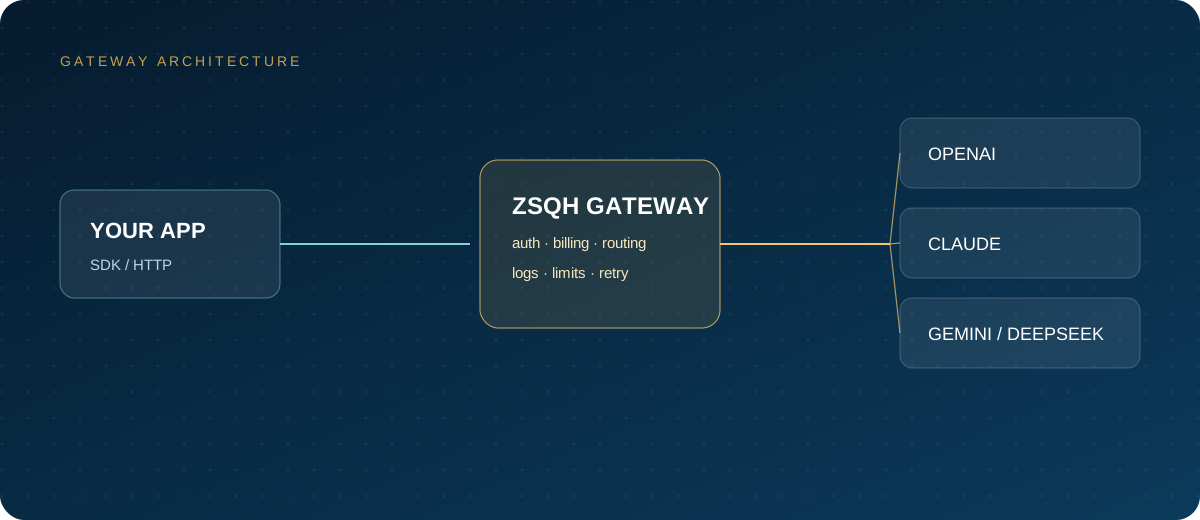
When enterprises procure the Gemini API, the discussion easily collapses into "how much per million tokens." What actually determines whether a project can launch is quota, rate limits, data terms, account and key management, bill reconciliation, and whether there is a backup when the primary channel falters.
This article provides a checklist in procurement and launch order. Specific models and prices follow the model pricing page and Google documentation. It does not hardcode unit prices and does not make legal conclusions for either party.
Note: Google and Gemini are trademarks of Google LLC. The terms, regions, and quota rules of Google AI Studio and Vertex AI may differ; signed contracts, vendor terms, and actual console configuration are authoritative. ZSQH AI Gateway is an independent third-party API gateway, and this article discusses integration and procurement methods only.
1. Size the workload before discussing quota
Answer four questions before procurement; otherwise quota planning is guesswork.
- How many requests occur per day, and at what hours does the peak concentrate?
- What are the average input and output token counts, and how long is the top 5% longest case?
- What share involves images, audio, video, or PDFs, and how large is each asset?
- How many extra requests come from retries, failures, and repeated sending of conversation history?
Group last week's logs by model, task type, and input length, calculate daily request volume, daily token volume, and peak concurrency, multiply by 30 for a monthly baseline, and add a 20%–30% retry buffer. For a new project without logs, run a small traffic pilot for a week rather than estimating "users × calls" by hand.
2. Quota, rate limits, and billing
The AI Studio free tier is suitable for validation, but rates and quotas are tighter, and data terms may differ. Plan production on the paid tier and put the following items into the purchase order:
- Whether the billing entity is an overseas account or a domestic company, and how currency and exchange rates are handled.
- Whether to use prepaid or postpaid billing, and how balance alerts and auto-recharge are configured.
- Whether quotas are allocated by project or by team, and who can request temporary increases.
- The retry, queueing, and degradation strategy when a 429 appears.
- Invoice type, invoicing cycle, and the fields required for reconciliation.
A direct connection to the vendor is usually billed in US dollars, which suits teams that already have overseas payment processes. Teams that need local-currency invoices and a unified multi-model bill can evaluate a domestic gateway. The two paths have different cost structures, so comparing sticker prices alone is not enough.
3. Data and compliance: ask before signing
The compliance boundary depends on which entry point you use, which features are enabled, and which region stores the data. Build a written question list during procurement and send it to legal, security, and business reviewers:
- Are inputs and outputs used to train models, and do enterprise terms differ on this point?
- How long is data retained, how are deletion requests submitted, and how quickly do they take effect?
- In which regions is data stored, and does this meet company or customer data-residency requirements?
- Can a data processing agreement be signed, and how are liability boundaries and compensation caps defined?
- Who are the subprocessors, and will changes be announced in advance?
- Are logging, caching, and file uploads enabled by default, and can they be disabled or the retention period shortened?
Do not accept verbal answers. Archive the privacy policy, data processing agreement, security documentation, and subprocessor list as acceptance materials. When personal information or cross-border data is involved, anonymize it first and have legal confirm the path.
4. Accounts, permissions, and key management
The biggest enterprise risk is "one key for the whole company." Implement in this order:
- Register with a corporate domain email, bind the organization to the legal entity, and do not run business on personal accounts.
- Split Cloud projects or workspaces by production, testing, and development so bills and quotas are aggregated separately.
- Grant administrator rights to only a few people, enable two-factor authentication, and review members quarterly.
- Use service accounts or dedicated keys for business calls, not administrator credentials.
- Label every key with owner, purpose, environment, and creation time; revoke on departure.
- Enable audit logs and usage alerts; on abnormal calls, disable the key first, then investigate.
Store keys only in server-side environment variables or a secrets manager; never in the frontend, repository, or support-ticket screenshots. Use a separate low-quota key for demos and delete it when the demo ends.
5. Cost control: start with architecture, not just a vendor switch
Gemini costs are determined by model tier, input and output length, multimodal assets, and retries. The order should be: govern the input first, then route by tier, and compare unit prices last.
- Fix system prompts and long document prefixes and use context caching to reduce repeated input.
- Send classification, extraction, and rewriting to lightweight tiers; escalate only complex reasoning.
- Set
maxOutputTokensand request JSON or fixed fields to avoid long, open-ended answers. - Downscale images, reduce video frame sampling, and send only relevant PDF pages.
- Run offline jobs through batch processing and accept queueing in exchange for lower cost.
- Cap retries with backoff; do not amplify request volume during a 429 period.
- Record usage by project, team, and task for internal cost allocation.
After integrating with a gateway, you can send unified requests through the OpenAI SDK and check usage in the response:
import os
from openai import OpenAI

client = OpenAI(
    api_key=os.environ["ZSQH_API_KEY"],
    base_url="https://ai.zhongshangqihang.com/v1",
)

resp = client.chat.completions.create(
    model="<Gemini model name from the pricing page>",
    messages=[{"role": "user", "content": "Reply with OK only"}],
    max_tokens=64,
)

print(resp.usage)
Model names follow the model pricing page; do not reuse names from older documentation. Before launching a new task, measure "the cost of completing one acceptable task" with real samples instead of looking only at the price per request.
6. Backup providers and degradation plans
Enterprise procurement should assume the primary channel will wobble. Prepare at least three layers: a backup model from the same vendor, a model from another vendor, and a business-side fallback message or cached result.
Abstract model calls behind a unified interface, and configure timeouts, retries, circuit breaking, and a switch. A switchover should complete within a minute without changing business code. Drill quarterly to confirm the backup channel's key, quota, and model names are valid, and write service levels and exit arrangements into the contract.
7. Pilot and acceptance: a four-week evaluation plan
Use four weeks for a limited pilot instead of a one-time full migration.
| Step | Responsible R | Accountable A | Consulted C | Informed I | Deliverable |
|---|---|---|---|---|---|
| Requirements and quota sizing | Business owner | Department head | Finance, engineering | Procurement | Usage baseline table |
| Data and compliance review | Security and compliance | Legal | Engineering, procurement | Management | Risk list and conclusion |
| Account and permission setup | Platform administrator | Engineering lead | Security | Business | Project and key inventory |
| Integration and load testing | Development lead | Engineering lead | Operations | Business | Integration report and load-test records |
| Cost monitoring and reconciliation | Finance | Finance lead | Engineering, procurement | Management | Weekly cost report |
| Contract and payment | Procurement | Finance lead | Legal | Business | Contract, invoice, receipt |
| Launch acceptance | Business owner | Department head | Engineering, security | Management | Signed acceptance form |
Week one gets the interface and permissions working; week two compares quality with real samples; week three runs peak load tests and failure drills; week four consolidates costs and submits acceptance. Metrics include task accuracy, P95 latency, error and retry rates, cost per task, and key and permission checks. The team sets specific thresholds according to the business.
8. Questions to ask in the contract
- How is the service level defined, and what are the measurement method and compensation mechanism?
- How much advance notice is given for price changes, and are already-purchased quotas affected?
- What is the process and response time for requesting a quota increase?
- Can the data processing agreement, regional restrictions, and deletion process be written into the contract?
- What are the invoice type, currency, payment cycle, and refund rules?
- What are the support channels, response times, and escalation path?
- After termination, how is data exported and deleted?
- How are subprocessor changes and security incidents communicated?
FAQ
Does enterprise procurement of the Gemini API always require Vertex AI?
Not necessarily. Teams with high requirements for data regions, IAM, auditing, and contracting are better served by Vertex AI; rapid validation and small-scale business can start with AI Studio. Confirm that terms and quotas meet the business need before choosing the entry point.
Can the free tier be used in production?
It is not recommended. Free-tier rates, quotas, and data terms usually differ from the paid tier, and sudden rate limiting hurts user experience. Plan production on the paid tier and reserve the free tier for prototypes and internal testing.
Is Gemini API data used for training?
The answer can differ by product, terms, and configuration. Follow the data processing agreement and vendor terms. For sensitive data, anonymize it first and have legal confirm retention and training terms.
What should I do when quota is insufficient or 429s are frequent?
First determine whether it is a rate limit or a total quota limit, then optimize retries, concurrency, and request length. Once you confirm the cause is business growth, request a quota increase or add a backup channel. Blindly resending requests only makes things worse.
How do I show that costs are under control after procurement?
Establish a usage baseline before launch, then produce weekly reports by project after launch, tracking cost per task, cache hit rate, retry rate, and the share of each model tier. Four consecutive weeks within budget and meeting quality targets is a reasonable definition of under control.
Next steps
Create a test key on ZSQH AI Gateway with a real task to verify models, latency, and local-currency billing, then split production keys by environment. Prices follow the model pricing page. Before procurement, send this checklist through finance, legal, and engineering for review.
Related reading: