Enterprise procurement of GLM API is easily reduced to two questions: how much to deposit and what the unit price is. What really determines long-term usability is who owns the account, how quota is allocated, whether data terms pass review, whether invoices can be booked, and whether there is a fallback when something fails.
GLM offers an OpenAI-compatible interface, so integration is fast, which makes it easy to skip the procurement process. This article provides a checklist in order, covering accounts, quota, billing, compliance, private deployment, cost, and launch acceptance.
Note: Zhipu, GLM, and BigModel are trademarks of their respective owners. This article is for technical explanation only; it has no affiliation with or agency relationship to Zhipu. Account rules, prices, invoicing, and deployment policies may change; before purchasing, refer to official documentation, the console, and the site's model pricing page.
1. The procurement checklist has five modules
| Module | Questions to confirm | Deliverables |
|---|---|---|
| Account and permissions | Who is the legal entity, and how are keys allocated | Account register, key inventory |
| Quota and rate limits | Balance, concurrency, overage rules | Budget sheet, alert configuration |
| Data and compliance | Retention, training use, zero retention | Terms, review records |
| Billing and invoices | Billing basis, invoicing, payment terms | Quote, invoices, payment receipts |
| Cost and disaster recovery | Cost per task, backup models | Cost model, switchover plan |
If any module is confirmed only verbally, rework is likely later. Start compliance and invoicing in parallel with technical integration.
2. Accounts, enterprise verification, and permissions
Enterprise verification is the first step. Official documentation states that it can be completed through legal-representative identification or business-license authorization, usually within seven business days; corporate transfer verification can take as little as about 30 minutes. A personal account can be converted to enterprise verification, but an enterprise account cannot be converted back to personal. Do not use an individual's identity to verify an enterprise account.
Account recommendations: register with a corporate-domain email and bind the company entity; have at least two administrators; split keys by production, testing, and development; keep keys only in server-side environment variables or a secrets manager; label each key with an owner and purpose, and inventory and rotate quarterly; revoke immediately when an outsourcing engagement ends. If the console supports sub-accounts, projects, or spending caps, split them by business line and keep audit logs.
If you want to use open-source GLM models in commercial scenarios, the platform offers a business-authorization application for enterprise entities, with review in about two business days. This is a model-use authorization and does not imply an agency or partnership relationship with the platform; procurement documents should make the distinction clear.
3. Quota, concurrency, and resource packages
GLM rate limiting is mainly based on concurrency, with independent caps per model and enforcement at the account level. Exceeding the limit returns 1302, a busy platform returns 1305, and quota ceilings may be 1308 or 1310: reduce concurrency or queue for 1302, back off and retry for 1305, and adjust the quota for 1308. If higher concurrency is needed, you can apply for an adjustment, with review taking about 10 business days; apply in advance based on peak demand.
Read resource-package rules carefully: at billing time, a package matching the scenario is applied first, then the cash balance; when several packages apply, the one expiring soonest is consumed first; after expiration, extension, renewal, and reactivation are not supported. Consumed and invoiced amounts are generally non-refundable; unused self-funded top-ups may be handled through customer service in special cases, while gifted or discounted portions are canceled.
Contracts or orders should state the quota size, overage handling, validity period, and treatment of unused balance, rather than simply saying "top up an amount."
4. Billing, statements, and invoices
GLM text models are billed by input and output tokens, while caching, long context, image generation, and video generation may use different bases. Budget separately for text, vision, generation, and retries. Current prices are on the model pricing page; prices change with models and promotions.
Confirm invoicing rules before payment. Official documentation states: invoices are issued against actual consumption, not the top-up amount; eligible items are API inference bills from the previous month and earlier, plus resource-package orders from the previous day and earlier; after application, invoices usually reach the designated email in three to seven business days. The invoicing entity must match the enterprise verification entity; some billing periods may not be invoiceable while the account is in arrears; after switching from Company A to Company B, consumption during A's period cannot be invoiced to B, so historical invoices must be handled before the change.
Export statements monthly, split costs by project or key, and reconcile packages, cash deductions, and invoice amounts.
5. Data compliance and private deployment options
The platform's privacy policy states that personal information is stored in China and is not currently transferred across borders; it also notes that anonymized data may be used for machine learning or model training. In September 2026, the platform announced an applicable "no data content retention" mechanism: once enabled, prompts and outputs are used only for the current request's computation and are not stored or used for training. However, public information indicates that persistent interfaces such as the Batch API and File API are outside its scope, and data may still be retained for 30 days or longer where required by law or during abuse investigations.
Procurement review should cover six points: whether data is retained and for how long; whether it is used for training; storage region and cross-border transfer; whether a data processing agreement can be signed; which sub-processors are involved; and how security incidents are notified. For personal information, customer contracts, and financial data, complete data classification and redaction first.
Private deployment deserves special attention as policies change. Official documentation shows that self-service "private instance deployment" is being scaled back: from October 16, 2026, new instances can no longer be created or modified, and service stops on November 16; users with an existing cloud-private service contract are unaffected. Enterprises with such needs should confirm cloud-private service or dedicated deployment through a commercial contract and ask about available models, compute specifications, service levels, update cadence, and exit arrangements.
6. Cost control: fix waste before discussing unit price
Runaway enterprise bills are usually not a unit-price problem but a matter of inputs that are too long, outputs without limits, cache misses, and duplicate generation from retries. The optimization order: compress input and retrieve only relevant passages; stabilize the prefix by fixing system prompts and tool definitions; limit output and require structured results; separate models so classification and extraction use lightweight ones; process offline jobs in batches; only then consider changing providers.
import json
import os
from collections import defaultdict

INPUT_RATE = float(os.environ.get("GLM_INPUT_RATE", "0"))
OUTPUT_RATE = float(os.environ.get("GLM_OUTPUT_RATE", "0"))
BUDGET = float(os.environ.get("GLM_MONTHLY_BUDGET", "0"))

cost = defaultdict(float)
for line in open("usage.jsonl", encoding="utf-8"):
    row = json.loads(line)
    p = row.get("project", "default")
    cost[p] += row.get("input", 0) * INPUT_RATE
    cost[p] += row.get("output", 0) * OUTPUT_RATE

total = sum(cost.values())
for p, amount in sorted(cost.items(), key=lambda x: -x[1]):
    print(f"{p}: {amount:.2f}")
print(f"total: {total:.2f} / budget: {BUDGET:.2f}")
if BUDGET and total > BUDGET * 0.8:
    print("warning: over 80% of budget")
The script only aggregates and warns; unit rates must be read from the official page and filled in. The answer to cost lives in the request logs.
7. Access control and failover
Before production integration, turn the base URL, key, and model name into configuration, so switching between official direct access, a gateway, or a backup model requires only a configuration change. Control at three layers: timeouts, exponential-backoff retries, and circuit breaking with half-open probes; use idempotency keys for write operations to avoid duplicate charges.
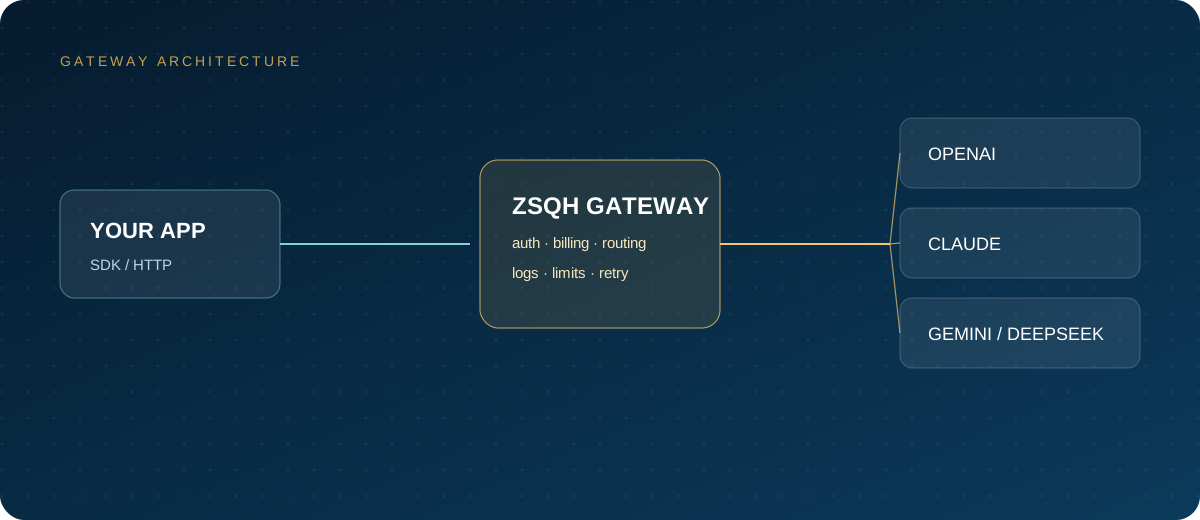
Evaluate backup channels in advance. Backup models may differ in quality, context, and tool calling; after a switch you must either accept the quality change or degrade only non-core functions. A unified gateway can consolidate keys and billing across multiple providers; a single-model direct connection has a shorter path. Both approaches need switch triggers, such as consecutive timeouts, a rising 5xx share, or first-byte latency above threshold.
8. Pilot acceptance checklist
- Select a real scenario and write down quality, latency, and cost metrics.
- Run 30 to 50 tasks for two weeks, covering peak and off-peak periods.
- Record pass rate, p95 latency, 429 count, and cost per task.
- Walk through corporate payment, statement export, and invoice application.
- Complete data classification, terms archiving, and the zero-retention application.
- Rehearse key rotation, permission revocation, and employee offboarding handover.
- Rehearse primary/backup switchover and record recovery time.
- Scale up only after acceptance, and set up monthly reconciliation.
9. FAQ
Is enterprise verification mandatory for buying GLM API?
Not mandatory for calling, but enterprise payment, corporate transfers, and invoicing under the company entity all depend on it. Complete it when procurement starts.
Can an expired resource package be renewed or refunded?
After expiration, extension, renewal, and reactivation are not supported, and refunds are limited. Estimate the size from actual consumption; do not treat resource packages as long-term deposits.
Are invoices issued on the top-up amount or actual consumption?
Invoices are issued against actual consumption, not the top-up amount. The eligible scope and cycle follow the official invoicing documentation.
Does GLM still support private deployment?
Self-service private instances are being scaled back: official documentation states that creation and modification stop on October 16, 2026, and service stops on November 16; users with an existing cloud-private service contract are unaffected. Confirm needs through a commercial contract.
How do I avoid a single-model or single-channel failure?
Prepare an evaluated backup model, configure timeouts, backoff, circuit breaking, and idempotency, and rehearse switching regularly. Disaster recovery depends on engineering processes, not on any entry point's promises.
Next steps
Create a test key on ZSQH AI Gateway, run real tasks for two weeks, and record quality, latency, failure rate, and cost per task before deciding on procurement scale. Models and billing follow the model pricing page.