Procuring the Grok API at enterprise scale is less about unit price than about permissions, quotas, data terms, content policy, and failure degradation. This article provides a checklist in process order so each item can be verified before traffic is expanded. Models and prices are subject to model pricing.
Note: Grok and xAI are trademarks of their respective owners. This article is for procurement and technical evaluation reference only. Product terms, data policies, and prices may change; official documentation, signed contracts, and this site's model pricing are authoritative.
1. Split procurement into six modules
| Module | Question to confirm | Procurement deliverable |
|---|---|---|
| Account and permissions | Who is the team entity, who are the administrators, how do members join | Organization chart, role list |
| Quota and rate | Prepaid balance, monthly billing cap, QPS/QPM/TPM | Quota table, alert configuration |
| Data and compliance | How long data is retained, whether it is used for training, whether ZDR is available | Terms, security documentation, DPA |
| Content policy | What content may be blocked, how it is reviewed | Review workflow, fallback wording |
| Contract and invoice | Contracting entity, currency, invoice, refund rules | Contract, invoice, payment receipt |
| Technology and cost | Model tiers, long context, degradation path | Architecture diagram, cost model |
The six modules should proceed in parallel. Discussing only technology and unit price often leads to a blockage in the contract or data terms.
2. Accounts, teams, and access control
Grok API usage and billing are aggregated by team, with two common roles: administrator and member. An enterprise should keep at least two administrators and enable two-factor authentication.
Before enabling automatic domain join, confirm domain verification and the offboarding process for corporate email addresses. Otherwise, anyone who can register an email address on that domain may be able to join the team. The safer default is to leave it off and have administrators invite members individually.
An easily missed point: after a member is removed, their API keys may remain under the team and do not automatically become invalid. The offboarding process must include both "remove member" and "revoke or rotate keys", and retain audit logs.
Separate the management plane from the call plane. Management keys should only create, update, and revoke call keys, and should never enter business code. Call keys should be split by project or environment and limited to least privilege with ACLs and QPS/QPM/TPM caps. Store keys in a server-side secrets manager or environment variables, never in front-end code, repositories, or chat logs.
3. Quotas, rates, and billing
A common settlement method for the Grok API is prepaid credit plus usage-based deduction. Top-up credit is bound to the team, and calls deduct from it first. When credit runs out, if a monthly billing cap is configured, the excess may roll into the monthly bill. If credit is exhausted and no cap is available, online requests may fail outright, so balance alerts must fire before business interruption.
Several rules are easy to overlook:
- Bills and invoices are handled per team. Fill in the company name, tax ID, address, and contact correctly before payment.
- The official service generally cannot issue historical invoices for consumption that has already occurred.
- Prepaid credit is generally non-refundable unless local law requires otherwise; deleting a team forfeits unused credit.
- Rate limits are configured per key, commonly in QPM and TPM; once TPM is triggered, new requests are rejected.
The purchase order should state who is responsible for top-ups, at what balance alerts fire, and who approves the monthly cap. Do not write only "pay-as-you-go".
4. Data retention, training, and zero data retention
According to the official security documentation, the Grok API retains requests and responses for a period by default for auditing, deletes them automatically at expiry, and encrypts data at rest. The provider states that API inputs and outputs are not used to train models without permission, and that audit-retained data does not enter training.
Enterprises with sensitive data can evaluate team-level zero data retention (ZDR). ZDR is off by default; when enabled it applies to the whole team, requires no code changes, and prevents inputs and outputs from being written to disk. It can be confirmed through response headers and console indicators. The trade-off is that features depending on storage become unavailable, such as the stateful Responses API, files, batch processing, deferred completions, and hosted image or video output.
Confirm each item during procurement:
- How long is the default retention period, and is there evidence of deletion?
- Can a data processing agreement (DPA) be signed, and how are responsibilities divided?
- Is ZDR supported, and which features require architectural changes once it is enabled?
- What is the notification window for security incidents, and are regional processing options available?
Official documentation also mentions security certifications such as SOC 2 Type 2 and the availability of a BAA on request. Certification and contract materials should go to legal and security teams for review; do not treat a verbal answer as a conclusion.
5. Content policy and business boundaries
The Grok API is subject to an acceptable use policy, and text, image, and video generation may pass through different levels of content moderation. Enterprises should build "what happens when content is blocked" into the product workflow rather than waiting for an error in production.
Four actions are recommended: have legal review the acceptable use policy; keep human review and an appeal path for customer-facing content; record the ID, scenario, and resolution of blocked requests; and do not rely on a single prompt for moderation. Business rules and manual sampling should be layered.
When finance, healthcare, legal, or cross-border data is involved, content policy and industry regulation must be reviewed together. What a model can generate is not the same as what an enterprise may publish.
6. Cost control: model tiers, long context, and monitoring
The Grok 4.x series includes 256K, 500K, and 1M context tiers. Specific model names, capabilities, and availability are subject to the model pricing page. Some models have long-context tiers; once input exceeds a threshold, the entire request may be billed at a higher tier, which has a large impact on long-document workloads.
Control cost in the following order:
- Use lightweight tiers for classification, extraction, and rewriting; reserve higher tiers for complex reasoning and code.
- Compress input and include only relevant passages; do not send an entire document every time.
- Set a reasonable
max_tokensand request JSON or fixed fields to reduce wasted output. - Send latency-tolerant offline jobs to batch processing, but note that batch processing may be unavailable when ZDR is enabled.
- Record token structure, 429 counts, and p95 latency by team, project, or key.
- Evaluate cost per completed qualified task, not just the list price.
The minimal call example puts the entry point, key, and model name in environment variables for easier switching and auditing:
import os
from openai import OpenAI

client = OpenAI(
    api_key=os.environ["GROK_API_KEY"],
    base_url=os.environ.get("GROK_BASE_URL", "https://ai.zhongshangqihang.com/v1"),
)

resp = client.chat.completions.create(
    model=os.environ["GROK_MODEL"],  # subject to the current model name on /pricing
    messages=[{"role": "user", "content": "Reply only with OK"}],
    max_tokens=32,
)
print(resp.usage.prompt_tokens, resp.usage.completion_tokens)
Before connecting, confirm the model name, entry point, and billing rules. Do not carry model names from old documentation into production.
7. Degradation and backup channels
Design degradation by failure type, not with a single instruction to "switch to the backup model":
- Within the same provider, move from a higher tier to a lightweight tier while keeping core fields and formats unchanged.
- Prepare a second channel across providers or gateways, and confirm in advance that its data terms also meet compliance requirements.
- Under rate limits, use exponential backoff with jitter, set a maximum retry count, and keep write operations idempotent.
- When timeouts or error rates keep rising, open the circuit breaker and move to queuing or a static fallback.
- Record the degradation rate and the quality change after degradation, and alert when thresholds are reached.
Degradation must not happen silently. Answer quality, field completeness, and response time may all change, so the product side must define acceptable ranges in advance.
8. Pilot acceptance: eight steps to launch
- Define the pilot scope and acceptance metrics: quality, p95 latency, 429 rate, and cost per task.
- Draw 30–50 tasks from real business, covering simple, medium, and complex levels.
- Run a minimal request in the production network environment to confirm the key, entry point, and model name.
- Load test at peak concurrency and record the trigger points for QPS, QPM, and TPM.
- Rehearse rate limiting, timeouts, insufficient balance, and regional failure.
- Verify billing: prepaid credit, monthly cap, invoice information, and refund terms.
- Archive data terms, content policy, security documentation, and ZDR configuration.
- Expand after two-person review, keeping a rollback switch and a weekly cost review.
Frequently asked questions
Does Grok enterprise procurement require a corporate email address?
Using a corporate domain email and a company entity is recommended. Personal accounts create problems with offboarding, permission recovery, and billing ownership. Whether to allow automatic domain join depends on your email management process.
Can unused prepaid credit be refunded?
It is generally non-refundable unless local law requires otherwise; the enterprise terms and contract are authoritative. Deleting a team forfeits unused credit, so calculate the budget carefully before topping up.
Is API data used for training?
The provider states that API inputs and outputs are not used to train models without explicit permission, and that audit-retained data does not enter training. The data processing agreement and official terms are authoritative; for sensitive data, evaluate ZDR.
Should zero data retention be enabled?
It depends on the data type and feature trade-offs. ZDR disables files, batch processing, and stateful interfaces. Customer service, code, and contract scenarios can be evaluated first; workloads that depend on those features need architectural changes.
How can a team in mainland China connect reliably and handle invoices?
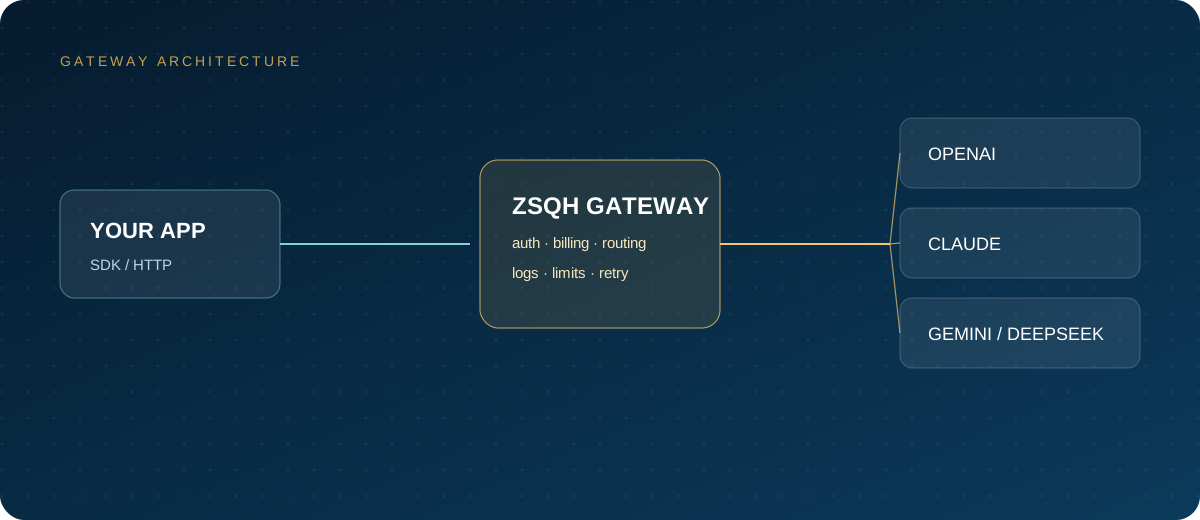
Teams with overseas payment and network conditions can use direct official access. Teams that need RMB payment and a domestic entry point can create a test key at ZSQH AI Gateway and then confirm billing rules in model pricing.
Next step
Run a small pilot with real tasks before deciding to expand. For a domestic entry point and multi-model management, start by signing up for ZSQH AI Gateway; prices are subject to model pricing.
Related reading: