Grok API relay and proxy services are often treated as a small matter of changing the base URL. Once you are in production, four things determine the experience: whether billing rules are transparent, who controls rate limits, whether you can switch when something fails, and who holds your keys and request data.
This article compares three routes and provides methods for billing verification, stability testing, migration, and acceptance. Specific prices and available models are subject to model pricing.
Note: xAI and Grok are trademarks of their respective owners. This article is not affiliated with xAI. The relay market changes quickly; the common forms described here reflect October 2026 and do not constitute an endorsement of any provider.
1. Distinguish four roles first
- Direct official access: Call the xAI API directly. Keys, billing, and accounts stay in your hands, and you handle network access and payment yourself.
- Network proxy: HTTP or SOCKS forwarding that addresses reachability only. It does not change API semantics, and the key remains yours.
- Self-hosted reverse proxy or relay: Forwarding on an overseas server, which can unify egress and add retries and rate limits, but requires maintaining streaming forwarding, certificates, and monitoring yourself.
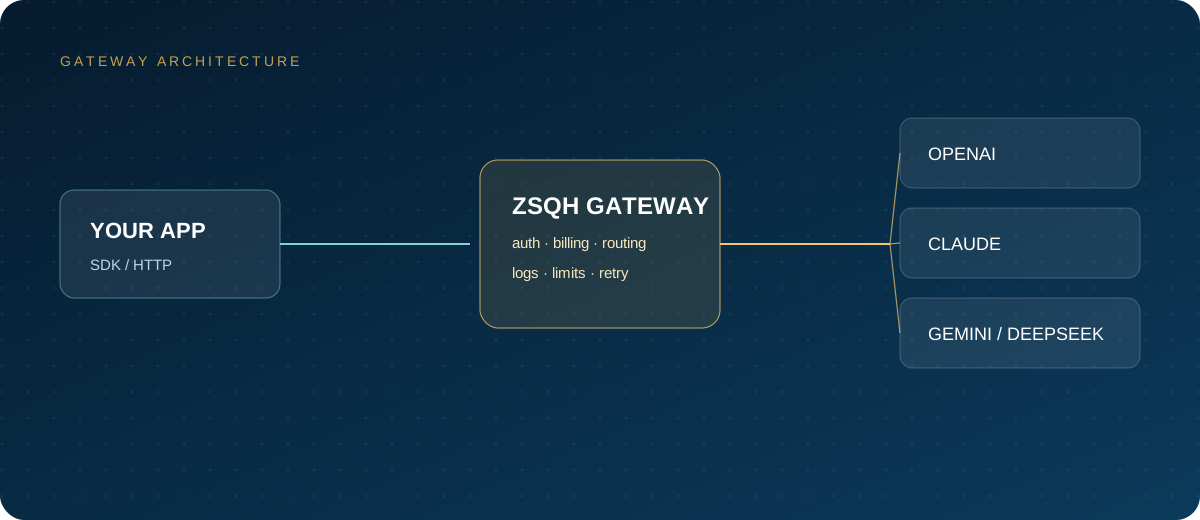
- Managed AI gateway: Provides an OpenAI-compatible endpoint, separate keys, unified billing, and model routing. Both commercial gateways and self-hosted open-source options can fall into this category.
Confusing these four concepts makes it easy to misdiagnose a network failure as a model problem. Before signing, clarify the service boundary and key ownership.
2. The three routes in one table
| Dimension | Direct official access | Self-hosted proxy | Managed gateway |
|---|---|---|---|
| Billing transparency | xAI invoice with clear terms | Upstream invoice plus server cost | Depends on pricing rules and usage detail |
| Network and egress | Affected by the local path | Depends on server and route | Depends on gateway route and upstream |
| Rate limits and concurrency | Limited by xAI account tier | You control flow, still bounded upstream | Gateway rules layered on upstream limits |
| Key ownership | Fully yours | Fully yours | Usually issues separate keys; confirm |
| Failover | You build a backup path | You build multi-upstream routing | Check whether backup routes are offered |
| Operations cost | Low, but troubleshooting is yours | Servers, certificates, upgrades, on-call | Shifted to the provider, with dependence on its capability |
No single route suits every team. If you only call Grok and network and payment are smooth, prefer direct access. If you need fixed egress or private keys, choose a self-hosted proxy. If you lack operations staff and need multi-model billing, consider a managed gateway.
3. Billing transparency: eight questions beyond the multiplier
A common relay quote is "official price times a multiplier" or a token package. A low multiplier does not mean a low total cost. At minimum, put these eight items into your comparison table:
- Are input and output priced separately, and is the multiplier the same for both?
- Is cached input discounted, and is cache writing billed separately?
- Are tokens produced by the reasoning process counted as output?
- Are failed requests, timeout retries, and cancelled requests billed?
- Do streaming responses return complete usage data, and can requests be reconciled?
- Is there a minimum top-up, an expiry date, and a refund rule?
- Are invoices supported, and how are settlement currency and exchange rate determined?
- Can bills be split by project, key, and model, and are price changes announced in advance?
Fix the rules first, then run the same batch of requests through the official endpoint and the gateway and compare actual charges. See model pricing for this site's rules; prices change, so do not rely on an old screenshot.
4. Rate limits and stability: design around upstream rules
xAI rate limits are typically calculated by requests per second and tokens per minute, with caps set per model. Account tiers relate to cumulative spending; Tier 0 is the default tier, not a free quota. Prompt, output, reasoning, and cache-hit tokens may all count toward TPM. Exceeding a limit returns 429, and exponential backoff is recommended.
A relay or gateway adds its own layer of concurrency and quota on top of upstream limits. It is not contradictory for the same request to succeed directly but return 429 through a gateway; examine both layers separately. At minimum, design a primary and backup entry point, error classification, circuit breaking, and an official fallback.
Below is a minimal probe that tests success rate and latency across two entry points and switches to the backup address on failure:
import os
import statistics
import time
from openai import OpenAI

ENDPOINTS = [
    ("primary", os.environ["GROK_PRIMARY_BASE"], os.environ["GROK_PRIMARY_KEY"]),
    ("backup", os.environ["GROK_BACKUP_BASE"], os.environ["GROK_BACKUP_KEY"]),
]
MODEL = os.environ["GROK_MODEL"]

def call(base_url: str, api_key: str, prompt: str, retries: int = 3):
    client = OpenAI(api_key=api_key, base_url=base_url, timeout=60, max_retries=0)
    for attempt in range(retries):
        start = time.perf_counter()
        try:
            resp = client.chat.completions.create(
                model=MODEL,
                messages=[{"role": "user", "content": prompt}],
                max_tokens=256,
            )
            return resp, (time.perf_counter() - start) * 1000
        except Exception as exc:
            wait = min(2 ** attempt, 8)
            print(base_url, type(exc).__name__, "retry in", wait, "s")
            time.sleep(wait)
    raise RuntimeError("endpoint failed")

latencies = []
for name, base, key in ENDPOINTS:
    try:
        resp, ms = call(base, key, "Reply only with OK")
        latencies.append(ms)
        print(name, "ok", round(ms), "ms", resp.usage)
    except Exception as exc:
        print(name, "down", exc)

if latencies:
    print("median", round(statistics.median(latencies)), "ms")
This is a functional probe, not a stress test. Before production, observe for at least seven consecutive days, covering morning and evening peaks, and record success rate, P50 and P95 latency, time to first token, 429 share, and streaming interruptions. Test long prompts and concurrency separately.
5. Key risk and data boundaries
The most easily overlooked aspect of a relay is key ownership. Shared keys, resold quota, or channels of unknown origin can bring four problems:
- If the upstream bans the account or changes quota, service stops and you cannot appeal directly.
- Multiple tenants share one key, so rate limits and failures affect each other and are hard to isolate.
- Request content passes through a third party, with opaque logging and retention.
- The terms of service may not permit resale, leaving no contractual basis in a dispute.
When choosing a provider, confirm whether it issues separate keys, whether keys can be rotated, whether limits can be set per project, and which fields are logged. Do not send requests containing personal information or contract text to a relay that cannot explain where the data goes.
Data terms need two layers. xAI states that API inputs and outputs are not used to train models without explicit permission; requests and responses are retained for 30 days by default for abuse auditing, and teams can choose zero data retention, at the cost of some stateful features. A gateway also has its own logging and retention policy, which must be confirmed separately.
6. Migration checklist: from direct access to a relay or gateway
- Record the current state: one week of success rate, P95 latency, token usage per thousand requests, and billing.
- Inventory model names and parameters: streaming, tool calling, structured output, and maximum context.
- Create separate test and production keys, each with budgets and alerts.
- Change only
base_urlandapi_key, and run a minimal request in staging. - Replay real prompts and compare output quality, latency, and usage accounting.
- Verify the mapping of 401, 402, 429, 5xx, and timeouts so retries do not amplify failures.
- Roll out to 5% to 10% of traffic, observe for three to seven days, and keep direct official access as a fallback.
- After full cutover, reconcile for another week to confirm billing, usage, and alerts match.
Do not change the model, the prompt, and the gateway at the same time during migration, or you will not be able to attribute results. Change one variable at a time.
7. Acceptance checklist: judging whether a relay is reliable
- Model identity: Do not trust only the
modelfield in the response. Use a fixed test set to compare capability boundaries, context, and output style. - Usage reconciliation: Do usage figures in responses match the backend bill, and do streaming requests have complete statistics?
- Rate-limit behavior: Are 429s concentrated at peak times, are quota rules clear, and are retries billed?
- Streaming stability: Do long answers break midway, does the proxy disable buffering, and how is idle timeout configured?
- Incident response: Is there a status page, notification channel, and backup route, and how quickly are tickets answered?
- Contracts and data: Are the entity, terms, invoice, data retention location, and deletion method clearly stated?
Red flags include prices persistently far below upstream, claims that service will never fail, refusal to provide usage detail, demands that you hand over your official key, and inability to state where data is retained. In these cases, test with a small traffic share first; do not migrate production all at once.
8. How to choose: rank by constraints
- Start with network and payment: can the official endpoint be reached reliably, and can you top up? If yes, prefer direct access.
- Then consider control: do you need fixed egress, auditing, and private keys? If so, evaluate a self-hosted proxy.
- Then consider model range: do you need one entry point for multiple models? If so, look at a unified gateway.
- Finally, assess service quality: are the entity, terms, invoice, support, and data policy transparent?
If you need a unified multi-model entry point, create a test key at ZSQH AI Gateway and run real traffic for a week; see model pricing for prices and available models.
Frequently asked questions
What is the difference between a relay and a proxy?
A proxy usually means forwarding at the network layer and addresses reachability only. A relay also involves distribution of accounts, billing, or keys. The terms are often used interchangeably, so clarify the service boundary before signing.
A relay offers a lower price. Can it be trusted?
The price may come from bulk purchasing, route subsidies, or quota resale, and it may come with shared keys, rate limits, or service interruptions. Verify billing rules, usage detail, and contract terms first, then test with a small traffic share.
How can I tell whether a relay has swapped the model?
Do not rely only on the model field in the response. Use a fixed test set to compare capability boundaries, context length, and usage structure, and keep direct official access as a control. If you see clear degradation, stop traffic before investigating.
How much code changes when migrating to a gateway?
Most OpenAI SDK projects only change base_url and api_key, with model names adjusted according to the gateway's pricing page. If you use streaming, tool calling, or specific response fields, run additional compatibility tests.
What should enterprise users focus on most?
Key ownership, data processing agreements, invoice and contracting entity, incident response, and exit mechanisms. Price matters, but business continuity and compliance responsibility matter more.
Next step
Use the probe and checklists in this article for a small-traffic acceptance test before deciding on a full cutover. For RMB billing and a multi-model entry point, create a test key at ZSQH AI Gateway; prices are subject to model pricing.
Related reading: