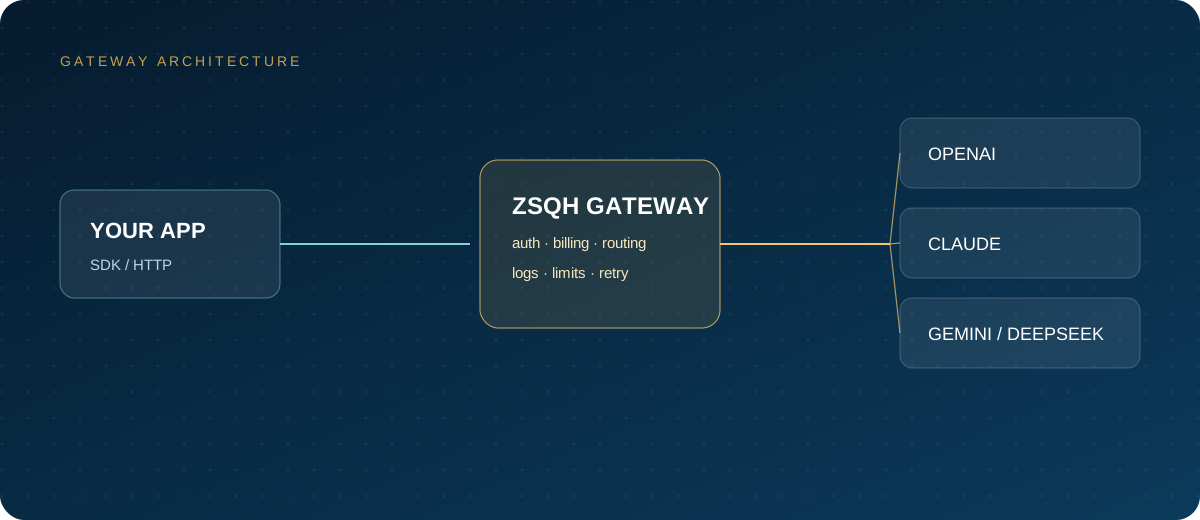
After Meta retired the public preview of its first-party Llama API, Llama calls did not disappear. They spread across cloud platforms, inference providers, and self-hosted nodes. For teams in China, connecting to each upstream directly costs both accounts and operations effort, so "relay" became a common approach: one OpenAI-compatible entry point with several Llama upstreams behind it.
But a relay only changes the access layer; it does not change model capability. It brings convenience and also new verification work: is the model the genuine article, is billing transparent, are keys and data safe, and how do you fail over from a single point of failure? This article takes those four questions in turn and closes with a migration checklist.
Note: Meta, Llama, and Llama 4 are trademarks of Meta Platforms, Inc.; the names Groq, Together AI, Fireworks, OpenRouter, AWS, Azure, and Google Cloud are trademarks of their respective owners. This article is a technical discussion and implies no affiliation or partnership with those companies. Models and prices follow each platform's documentation and our pricing page; prices change.
1. Why Llama relay grew in 2026
Meta's Llama API public preview was retired on July 6, 2026. Llama weights remain downloadable and are still hosted by platforms including AWS Bedrock, Azure AI Foundry, Google Cloud Vertex AI, Groq, Together AI, Fireworks, and DeepInfra, but each has different model IDs, interfaces, rate limits, and bills.
A relay consolidates those differences: the team holds one key, remembers one base URL, and reconciles one bill. For small teams that is genuinely easier. The cost is an extra dependency and one more object that needs auditing.
2. Relay, proxy, gateway: three terms are not the same
Relay/aggregator: the provider holds multiple upstream accounts and forwards requests to different platforms by rule, with unified billing and logging. It often also maps model names, for example mapping llama-4-scout to a specific upstream's full model ID.
Proxy: closer to a reverse proxy or forwarder. It solves network reachability and a unified egress, may map to only one upstream, and may have no billing or multi-provider capability.
Gateway: a broader scope. Besides forwarding, it includes authentication, quotas, member management, auditing, routing, and billing. In real products the three often overlap, so when selecting one, do not judge by the name; ask what it actually does.
Every extra forwarding layer adds latency, a failure point, and a data exposure surface, and must be included in architecture and contract management.
3. How to combine multiple providers
The principle is to assign by task: low-latency chat on Groq; enterprise contracts, regional compliance, or private networking on Bedrock, Vertex AI, or Azure; batch and offline work on pay-as-you-go platforms such as Together AI, Fireworks, and DeepInfra; and self-hosting when data cannot leave the data center.
One entry point can hold several routes, but each route needs its own model mapping and evaluation baseline. Do not route automatically by price alone: quantization level, context, and content filtering can differ by upstream, and the cheaper route may not meet quality requirements.
4. Model identity verification: the same name is not the same thing
"Llama 4 Scout" may mean different things on different platforms: different weight versions, quantization methods (FP8, INT4, AWQ, GPTQ), context windows, chat templates, maximum output, and sometimes the platform's own safety filters stacked on top. The name can be identical while behavior differs substantially.
Verification can start from six places:
- Read the model card: weight version, quantization, context length, knowledge cutoff, and whether it was fine-tuned.
- Check the model ID and version fields returned by the
/modelsendpoint; confirm it is not a vague alias. - Use a fixed prompt as a behavioral fingerprint: token counts, output structure, long-context recall.
- Test tool calling, JSON output, streaming format, and multimodal capability; these expose differences most easily.
- Record response headers, request IDs, and upstream identifiers so problems can be traced to a specific node.
- Run A/B tests with your business evaluation set instead of asking the model "who are you"; self-description is not proof of identity.
For version-sensitive workloads, pin the model ID and upstream and do not accept "automatic upgrades."
5. Billing transparency: break the bill into parts
A relay bill usually has several layers: upstream token fees, the provider's markup or multiplier, minimum spend, top-up discounts, failed requests, and retries. Looking only at "price per million tokens" easily misses items.
At minimum, confirm: whether input, output, and cache hits are billed separately; who counts tokens and with which tokenizer; whether stream interruptions and timeouts are billed; whether retries are billed twice; which exchange rate applies across currencies; and whether invoices can be issued to a company entity. The safer practice is to require per-request usage logs containing request ID, model, tokens, latency, and upstream name, and to sample-reconcile them daily.
Billing and models for the ZSQH AI Gateway follow our pricing page. Whichever provider you choose, start with a small top-up, run it for a week, and verify multipliers and failed-request rules against the real bill. The sign-up page is here.
6. Keys, data, and single-point risk
A relay can see plaintext prompts and outputs. That is inherent to the model and cannot be removed by a promise. When selecting one, ask: how long are logs retained, who can access them, are they used for training, what is the deletion mechanism, and is there a data processing agreement? For personal information or customer data, redact fields where possible or keep sensitive requests on self-hosted nodes.
For key management, issue a separate sub-key per project, set quotas and model allowlists, bind the source, rotate regularly, and revoke immediately when a project ends. Never put the main key in a frontend or mobile app. The relay itself is also a single point: if it goes down, it does not matter how many upstreams sit behind it. Critical workloads need a direct or self-hosted backup path.
7. Failover: turn "switch providers" into a process
Failover cannot depend on last-minute code changes. Maintain a routing table ordered by priority, with an independent key, model ID, and timeout budget for each upstream. Trip a circuit breaker when a health check fails and move to the next upstream. Add exponential backoff and jitter to retries. When everything fails, degrade to a smaller model or return an explainable error.
Below is a minimal example that demonstrates sequential failover only. Production needs circuit breakers, logging, and quota controls as well. Model IDs and addresses follow each platform's documentation.
import os
from openai import OpenAI

ROUTES = [
    ("groq", "https://api.groq.com/openai/v1",
     "llama-4-scout-17b-16e-instruct", "GROQ_API_KEY"),
    ("together", "https://api.together.xyz/v1",
     "meta-llama/Llama-4-Scout-17B-16E-Instruct", "TOGETHER_API_KEY"),
    ("gateway", "https://your-gateway.example.com/v1",
     "llama-4-scout", "GATEWAY_API_KEY"),
]

def chat(messages):
    last_error = None
    for name, base_url, model, key_env in ROUTES:
        try:
            client = OpenAI(
                base_url=base_url,
                api_key=os.environ[key_env],
                timeout=30,
            )
            return client.chat.completions.create(
                model=model,
                messages=messages,
            )
        except Exception as exc:
            last_error = exc
    raise last_error
A backup model may differ in context, tokenizer, and tool-calling ability. After failover, cap input length and record a degradation flag so you avoid "the request succeeded but the result is unusable."
8. Migrating from the old Llama API: a nine-step checklist
- Inventory base URLs, keys, model IDs, SDK versions, and call patterns in the codebase.
- Move model IDs into configuration and build a mapping table from old IDs to new upstream IDs.
- Choose a primary and a backup upstream; confirm region, payment, invoicing, and data terms.
- Change authentication and base URLs; prefer OpenAI-compatible endpoints to minimize SDK changes.
- Retest streaming, tool calling, JSON mode, and vision input.
- Adjust context, maximum output, and timeouts to the new upstream's limits.
- Compare quality, p95 latency, and cost per request with your business set.
- Reconcile for a week; confirm token counting, failed-request, and retry rules.
- Roll out in stages, from a small share to all traffic, keeping one-click rollback and configuration snapshots.
9. One table: relay provider verification checklist
| Check | Questions to ask | Suggested practice |
|---|---|---|
| Model identity | Weight version, quantization, context | Request the model card; run a fixed evaluation set |
| Upstream composition | Which providers receive traffic; can you choose | Require visibility into upstream and request ID |
| Billing | Input/output, cache, failed requests | Require per-request logs and sample reconciliation |
| Quotas | Can members and projects have separate limits | Sub-keys plus budget alerts |
| Data | Log retention, training use | Sign a data processing agreement; redact fields |
| Stability | Rate limits, SLA, outage notification | Load-test and keep a backup channel |
| Failover | Automatic multi-upstream switching | Build your own routing table and rehearse regularly |
| Contract | Invoices, refunds, notice before shutdown | Put them into procurement and exit terms |
10. Frequently asked questions
What is the difference between a Llama API relay and connecting to an upstream directly?
Direct connection means holding your own upstream account, key, and bill. You have more control but higher maintenance cost. A relay consolidates several upstreams behind one interface, which is faster to start and gives you one bill, but adds a service dependency and requires verifying model identity, billing, and data terms.
How can I tell whether a relay serves the genuine Llama?
Check the model card and version fields, inspect the /models response, and test fixed-prompt behavior, tokenizer counts, long context, and tool calling, then compare on your business evaluation set. The model's self-description and marketing name are not sufficient evidence on their own.
Why doesn't the relay bill match the upstream bill?
Common causes include tokenizer differences, cache accounting, charges for failures and retries, multipliers or minimum spend, and currency conversion. Per-request logs and sample reconciliation by request ID are more effective than comparing monthly totals.
What should I do if the relay service goes down?
Keep a direct or self-hosted backup path for critical workloads, switch by priority, and configure circuit breaking and degradation. Also confirm outage notification, SLA, and exit terms in the contract. Do not put all traffic through a single relay.
How much code has to change during migration?
If both interfaces are OpenAI-compatible, usually only the base URL, key, and model ID change. Proprietary cloud protocols, vision, tool calling, and streaming details require more work. Move model IDs into configuration first, then validate with a canary rollout.
Summary
The value of a Llama relay is in the access layer: one entry point, one bill, and multi-upstream failover. It does not change model capability and does not automatically solve compliance and data problems. Write model identity, billing, key and data risk, and failover into your acceptance criteria, and migration becomes far more controllable.
Related reading: API Relay Selection Guide, How to Build an LLM API Proxy, and OpenAI API Access from China. When you need a unified entry point, start on the sign-up page; prices follow the pricing page.