Search for "Midjourney API key" and you will find plenty of purchase pages and tutorials. But as of October 2026, Midjourney has not released a general public API for developers. The official documentation and community guidelines state that no API is offered, no third-party applications or scripts are supported, and automated access is prohibited by the terms of service. As a result, nearly every "Midjourney API key" on the market comes from a third-party wrapper service, not from Midjourney itself.
That fact is not a reason to walk away; it is the premise for choosing an approach. This article explains the official workflow, the shape of third-party interfaces, a due-diligence checklist, and key security, so you can decide whether to use one and how to do it more reliably.
Trademark note: Midjourney is a trademark of Midjourney, Inc., and Discord is a trademark of Discord Inc. This article is for technical explanation only and implies no partnership, agency, or endorsement. Terms of service, interface shapes, and billing are governed by the official pages.
1. First, Understand: There Is No General Public API
Midjourney's main entry points are the Discord bot and, later, the web editor. Users type /imagine in Discord or submit a prompt on the web page, and the bot returns images. The whole process is designed for people: there is no developer console, no API key issuance page, and no public REST endpoint documentation.
The official community guidelines explicitly state that no API and no third-party applications or scripts are provided, and the terms of service prohibit automated tools from accessing the service. That means two things:
- You cannot "apply" for an API key from the Midjourney website.
- Any page claiming a direct connection to an official Midjourney API should be treated with skepticism first.
If you only generate images occasionally, an official subscription plus Discord or the web version is the most reliable path. It needs no key and has no wrapper layer, but it cannot be embedded in automated workflows.
2. Official Workflow vs. Third-Party Interfaces
| Dimension | Official Discord/web workflow | Third-party API wrapper |
|---|---|---|
| Entry point | Discord bot, web editor | HTTP interface provided by the vendor |
| Credential | Subscription account, no API key | Key issued by the vendor |
| Automation | Prohibited by official terms | Vendor carries the account and automation layers |
| Stability | Depends on the official product | Depends on the wrapper, account pool, and upstream changes |
| Billing | Subscription | Per image, per task, or packages, with wide variation |
| Compliance risk | Use under official terms | May violate upstream terms; assess it yourself |
The core difference is not "which is faster" but where responsibility ends. A third-party interface wraps Discord accounts, proxies, queues, and retries, and gives you an ordinary HTTP service. The price is terms-of-service risk, interruptions when accounts are banned, and uncertainty about the vendor's own survival. In 2026, some Midjourney wrapper providers have already exited this category, so treat it as genuine supplier risk before integrating.
3. Common Sources of Third-Party Keys
There are three common forms on the market:
- Hosted wrappers: the vendor holds paid accounts and packages Discord or web operations as an API, charging per image or per month.
- Account pools/proxies: multiple accounts rotate and tasks are submitted through a queue, suitable for large volumes but dependent on operations quality.
- Self-hosted proxies: you run an open-source proxy project with your own account and server, manage the key yourself, and retain the automation risk.
Some vendors claim to have Midjourney's permission. Such claims must be verified directly with Midjourney, not accepted from badges or customer logos on a vendor page. Public documentation lists no recognized API suppliers, so the default assumption should be "unofficial wrapper."
4. Due-Diligence Checklist Before Choosing a Vendor
- Open Midjourney's official terms of service and community guidelines, confirm the current position on automated access, and save the date and screenshots.
- Ask the vendor to explain the account source: its own accounts, an account pool, or bring-your-own-account.
- Confirm the billing unit: per successful image, per submitted task, or per subscription period; and whether failures and moderation rejections are billed.
- Ask how long task records and image links are retained, and whether you can request deletion.
- Run a one-week test with a minimal balance, recording success rate, average latency, failure rate, and peak-hour queueing.
- Check the contract, invoices, cross-border data, and privacy terms, and confirm how refunds work if accounts are banned or service stops.
- Prepare an exit plan: keep at least one channel for human-operated generation or a fallback model.
Do not prepay for a long period at once. The upstream behind a wrapper can change at any time, so short cycles, small amounts, and portability matter more than unit price.
5. Key Security: Where to Put It After You Get It
A third-party key usually equals account balance and call permissions, and a leak can lead to abuse. The minimum requirements are:
- Store it only in server-side environment variables or a secrets manager, never in frontend code, app packages, or public repositories.
- Split keys by environment: one each for development, testing, and production, so one can be disabled independently if something goes wrong.
- Mask keys in logs, keeping only the first and last four characters; do not print entire request headers and response bodies.
- If the vendor supports IP allowlists, spending caps, or sub-accounts, turn all of them on.
- Review usage curves regularly; on an abnormal spike, disable the key first and investigate second.
# Keep .env server-side only and add it to .gitignore
MJ_API_KEY="sk-xxxx"
MJ_BASE_URL="https://provider.example.com"

curl -sS -X POST "$MJ_BASE_URL/v1/midjourney/imagine" \
  -H "Authorization: Bearer $MJ_API_KEY" \
  -H "Content-Type: application/json" \
  -d '{"prompt":"a quiet harbor at dawn, cinematic light","aspect_ratio":"16:9"}'
The path and fields above are examples only. Vendors differ widely, so use their documentation as the source of truth before integrating.
6. Troubleshooting 401 and Rotating Keys
A 401 does not necessarily mean you copied the key wrong. Work through this order:
- Header format: is it
Authorization: Bearer, or a custom header defined by the vendor? - Base URL match: the key and endpoint must belong to the same vendor and the same environment.
- Key status: disabled, expired, out of quota, or bound to an IP address that changed.
- Account-level issues: an upstream account ban or risk-control trigger can also surface as 401 or 403.
- Character issues: spaces or line breaks from copying, or a test key configured in production.
Rotate on events rather than on a fixed schedule: staff departures, a key appearing in logs or repositories, abnormal usage, a vendor disclosure, and every major version switch. When rotating, create the new key first, shift traffic gradually, watch the success rate, and only then disable the old key to avoid a hard cutover outage.
7. Cost, Copyright, and Compliance
Third-party wrappers usually bill per image, and whether failed tasks are charged varies by vendor; add retries, upscales, and variations, and the real cost will be higher than the headline rate. Calculate a "cost per usable image" on a small batch before scaling up.
On copyright, Midjourney's commercial-use rules for generated content follow its terms, and different subscription plans are not identical. A third-party interface does not grant you additional rights, and the vendor cannot replace your own copyright, likeness, and trademark review. When brand assets, real people's likenesses, or sensitive industries are involved, keep prompts, generation records, and human review records.
In addition, if your business needs a stable production-grade image interface, prioritize image models with public API documentation, clear SLAs, and compliance statements. Midjourney wrapper interfaces are better suited as a style supplement or an extension of a human workflow than as your only foundation.
FAQ
Does Midjourney have an official API key?
No. As of October 2026, Midjourney offers no general public API for developers and no official key issuance entry point. Its website mainly provides the Discord bot and the web version.
Are keys sold by third parties official?
Usually not. They are issued by wrapper vendors themselves and backed by the vendor's accounts and automation system. Whether a vendor has permission must be verified directly with Midjourney, not judged from a promotional page.
Does a 401 always mean the key is wrong?
Not necessarily. Header format, a mismatched base URL, IP restrictions, exhausted quota, and upstream bans can all return 401 or 403. Read the response body and request ID first, then rule items out one by one.
How often should a key be rotated?
There is no universal interval. Rotate on events: staff changes, signs of a leak, abnormal usage, or vendor notices. Create the new key and shift traffic gradually before disabling the old one.
Can using a third-party interface get my account banned?
The risk exists. Automated access conflicts with Midjourney's terms, and bans usually occur on the vendor's side, but they surface as failed tasks or interrupted service for you. Assess a contingency plan before integrating.
Next Steps
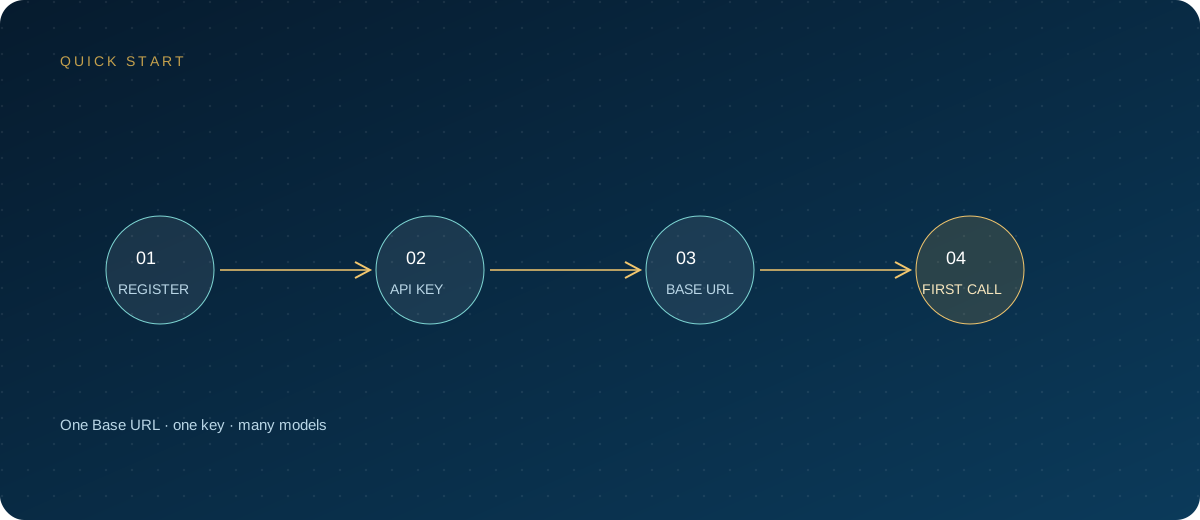
First confirm whether your scenario really needs automation. If you only generate a small number of images, the official workflow is simpler. If you must integrate with a system, choose a small-balance vendor you can exit on short notice using the due-diligence checklist, and keep the key server-side. If you need to manage text, image, and other model entry points in one place, you can register with the ZSQH AI Gateway and check the model pricing page for currently supported models and billing methods; prices change with upstream adjustments.
Related reading: