Replacing the Mistral API is rarely a matter of swapping one model for another. It is usually a matter of splitting workloads into a combination. Mistral's product line includes both open-weight and hosted models, spanning text, code, OCR, audio, and embeddings. Licensing, regional availability, and access methods differ from model to model, so each choice needs individual verification rather than a decision based on the family name alone.
For most teams, three questions matter: which tasks must move, whether the total cost after migration is lower, and how to prove that quality did not regress. This article compares Llama, DeepSeek, and GPT by use case and provides an actionable migration checklist. Model availability and pricing are listed on the model pricing page.
Note: Mistral, Llama, DeepSeek, GPT, and other names are trademarks of their respective owners. This article discusses technical selection only. Model capabilities, licenses, prices, and terms change; verify them on the official pages before purchasing.
1. First decide: does the model or the access path need replacing?
Not every problem justifies switching models. Classify the cause with a week of data:
- Quality gap: the same tasks fail repeatedly, and prompt changes plus additional retrieval do not help.
- Access constraints: unstable connectivity, keys that are hard to manage, or a need for consolidated billing and logs.
- Cost structure mismatch: heavy retries, long outputs, and low cache hits push total cost out of control.
- Supply risk: a single vendor's model retirement, regional restrictions, or term changes threaten business continuity.
- Compliance requirements: data cannot leave a jurisdiction, or must run in a specified region or cloud account.
If the problem is networking, keys, or rate limits, switching models often just carries the same engineering problem to a new platform. Fix the access layer, retry policy, and monitoring first, then assess whether a replacement is really needed.
2. What each of the four alternatives solves
Llama: control over deployment and data boundaries. The Llama family offers open weights and a mature inference ecosystem. You can self-host or choose a managed service. The trade-off is that GPU capacity, inference optimization, model upgrades, and operations are yours to carry, and license terms need line-by-line review, especially for commercial use and redistribution.
DeepSeek: Chinese-language content, code, and cost-sensitive tasks. DeepSeek offers an OpenAI-style interface, which keeps integration and troubleshooting familiar for many teams, and it is often the first alternative considered for Chinese comprehension, code generation, and batch jobs. Confirm data paths, peak-hour rate limits, and a continuity plan in advance. Do not assume that any platform will sustain the same throughput at peak.
GPT: tool calling, multimodality, and a mature ecosystem. The GPT family's advantage is a complete SDK, function calling, structured outputs, and surrounding tooling, which suits complex agent workflows and products that need multimodal input. Evaluate regional availability, compliance paths, and the actual bill separately before adopting; model capability alone is not enough.
Stay with Mistral, but self-host or use a cloud platform. Replacing "the Mistral API" does not mean leaving Mistral. If the team needs open weights, European language coverage, or a specific deployment region, Mistral's open-weight models can run in your own environment or on a cloud platform. This path also requires checking licenses, model versions, and the hosting provider's terms of service.
3. Choose by scenario: one table
| Scenario | First choice | Why | Confirm first |
|---|---|---|---|
| Data must stay in your own environment | Mistral open weights or Llama | Self-hosting keeps data boundaries under control | GPU capacity, license, operating cost |
| Chinese content and domestic team collaboration | DeepSeek | Familiar language data and interface conventions | Data path, peak rate limits, version changes |
| European multilingual support and documents | Mistral | Broad European language coverage and a complete product line | Test the target languages, regional compliance |
| Code completion and engineering tasks | Codestral, GPT, or DeepSeek | Coding ability and tool calling differ by model | Repository context, license, latency |
| Complex tool calling and multimodality | GPT | Mature SDK, function calling, and ecosystem | Regional availability, billing structure |
| Batch offline jobs, cost-sensitive | DeepSeek or self-hosted open weights | Jobs can queue, degrade, and control concurrency | Total cost of ownership, rate limits, retries |
The table only narrows the field; it does not replace evaluation. Within the same scenario, prompts, retrieval quality, output length, and concurrency patterns all change the conclusion. Compare small samples of real business requests rather than relying on public leaderboards.
4. Access methods: direct, cloud-hosted, and unified gateway
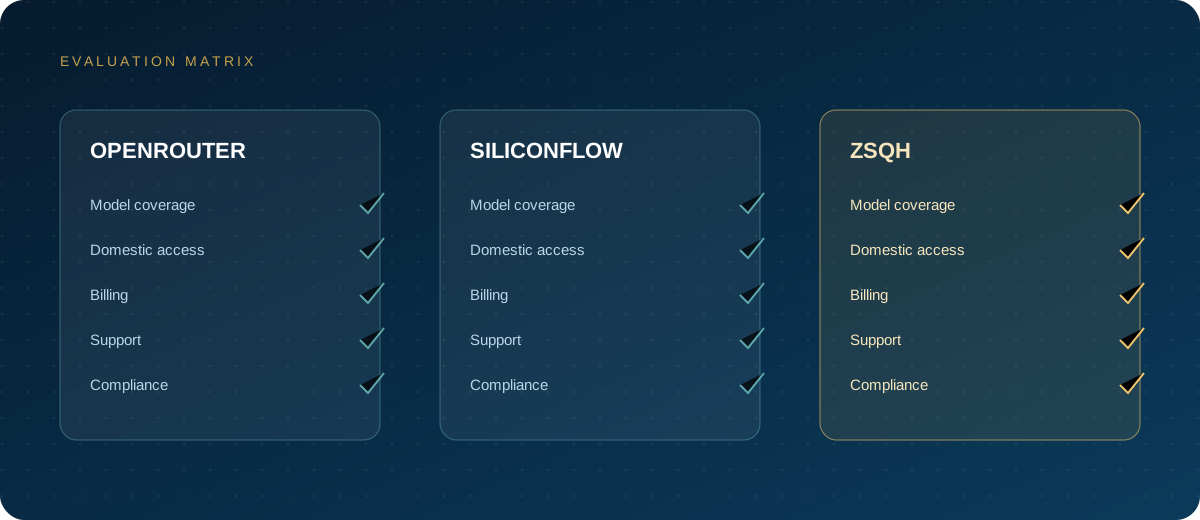
Connecting directly to a vendor API is the simplest option, but every additional vendor means another set of keys, error handling, and billing. Cloud hosting suits teams that already have cloud procurement and regional compliance requirements, at the cost of letting the cloud provider decide the model list and version cadence. A unified gateway consolidates multiple models behind one OpenAI-compatible endpoint, which simplifies routing, quotas, and logging, but three things need confirmation: whether the models are genuinely available, which nodes the data passes through, and whether the billing rules are clear.
The example below uses an OpenAI-compatible endpoint and reads the model name from an environment variable, so no vendor's model name is hard-coded. Switching models then requires a configuration change, not a code change.
import os
from openai import OpenAI

client = OpenAI(
    api_key=os.environ["ZSQH_API_KEY"],
    base_url=os.environ.get("ZSQH_BASE_URL", "https://ai.zhongshangqihang.com/v1"),
)

resp = client.chat.completions.create(
    model=os.environ["MODEL_NAME"],  # use a model actually available in the console
    messages=[{"role": "user", "content": "Explain what an API gateway does in one sentence."}],
    timeout=60,
)
print(resp.choices[0].message.content)
The access layer should keep timeouts, retry caps, and error logs. Multi-model routing should not be "random switching"; set explicit rules by task type, failure reason, and cost budget, otherwise troubleshooting becomes very difficult.
5. Seven steps before migrating
- Freeze an evaluation set: sample 50 to 200 real requests covering normal, edge, and failure cases, and record expected outputs and acceptance criteria.
- Record a baseline: quality pass rate, manual rework rate, p95 latency, 429 share, and total cost per successful task, observed for at least a week.
- Align the interface: confirm differences in base URL, authentication, model names, streaming, tool calling, and structured output, and get a minimal request working first.
- Adapt the differences: handle different system prompts, maximum output length, stop words, error structures, and usage fields; do not reuse old parameters blindly.
- Run a small canary: move 5 to 10 percent of traffic first and observe by task type instead of cutting everything over at once.
- Prepare a rollback: keep the old channel and model names, provide a one-step switch back, and rehearse the rollback before the actual cutover.
- Complete billing and compliance: confirm billing rules, invoices, data retention, and log redaction, and update the vendor list and contingency plan.
After migration, re-run the same evaluation set and compare success rate, latency, rate-limit counts, and total cost. If any one metric gets materially worse, find the cause before expanding traffic.
6. Three common misconceptions
- Open weights mean free. The weights can be downloaded, but GPUs, bandwidth, operations, monitoring, and compliance all cost money; idle capacity is also a cost.
- Leaderboard scores equal production performance. Benchmark tasks differ from your business distribution; validate with your own evaluation set.
- More models always mean more reliability. Each routing layer adds another failure point; without unified logging and rollback, multiple models can make diagnosis harder.
Frequently asked questions
Can the Mistral API be called with the OpenAI SDK?
The interface style is similar but not equivalent. Fields, tool calling, error structures, and streaming details may differ. Test each item when using a compatibility layer and do not assume every parameter passes through unchanged.
Do open weights mean free commercial use?
Not necessarily. License terms differ by model, and the requirements for commercial use, redistribution, labeling, and retraining vary. Have legal review the license before launch and keep records of model versions and provenance.
Do Chinese-language tasks always require DeepSeek?
Not always. Split Chinese tasks into understanding, generation, extraction, and code, then compare them on the same sample set. Mistral handles Chinese as well, but the data distribution and wording conventions differ; the decision should rest on your business metrics.
Should multilingual projects choose Mistral or GPT?
Test in the target languages. For European languages, regional compliance, and open-weight requirements, Mistral deserves a first look; for global general capability, complex tool calling, and a mature ecosystem, GPT deserves a first look. Do not decide on brand or a single demo.
How do you judge whether migration succeeded?
Track five metrics: task pass rate, manual rework rate, p95 latency, 429 share, and total cost per successful task. Then confirm that rollback works, that logs can locate a request ID, and that the bill matches expectations.
Next step
Create a test key in the ZSQH AI Gateway, run a small comparison with real tasks, and then decide whether to migrate. The model list and billing rules are listed on the model pricing page.
Related reading: