Enterprise procurement of the Qwen API is easily reduced to two questions: what is the unit price, and how much should we top up? What really determines whether it can be used long term is who owns the account, how permissions are split, what happens when quota runs out, whether the data terms pass review, whether invoices can be booked, and whether there is a fallback when something fails.
Qwen provides its API through Alibaba Cloud Model Studio (often called DashScope at the API layer), with both a native interface and an OpenAI-compatible mode, so integration is fast. That is precisely why many teams get a prototype working on a personal account and only discover at scale that the entity, contract, permissions, and billing do not line up. This article follows the procurement sequence.
Note: Qwen, Tongyi Qianwen, Alibaba Cloud, Model Studio, and DashScope are trademarks of their respective owners. This article implies no partnership or licensing relationship with those owners. Models, prices, quotas, and terms change; the official documentation, console, and signed contract are authoritative.
1. The procurement checklist has five parts
| Module | Questions to confirm | Suggested deliverables |
|---|---|---|
| Accounts and permissions | Who is the legal entity, and how are keys split by environment? | Account register, key inventory, permission matrix |
| Quota and billing | Free quota, RPM/TPM, arrears and suspension rules | Budget sheet, alert configuration, capacity estimate |
| Data and compliance | Used for training or not, retention period, storage region | Archived terms, data processing agreement, review record |
| Deployment model | Public cloud, dedicated deployment, or self-hosted open models | Selection comparison, resource and operations estimate |
| Contract and finance | Contracting entity, payment method, invoice type | Contract, order, payment receipt, invoice |
Any part confirmed only verbally can cause rework. Start compliance, legal, and finance work in parallel with technical integration.
2. Accounts and permissions: corporate entity, dual administration, least privilege
- Complete enterprise identity verification and bind the company entity; do not run business on a personal account.
- Set up at least two administrators and enable multi-factor authentication, so the account can still be taken over after someone leaves.
- Use RAM sub-accounts instead of the primary account for daily operations, granting least privilege by role.
- Split business workspaces and keys by environment: production, staging, test, and development each get their own.
- Store keys in server-side variables or a secrets management service, never in front-end code, repositories, or chat logs.
- Label each key with an owner, purpose, and expiry date; review quarterly and disable keys when their work ends.
Console menus change, but the principle does not: one key serves one environment.
3. Quota and billing: free quota is only a ticket in
Model Studio's new-user free quota is issued per model, about 1 million tokens per model, valid for 90 days, and covers real-time inference in some regions only. Batch calls, fine-tuning, and deployment usually do not draw on it, and some models offer none. The primary account and RAM sub-accounts share the quota, and re-registering generally does not grant it again.
An enterprise pilot can use it for functional validation, but confirm three things in advance:
- Behavior after quota exhaustion: enabling "stop when exhausted" stops responses and returns 403; disabling it may switch to pay-as-you-go and incur arrears. Production environments should set budget alerts.
- How rate limits are counted: RPM and TPM are aggregated per primary account, combining sub-accounts, business workspaces, and keys; short bursts may also hit RPS and TPS limits.
- Topping up is not capacity expansion: the official documentation states that topping up only keeps the account from being suspended for arrears and does not automatically raise default rate-limit thresholds. Higher quotas usually require a commercial request.
Billing models typically include pay-as-you-go, Batch, subscription plans, and dedicated deployment; see the model pricing page for the exact scope. During procurement, calculate average and peak usage separately, because the latter determines rate limits and deployment shape.
4. Data and compliance: turn verbal promises into documents
The Model Studio privacy notice states that user data is not used for model training and that data is encrypted. However, call data is stored, and retention periods, deletion methods, and subprocessors depend on the data retention policy and agreement. A sales representative's verbal "no training, no retention" cannot replace written terms.
For internal review, confirm each item:
- Whether inputs and outputs are retained, for how long, and whether they can be deleted.
- In which region data is stored, and whether cross-border transfer is involved.
- Whether a data processing agreement can be signed, and how responsibilities are allocated.
- Whether subprocessors and the security incident notification mechanism are clearly defined.
- Whether the models used have completed applicable filings or registrations.
When personal information, contracts, financial data, and source code are involved, classify and grade them first, and de-identify wherever possible. Content safety also needs safeguards: input filtering, output review, and human review in sensitive scenarios.
5. Private and dedicated deployment: distinguish three paths first
| Path | Form | Suitable scenarios | Costs to assess |
|---|---|---|---|
| Public cloud pay-as-you-go | Multi-tenant API | Most pilots and routine business | Usage, rate limits, data terms |
| Dedicated deployment | Inference instances with dedicated resources | High concurrency, low latency, stable quota | Instance fees, operations, capacity planning |
| Self-hosted open models | Download weights and deploy yourself | Data cannot leave the intranet; deep customization | GPUs, data center, operations, model upgrades |
Model Studio offers model deployment with dedicated resources, suitable for high-concurrency, low-latency scenarios; there are also dedicated editions and appliance forms for government and enterprise, with delivery and commercial terms governed by the official offering. Open Qwen weights can be self-hosted, but licenses vary by model, so check each one before commercial use.
Private deployment transfers platform responsibility to you: vulnerability fixes, model upgrades, monitoring, and scaling all need an owner. Without an operations team, prefer dedicated deployment over fully self-hosted.
6. Cost control: change the request structure before discussing unit price
Bills for Qwen text models consist of input, output, cache, and retries. For reasoning models, the chain of thought counts as output, and long thinking raises cost. Context caching lowers the cost of repeated prefixes, but the hit rate depends on request structure. Optimize in this order:
- Compress input: retrieve only relevant passages in RAG and summarize conversation history.
- Stabilize the prefix: fix system prompts and tool definitions to improve cache hit rates.
- Limit output: set a maximum output length and require JSON or fixed fields.
- Tier models: use lightweight models for classification and extraction, and higher-tier models for complex reasoning.
- Move offline jobs to Batch or off-peak hours.
- Control retries: exponential backoff with jitter and a maximum attempt count.
export QWEN_API_KEY="your-key"
export QWEN_BASE_URL="https://ai.zhongshangqihang.com/v1"

curl "$QWEN_BASE_URL/chat/completions" \
  -H "Authorization: Bearer $QWEN_API_KEY" \
  -H "Content-Type: application/json" \
  -d '{
    "model": "<model-name>",
    "messages": [{"role": "user", "content": "Reply with OK only"}],
    "max_tokens": 16
  }'
Model names are governed by the model pricing page and the console; do not put placeholders into production. After the first successful call, record the returned usage field and reconcile it against the bill once to confirm how input, output, and cache are counted.
7. Contracts, payment, and invoices
For enterprise payment, use corporate transfer where possible and retain the contract, order, payment receipt, and invoice. Alibaba Cloud accounts support online top-ups and pay-as-you-go deductions, with invoices requested under platform rules. When choosing a gateway, confirm the service entity, currency, refund rules, and data terms.
In the contract, specify the scope of service, quota and rate limits, data terms, incident notification, treatment of remaining balance, invoice type, and deadlines. Prices change, so it is best to agree on advance notice of price adjustments.
8. Pilot acceptance checklist
- Prepare 10 to 20 real tasks with reference answers, covering edge cases and failure examples.
- Record quality pass rate, P95 latency, error rate, and cost per task.
- Test rate limits at peak load and confirm that 429 backoff and queuing strategies work.
- Rehearse degradation for quota exhaustion, primary-model failure, and network timeouts.
- Complete key separation by environment, permission minimization, and offboarding revocation.
- Archive the privacy policy, data retention policy, and review records.
- Confirm that contracts, invoices, and payment receipts have reached finance, and that budget alerts are active.
- Prepare data export, key revocation, and backup-model switching plans.
Acceptance is not getting one request to work; it is proving that the interface is controllable under real traffic, failures, and audit. For projects without a written conclusion, run a small traffic pilot first.
FAQ
Does enterprise Qwen API procurement have to go through an Alibaba Cloud contract?
Public cloud calls usually follow the platform's online agreement and enterprise verification; dedicated deployment, higher quotas, or custom terms go through a commercial contract. The entity and terms are governed by the documents actually signed.
Can free quota cover an enterprise pilot?
It suits functional and pipeline validation but is usually insufficient for quality evaluation, load testing, and multi-user concurrency. Estimate tokens for real tasks first, then decide whether to top up.
Is data used for model training?
The privacy notice states that data is not used for model training, but call data is stored, and retention and deletion rules depend on the data retention policy and agreement. Sensitive data still needs de-identification and legal review.
Does private deployment require buying an appliance?
Not necessarily. Public cloud, dedicated deployment, and self-hosted open models are all options. Whether to use an appliance depends on data boundaries, compute scale, and operations capability; the solution and quotation are governed by the commercial agreement.
Can topping up raise rate limits?
The official documentation states that topping up only keeps the account from being suspended for arrears and does not automatically raise default RPM or TPM thresholds. Higher quotas require an advance request and peak-load testing.
Next steps
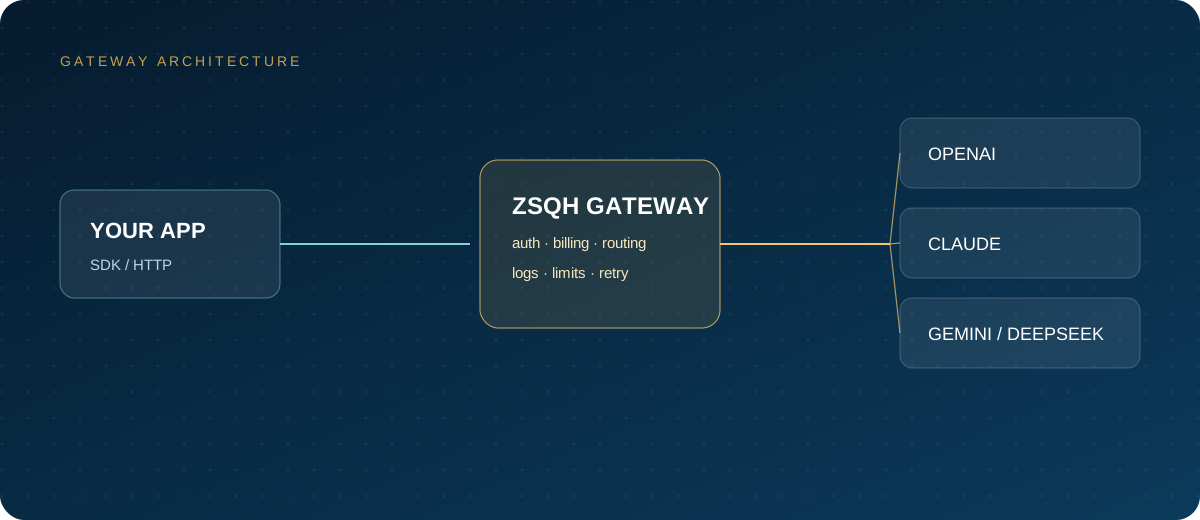
Run a two-week pilot on real tasks, recording quality, latency, failure rate, and cost per task, and then set the procurement scale. If you need a unified multi-model entry point and RMB billing, start with a small validation on the ZSQH AI Gateway; prices are governed by model pricing.