A relay or proxy for the Qwen API is not just "another endpoint." Choosing one means answering four questions: how billing works, whether the network is stable, who is responsible when something breaks, and whether keys and data meet compliance requirements.
This article compares four approaches and provides billing checks, stability tests, and a migration checklist. For prices, use the model pricing page.
Note: Qwen, Tongyi Qianwen, Alibaba Cloud, Model Studio, and DashScope are trademarks of Alibaba Group and its affiliates. This article is a technical description only and implies no affiliation or agency relationship with Alibaba Group. The relay market changes quickly; the forms described here reflect common arrangements as of October 2026 and do not endorse any provider.
1. Define the terms: relay, proxy, and gateway are not the same
- API relay: forwards requests to an upstream provider and may add billing, quotas, and logging. Some "relays" are simply shared or resold keys, so stability depends on the operator.
- Network proxy: an HTTP, SOCKS, or reverse proxy that only solves reachability; the key remains yours.
- Self-hosted proxy: you deploy a reverse proxy or open-source gateway and control keys, logs, and routing, but you also own the upstream account and operations.
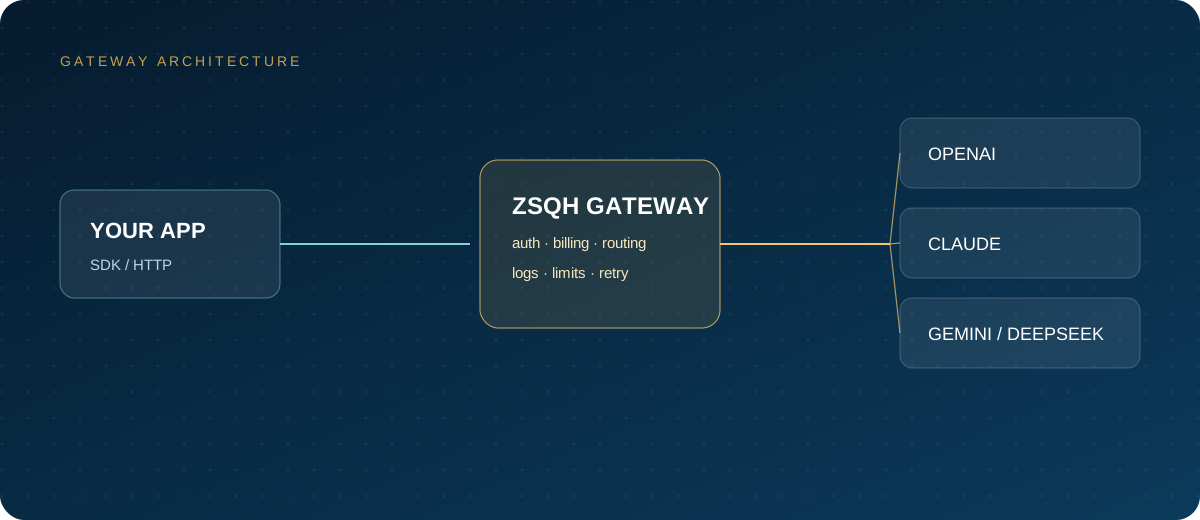
- Unified AI gateway: an OpenAI-compatible endpoint that aggregates multiple models and provides unified keys, billing, and a console.
Mixing these four concepts makes it easy to mistake a network problem for a model problem. Before signing, ask which layer the provider supplies and who owns the key.
2. The four approaches in one table
| Dimension | Direct official access | Self-hosted proxy | Commercial relay | Unified AI gateway |
|---|---|---|---|---|
| Billing transparency | Alibaba Cloud bill | Upstream bill plus your costs | Depends on operator; reconcile carefully | One consolidated bill |
| Network stability | Affected by local egress | Depends on server and route | Depends on relay routes | Depends on gateway and upstream |
| Rate limits and concurrency | Account-level RPM/TPM | Self-controlled, still capped upstream | May share a pool; confirm | Depends on gateway rules and plan |
| Model coverage | Qwen and Model Studio models | Depends on upstream | Broader; verify | Multiple models; see pricing page |
| Key risk | Key stays with you | Key stays with you | May be shared or resold | Usually issues a dedicated key |
If you use only Qwen and network and payment work well, direct access is the first choice. If you need a fixed egress and audit trail, choose self-hosting. Without operations staff, evaluate a commercial relay. If you need one bill across models, look at a gateway.
3. Billing: do not look only at the "multiplier"
Relay quotes often take the form of "official price times a multiplier" or a "token package." A low multiplier does not mean a low total cost. At minimum, clarify:
- Whether input and output are priced separately and whether the multiplier is the same.
- Whether cached input receives a discount and how it is calculated.
- Whether reasoning tokens from thinking mode count as output.
- Whether failed and retried requests are billed.
- Whether streaming responses return complete usage data.
- Whether top-ups have a minimum amount, expiry date, and refund rules.
- Whether invoices are available, and in which currency and from which legal entity.
- Whether usage can be broken down by project, key, and model.
Qwen on Model Studio bills by token, with separate input and output prices, and some models support context caching and batch discounts. A relay that gives only a "blended multiplier" is hard to reconcile; only the same set of requests run through both paths reveals the real cost.
4. Stability: verify with data, not marketing claims
Look at at least six metrics: success rate, P50/P95 latency, time to first token, timeout rate, share of 429s, and output speed. Test with real prompts covering streaming, long context, and concurrency, using direct access as the baseline.
import os
import time
from openai import OpenAI

prompt = "In 200 words, explain the main stages of cross-border e-commerce order fulfillment."
targets = {
    "direct": OpenAI(
        api_key=os.environ["DASHSCOPE_API_KEY"],
        base_url="https://dashscope.aliyuncs.com/compatible-mode/v1",
        max_retries=0,
        timeout=60,
    ),
    "relay": OpenAI(
        api_key=os.environ["RELAY_API_KEY"],
        base_url=os.environ["RELAY_BASE_URL"],
        max_retries=0,
        timeout=60,
    ),
}

for name, client in targets.items():
    start = time.perf_counter()
    try:
        resp = client.chat.completions.create(
            model=os.environ["QWEN_MODEL"],
            messages=[{"role": "user", "content": prompt}],
            max_tokens=512,
        )
        ms = (time.perf_counter() - start) * 1000
        print(name, f"{ms:.0f}ms", resp.model, resp.usage)
    except Exception as exc:
        print(name, type(exc).__name__, exc)
This is only a minimal probe, not a load test. Observe for seven consecutive days and run one round at peak hours and one at off-peak hours. For a commercial relay, watch the evening peak and long requests. For a self-hosted proxy, watch egress and upstream rate limits. For a gateway, check whether failover is transparent and whether the bill matches usage.
5. Key risk and compliance: more important than price
Key ownership is the most easily overlooked issue. Shared or resold keys and credit from unknown sources can cause four problems:
- If the upstream provider bans the account or changes its quota, service is interrupted and appeals are difficult.
- Multiple tenants sharing a key affect each other's rate limits and failures.
- Requests pass through a third party whose logging and retention policies are opaque.
- Reselling or sharing may violate terms, leaving no contractual basis in a dispute.
Model Studio keys are bound to a region, and cross-region calls return 401. If a relay does not disclose its upstream region, you cannot determine where data is stored, nor plan regional disaster recovery.
When choosing a provider, confirm at least the legal entity, terms of service, privacy policy, invoicing, and an incident contact. Do not send requests containing personal information, secrets, or contract text unless the provider can explain where the data goes. For heavily regulated workloads, prioritize direct official access, private deployment, or a provider willing to sign a data processing agreement.
6. Rate limits and failover: a relay is not high availability
Model Studio enforces rate limits at the Alibaba Cloud primary account level. All keys under the account share the quota, and different models have separate RPM and TPM allowances. If a relay serves many customers from one upstream account, it is more likely to hit 429s at peak times, and you cannot see how full the pool is.
Ask four questions before connecting: Does each customer use a dedicated upstream account or key? Are limits per customer or shared across the whole pool? On a 429, does the relay queue, return an error, or switch models? After a model switch, are customers notified, and which model is billed?
Failover needs defined triggers, such as consecutive timeouts, a rising share of 5xx responses, or time-to-first-byte exceeding a threshold. Evaluate backup models in advance, and implement circuit breaking plus half-open probes. A relay may also switch models silently, degrading quality while still billing at the original rate. Require a model allowlist, switch logs, and usage details.
7. Migration checklist: from direct access to a relay or gateway
- Record the current baseline: success rate, P50/P95 latency, token usage, and bills.
- Inventory model IDs and parameters: streaming, tools, JSON output, and thinking.
- Create separate test and production keys, each with its own budget and alerts.
- Change only
base_urlandapi_key, then run a minimal request in staging. - Replay real prompts and compare output quality, latency, and usage.
- Check the mapping for 401, 402, 429, 5xx, and timeouts, and confirm retries do not amplify failures.
- Canary 5% to 10% of traffic for three to seven days, keeping direct access as a fallback.
- After full cutover, reconcile bills for a week and confirm they match usage.
Do not change the model, prompt, and gateway at the same time during migration; otherwise you cannot attribute the result. Change one variable at a time.
8. How to verify that a relay is reliable
The model field can be rewritten, so use a combination of checks:
- Latency: send the same prompt repeatedly and compare P50/P95. Persistent slowness versus direct access is a warning sign.
- Error rate: measure the share of 429s, 5xx responses, and timeouts. Failures concentrated at peak hours indicate insufficient capacity.
- Usage: compare response usage with the backend bill. A mismatch or missing streaming usage is abnormal.
- Model identity: use a fixed test set to compare capability boundaries and output style.
- Key isolation: confirm dedicated keys, rotation support, and a clear region.
- Contract and support: check the legal entity, terms, invoices, and exit process.
Red flags include prices far below official rates, promises of "zero failures," refusal to provide usage details, requests that you hand over your official key, and no disclosure of where data is retained. In these cases, run a small pilot first rather than migrating everything at once.
9. When a self-hosted proxy is the better fit
A self-hosted proxy suits teams with engineering capacity: they need a fixed egress IP, unified auditing, routing across multiple upstreams, or keys kept in-house. A common setup is a reverse proxy plus key management, rate limiting, logging, and alerting, while still using official upstream accounts.
Count the costs as well: servers, bandwidth, certificates, upgrades, and on-call time. Without operations staff, self-hosting is often more expensive and cannot bypass upstream rate limits or terms.
10. Recommendations
Start with network and payment: if the endpoint is reachable and top-ups work, prefer direct access. Then consider control and model coverage: for a fixed egress, auditing, and private keys, evaluate a self-hosted proxy; for one entry point to multiple models, consider a unified gateway. Finally, assess service quality: whether the entity, terms, invoices, and data policy are clear.
If you need a unified entry point for multiple models, create a test key on the ZSQH AI Gateway and validate before migrating; see model pricing for prices and available models. Include migration and failure costs in the comparison.
FAQ
What is the difference between a Qwen API relay and direct Model Studio access?
Direct access calls Alibaba Cloud Model Studio, with keys, billing, and rate limits under your own account. A relay adds a service layer, so key ownership, the rate-limit pool, and the data path depend on the operator.
A relay quotes a "multiplier." How do I reconcile it?
Ask for usage details broken down by model and by input versus output, then run the same requests through direct access and the relay and compare token counts and fees. Also confirm the treatment of caching, batch calls, and streaming usage.
Can a self-hosted proxy bypass Model Studio rate limits?
No. A proxy only changes the request path; the upstream still enforces RPM/TPM limits per Alibaba Cloud account. Self-hosting solves egress, auditing, and key management, not quota.
Does a relay switching models affect output quality?
Yes. Different models have different capability boundaries and output styles, and silent switching makes results incomparable. Confirm the model allowlist and switching conditions, and periodically spot-check with a fixed test set.
How can I reduce interruption risk during migration?
Keep direct official access as a fallback, canary 5% to 10% of traffic for three to seven days, make the base URL, key, and model name configurable, add circuit breaking and backoff for 429s and 5xx responses, and rehearse switching back.