There are two common ways to use Claude Code: buy an official subscription, or use your own API key and pay per token. Many people ask which is cheaper, but there is no universal answer. It depends on your usage, context length, model tier, and team size.
This article gives you a method you can calculate yourself, without hard-coding prices that will expire.
Note: This article reflects common usage as of October 2026. Subscription prices, quotas, and model unit prices change. Refer to the official pages and Model Pricing for current figures.
1. Understand the two billing models
1. Subscription
You pay monthly or annually and receive a certain quota and feature set. The advantage is a fixed bill and no token math; the disadvantage is that once the quota runs out you may be rate-limited or need to upgrade.
Suitable for:
- Individual daily use.
- People who do not want to calculate tokens.
- Stable, predictable usage.
2. API pay-as-you-go
You are billed for input tokens, output tokens, caching, and similar usage. The advantage is that you pay for what you use and can switch models; the disadvantage is that heavy usage can cost more than a subscription.
Suitable for:
- Teams and multiple projects.
- Usage that fluctuates widely.
- Work that requires specific models or your own gateway.
- Cost allocation by project or member.
2. The cost formula
You can estimate pay-as-you-go costs with this formula:
Cost per request =
  input tokens × input unit price
+ output tokens × output unit price
+ cache write/read cost (if any)

Monthly cost =
  cost per request × average daily requests × 30
+ retries and failed requests
+ extra long-context cost
Keep in mind:
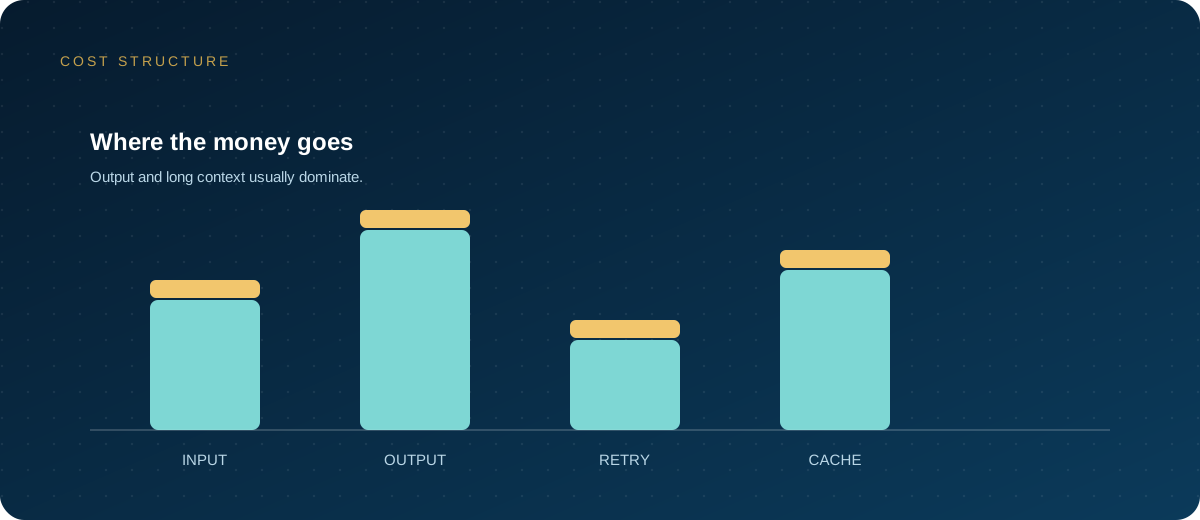
- Output tokens usually cost more than input tokens.
- Long context makes input tokens rise quickly.
- Claude Code reads files, runs tools, and holds multi-turn conversations, so actual token use is often higher than a single question-and-answer exchange.
- Caching saves money, but not every request hits the cache.
3. Estimating three usage tiers
The examples below use hypothetical unit prices to demonstrate the method. They are not actual prices. Plug in the current unit prices yourself.
Light user
- 30 requests per day.
- Average input of 8,000 tokens and output of 1,500 tokens.
- Mainly fixing small bugs and explaining code.
Estimate:
Daily cost = 30 × (8000 × input unit price + 1500 × output unit price)
Moderate user
- 100 requests per day.
- Average input of 20,000 tokens and output of 3,000 tokens.
- Multi-file edits, code review, and writing tests.
Heavy user or team
- 500+ requests per day.
- Average input of 40,000 tokens and output of 5,000 tokens.
- Long context and multi-turn agent tool calls.
In heavy usage, pay-as-you-go can easily exceed a subscription. Collect a week of logs to measure real token use before deciding.
4. How to get real usage data
Do not estimate by feel. Use three sources:
- Console usage logs: token counts by model, key, and project.
- Application instrumentation: record input and output tokens for every request.
- Billing: compare actual charges with your estimate.
Collect data for seven consecutive days and use both the daily average and the peak. A single day is easy to misread.
5. Hidden costs
1. Retries
Network timeouts, 429 responses, and 5xx errors trigger retries, and retries also cost money.
2. Long context
When Claude Code reads large files or long logs, input tokens can far exceed expectations.
3. Tool calls
Multi-turn tool calls increase both the number of requests and token usage.
4. Model tier
Opus costs more than Sonnet, and Haiku is cheaper. Using the wrong tier magnifies costs.
5. Unused quota
Unused subscription quota is wasted; pay-as-you-go does not have this problem.
6. How teams should choose
| Scenario | Recommendation |
|---|---|
| 1–2 people doing daily coding | Try a subscription first; simple and worry-free |
| 5+ people across multiple projects | API plus a gateway, with limits per member/project |
| Highly variable usage | Pay-as-you-go API to avoid wasted subscription quota |
| Multiple models required | API plus a gateway, switch at any time |
| High demand for billing transparency | API plus usage logs |
When a team uses the API, issue one key per person, create keys per project, set spending limits, and review usage weekly.
7. How to reduce Claude Code costs
- Use Sonnet or Haiku for simple tasks and reserve Opus for complex work.
- Do not dump the entire repository into context at once; let Claude Code read the relevant files first.
- Use
.claudeignoreor project rules to exclude irrelevant files. - Summarize long logs before passing them to the model.
- Set spending limits on keys to prevent runaway loops.
- Monitor retries and 429 responses to reduce wasted usage.
- Allocate costs by project so you can identify high-consumption scenarios.
8. FAQ
Can I use a subscription and the API at the same time?
Yes. Many people use a subscription for daily work and the API for automation and team projects.
Is pay-as-you-go always more expensive than a subscription?
No. Light users may pay less with the API, while heavy users may get better value from a subscription. Calculate with real token data.
Is a gateway more expensive than going direct?
It depends on the gateway's pricing and your usage. A gateway also provides a unified bill, quota management, multi-model switching, and access from mainland China. Include operations costs in the comparison.
Why is my bill higher than the estimate?
Common causes are long context, output tokens, retries, tool calls, and multi-turn conversations. Check the usage logs line by line.
Next steps
Start by collecting a week of logs to measure real usage, then apply the formula above. If you need pay-as-you-go billing and unified management, sign up for ZSQH AI Gateway, create a test key, and review the bill after a week. Unit prices are listed under Model Pricing.
Further reading: