Cline is an open-source coding agent. The tool itself does not charge a monthly per-seat fee; the real bill comes from model calls. So "Cline pricing" is usually not one question but three: whose key you use, whether you pay per use or by subscription, and how many tokens a coding task actually consumes.
This article avoids unit prices that go stale and instead provides a method for estimation and cost control. You can recalculate with your own real logs and then compare against model pricing before deciding.
Note: Cline is a trademark of Cline Bot Inc.; Cursor, Claude, Anthropic, and other names belong to their respective owners. This article is for technical discussion only and implies no affiliation with the vendors mentioned. Prices and plans are governed by their official pages.
1. Separate the three kinds of cost
The first is the tool fee. Cline's open-source version can be installed for free; the paid element is not the editor plugin itself.
The second is the model fee. Cline supports bring-your-own-key (BYOK) and also offers account usage billing and an optional fixed subscription. With BYOK, the money goes to the model provider or gateway; a subscription limits usage within a rolling time window, with quota and price governed by Cline's official page.
The third is hidden cost: the management overhead of keys scattered across team members, failed retries, overly long context, and the time spent repeatedly tuning settings to save money.
| Payment model | Who is paid | Best for | Notes |
|---|---|---|---|
| Bring your own key (BYOK) | Model provider or gateway | People who can manage keys and need multiple models | Transparent usage, but you handle limits and auditing |
| Account usage billing | Cline | Individuals who do not want to apply for keys themselves | Depends on the platform's available models and billing rules |
| Fixed subscription | Cline or a model platform | Stable usage and predictable bills | Rolling-window limits; overage needs another route |
| Unified gateway | Gateway provider | Teams with multiple people and projects | One key for multiple models, easier limits and reconciliation |
2. Why coding agents amplify token usage
Ordinary chat is one question and one answer; a coding agent runs a loop of reading files, editing code, running commands, inspecting results, and continuing. Each round resends the system prompt, rules files, conversation history, and tool results to the model, so input tokens accumulate with every turn.
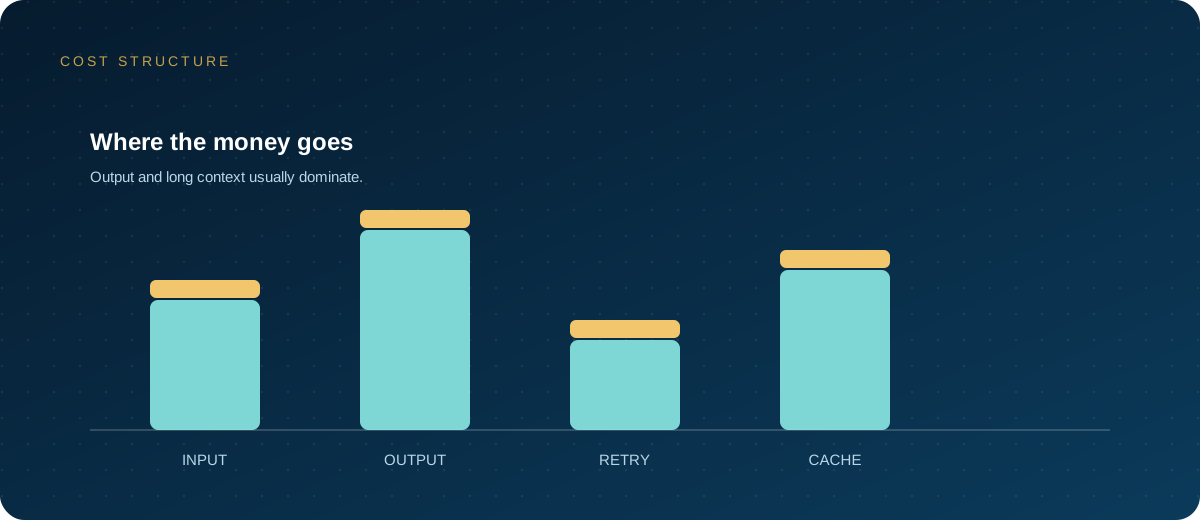
Here is an example without prices: a task averages 40,000 tokens of context and runs for 15 turns, so cumulative input is roughly 600,000 tokens, while the final code output may be only a few thousand tokens. The bulk of the bill is usually input, not the answer you see.
Three amplifiers deserve attention:
- Tool results: entire file contents, test logs, and directory listings all enter the context.
- Auto-approve: once enabled, the agent can execute continuously; it is fast, and it consumes quickly too.
- Long sessions: the closer the context gets to the window limit, the more expensive each repeated round becomes.
3. The pay-as-you-go cost formula
Plugging numbers from real logs into a formula is more reliable than guessing. The function below does arithmetic only; read the unit prices from the official pricing page of the model you use or from model pricing, normalized to currency per million tokens:
def task_cost(input_tokens, cached_tokens, output_tokens, price):
    """price: {"input": ..., "cached_input": ..., "output": ...}"""
    fresh = input_tokens - cached_tokens
    return (
        fresh * price["input"]
        + cached_tokens * price["cached_input"]
        + output_tokens * price["output"]
    ) / 1_000_000

# Monthly cost = per-task cost x daily tasks x working days
Record at least four values when estimating: input per round, cache hits, output, and retry count. Counting only successful requests will underestimate the bill.
4. How much caching saves depends on prefix stability
Most providers offer a cached price for repeated input prefixes. Cache reads are usually noticeably cheaper than fresh input, but cache writes may cost more. Whether a hit occurs depends on what you put first.
In practice, put stable content at the front: system prompts, project rules, and common code conventions. Put changing content at the back: the current error, temporary logs, and recently modified files. Frequently editing early messages or switching models can invalidate the cache.
Cline's rules files (.clinerules/ or .cline/rules/) reduce repeated explanation, but the rules themselves also occupy context. More detailed rules are not necessarily cheaper; the key is to keep only the constraints that genuinely affect generation.
5. What usage suits subscriptions versus pay-as-you-go
The advantage of a subscription is predictability. It suits people who have stable tasks every day and are likely to use the quota fully. The advantage of pay-as-you-go is paying only for actual consumption. It suits teams whose usage fluctuates widely, whose tasks are heavy, and who need to switch between providers.
The test is simple: record real tokens for one to two weeks, calculate the pay-as-you-go cost, and compare it with the subscription quota. Do not estimate from "roughly how many questions per day"; a single coding-agent task may contain dozens of model requests.
If a team uses Cline, Cursor, Claude Code, and other tools at the same time, a unified gateway is usually easier to manage: one entry point, one bill, and limits by member or project. The sign-up page is at /sign-up.
6. At which layer should budget limits be set
Do not rely on self-discipline alone. Budget control works best at three layers:
- Provider or gateway layer: set a monthly limit and alert threshold for each key.
- Tool layer: Cline displays task cost and tokens, so stop promptly when the number of rounds looks abnormal.
- Process layer: define which tasks may use high-cost models and which must first be tried on a cheaper model.
A practical implementation order:
- Give each member an independent key instead of a shared key.
- Set budgets by project, not evenly per headcount.
- Limit auto-approve to reading and test commands.
- Enable checkpoints for long tasks so failures can be rolled back and repeated work avoided.
- Review the highest-usage tasks once a week.
- Track abnormal retries and 429 responses separately.
- Give new members a low default limit and raise it as needed.
- Regularly clean up keys that are no longer used.
- Plan large tasks before executing them.
- Keep a monthly bill snapshot for comparison.
7. Common misconceptions
"Open source means free" ignores the model fee. "Bringing your own key is always cheaper" ignores the fact that pay-as-you-go can cost more under heavy usage. "It does not matter if the subscription quota goes unused" treats idle capacity as a form of security. Another common misjudgment is comparing only unit prices without comparing the number of rounds needed to finish a task. If a cheap model fails repeatedly, the total cost may be higher.
FAQ
Does Cline itself charge a fee?
The open-source version can be used for free, and costs mainly come from model calls. Cline also offers account usage billing and an optional subscription; specific rules are governed by its official page.
Is BYOK always cheaper than a subscription?
Not necessarily. For light users, a subscription may be more convenient; for heavy users, pay-as-you-go may cost more. Recalculate with real token records rather than looking only at the marketing page.
Why is a Cline bill much higher than chat?
Because the agent resends context every round, and it also reads files, runs commands, and receives tool results. Input tokens accumulate far faster than in ordinary chat.
How much can prompt caching save?
It depends on prefix stability and provider rules. A stable prefix produces a high hit rate and noticeable savings; frequently changing early messages invalidates the cache.
How should a team set budget limits?
Set monthly limits per key on the gateway or provider side, monitor per-task consumption in the tool, and define model tiers in the process. Using all three layers together is more reliable than relying on reminders.
Next steps
Run the formula above against one week of real logs before deciding between BYOK, a subscription, and a unified gateway. If you need a single entry point and multi-model switching, start by signing up for ZSQH AI Gateway, then check current billing on model pricing.
Related reading: