Cursor is a widely used AI code editor. It ships with a model quota and also supports bringing your own API key. Many developers ask how Cursor pricing actually works and whether a bring-your-own-key setup is cheaper, but the answer depends on your usage and plan.
This article gives you a method to calculate it yourself, without hard-coding prices that will expire.
Note: Cursor is a trademark of its owner. Plans and prices change; refer to Cursor's official page and model pricing on this site.
1. Three kinds of Cursor cost
1. Subscription fee
Cursor typically offers individual and team plans that include a certain amount of model usage and product features. The quota, concurrency, and management capabilities differ between plans.
2. Overages and on-demand usage
After a plan's quota is used up, usage may be billed on demand or require an upgrade. The exact rules depend on the current version of Cursor.
3. Bring your own API key
You can enter your own OpenAI-compatible key in Cursor, and usage is billed to your API account. This suits teams that need unified billing, specific models, or access from mainland China.
2. Figure out which tier you are in
| Type | Characteristics | Recommendation |
|---|---|---|
| Light | A few dozen completions or questions per day | Start with a basic plan |
| Medium | Multi-file edits and agent use every day | Compare plan quota with API cost |
| Heavy | Long agent sessions, multiple team members | Bring your own key plus a gateway, with project limits |
| Team | Multiple people, projects, and audit needs | Unified gateway plus per-member keys |
Do not look only at the monthly fee. Look at how many requests and how much context you actually use in a month.
3. Cost formulas
Subscription
Monthly cost = plan fee + overage usage + optional add-ons
Bring your own key
Cost per request =
  input tokens × input price
+ output tokens × output price
+ retry/failed requests

Monthly cost = cost per request × daily requests × 30
Cursor's agent reads files, edits code, and runs commands, so actual token usage is often higher than ordinary chat. Estimate from real logs, not from intuition.
4. Estimating three usage tiers
Light
- 30–50 requests per day.
- Short context.
- Mostly completions and small edits.
Medium
- 100–200 requests per day.
- Multi-file edits, code review, and test writing.
- Moderate context.
Heavy
- 300+ requests per day.
- Long agent sessions and multi-turn tool calls.
- Long context and large outputs.
Record daily input and output tokens, apply the formula, and you can compare a subscription with a bring-your-own-key setup.
5. Hidden costs
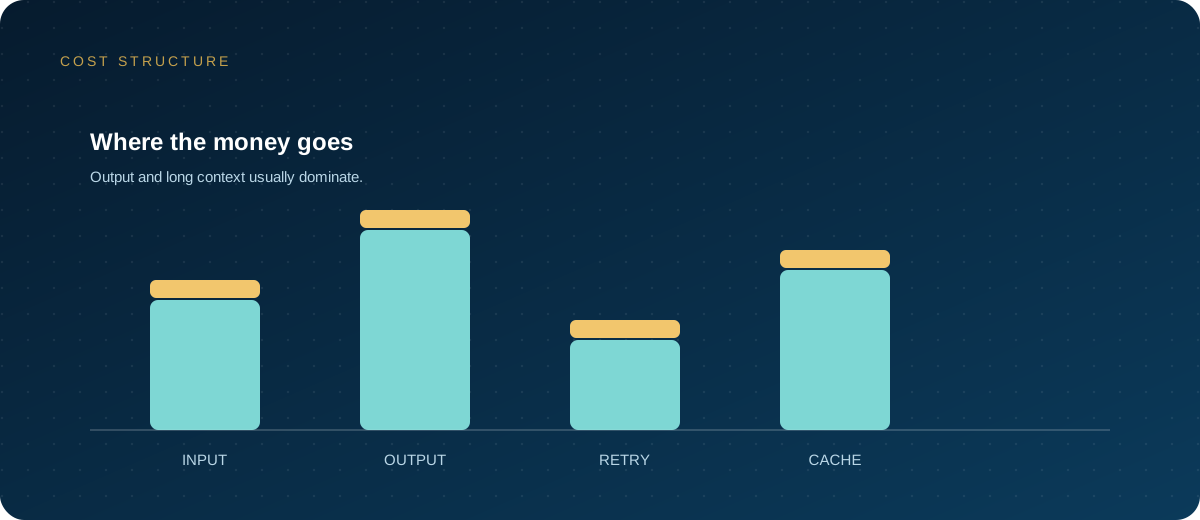
- Retries: timeouts and 429 retries also cost money.
- Long context: large repositories and long logs multiply input tokens.
- Model tier: Pro and Opus models cost more than Flash and Haiku.
- Tool calls: multi-turn agents increase the number of requests.
- Idle quota: unused subscription quota is wasted spend.
- Operations time: managing keys, limits, and bills still takes labor.
6. How teams choose
- One or two people writing code daily: try a subscription first.
- Five or more people with multiple projects: bring your own key plus a gateway, with member and project limits.
- Highly variable usage: pay-as-you-go API billing avoids wasted quota.
- Need multiple models: use a gateway to switch between Claude, GPT, Gemini, and DeepSeek.
- Need auditing: one key per person and retained usage logs.
7. How to reduce Cursor costs
- Use fast, inexpensive models for simple tasks.
- Do not put an entire repository into the context in one go.
- Use rules and ignore files to reduce irrelevant context.
- Summarize long logs first.
- Set spending limits on keys to stop runaway agent loops.
- Monitor retries and 429 responses.
- Allocate costs by project across the team.
8. FAQ
Do I still need a Cursor plan after bringing my own key?
Some features may still require an active plan. The exact behavior depends on the current version of Cursor.
Is bringing your own key always cheaper?
No. A subscription may be simpler for light users, while pay-as-you-go can cost more for heavy users. Calculate with real token counts.
Which models does Cursor support?
It depends on the Cursor version and your configuration. Custom model names must match currently available names; see model pricing.
Will a gateway affect Cursor features?
It may affect features that depend on the official model service. Test with your own workflow before committing to long-term use.
Next steps
Spend a week collecting real usage logs, then apply the formula. If you need to bring your own key, sign up for the ZSQH AI Gateway, create a dedicated cursor key, and configure it according to the Cursor API guide. Unit prices are subject to model pricing.
Related reading: