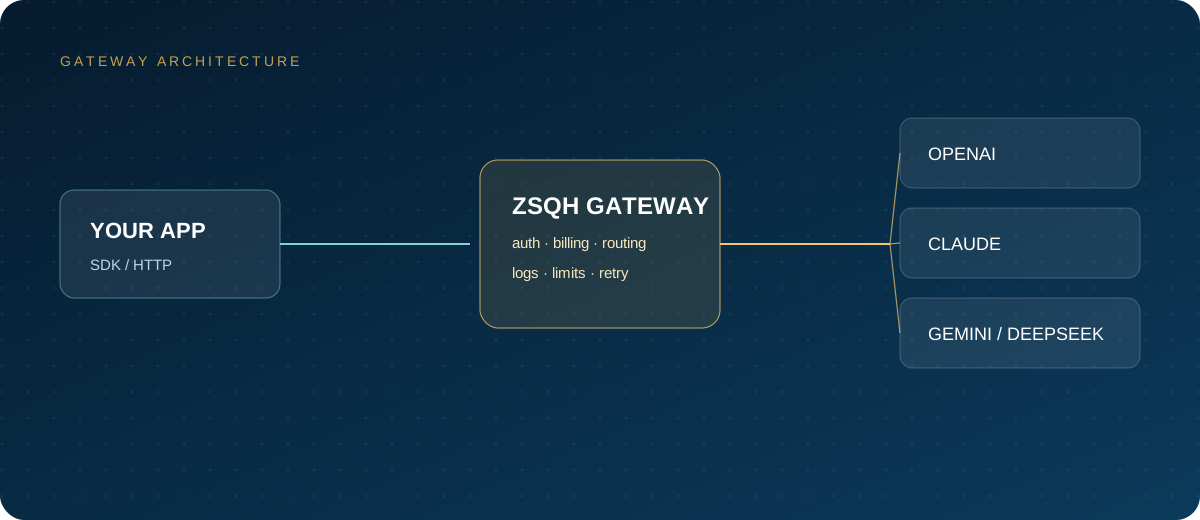
Kling is a video generation model from Kuaishou. For teams in China, the problem is usually not whether the site opens, but which route to take, how the bill is settled, and how to recover after a task fails. Kling is itself a domestic platform, so cross-border networking is not the main issue; what actually affects stability is the account entity, the API domain, concurrency quotas, asynchronous tasks, and result transfer.
This article compares direct access, a self-built proxy, and an aggregation gateway, and explains practices for networking, payment, tasks, storage, failover, and acceptance.
Note: Kling and Kling AI are trademarks or registered trademarks of Kuaishou and its affiliates. This article is for technical explanation only and implies no affiliation with or partnership with Kuaishou. Interface domains, model versions, and billing rules are subject to official documentation and the in-site model pricing page; prices may change.
1. Separate three different "domestic access" questions
"Domestic access" is often treated as one problem, but it should be split into at least three layers:
- Network layer: DNS resolution, TLS handshake, egress bandwidth, allowlists, and timeouts. Kling is a domestic platform, so an extra cross-border leased line is usually unnecessary, but office networks, cloud host regions, and carriers still affect first-byte and download speed.
- Account layer: personal or enterprise entity, prepaid or postpaid, CNY or USD settlement, and whether invoices are available. This layer determines whether procurement and reimbursement can proceed.
- Task layer: video generation is an asynchronous task. A successful submission does not mean a successful generation; task records, polling, callbacks, and result downloads must all be designed by you.
Identify which layer is blocking you before choosing a path. Otherwise you may treat an account problem as a network problem and switch routes indefinitely without effect.
2. How to choose among the three access paths
| Path | Best for | Main advantage | What you take on |
|---|---|---|---|
| Direct official access | Teams with development and operations staff and complete entity qualifications | Shortest path; parameters and status closest to official documentation | Real-name verification and top-ups, concurrency quotas, retries, logging, result transfer |
| Self-built proxy/gateway | Multiple teams and environments, or data export and audit requirements | Key isolation, unified egress, added logging and quotas | Servers, bandwidth, certificates, abuse prevention, and all operations |
| Aggregation gateway | Small teams using several video models at once | One entry point, unified keys and billing, less integration work | Upstream stability, parameter mapping differences, result retention policy |
The selection criterion is not "which is cheaper" but "who can locate the fault when something breaks." Direct access has clear boundaries, making ownership easy to determine. An aggregation gateway saves work but adds a hop; you must confirm whether task IDs are persisted, how statuses are mapped, and whether result addresses can be fetched at the source.
3. What to verify about networking and authentication parameters
New official interfaces usually use an API key with the header Authorization: Bearer <KEY>; earlier AK/SK schemes require you to issue a JWT yourself, commonly with HS256 and a 30-minute validity. Do not mix the two, and keep keys on the server only.
Verify each item before integration:
- The API domain currently assigned in the console; do not copy addresses from blogs or old code.
- Whether the account belongs to the domestic or overseas site, and whether billing is in CNY or USD.
- Whether an IP allowlist is required; error
1304is usually related to allowlist policy. - Concurrency slots per account and model, and the resource pack expiration date.
- Whether the paths and fields for submission, query, and callback match the documentation.
Official documentation currently lists a Singapore domain for overseas servers; domestic entities should use the domain shown in their own console. Put the domain, key, and model version in configuration rather than hard-coding them, so migration requires only a configuration change.
Kling does not describe rate limiting in terms of QPS; it limits the number of tasks running at once. Exceeding resource pack concurrency returns 1303, and high-frequency requests may also trigger 1302. Both cases should use backoff retries rather than immediate resubmission.
4. Payment, invoices, and account entity
Video generation is billed by second, resolution, or task. Before purchasing, confirm the billing unit and resource pack rules; actual deductions follow the bill.
- Use an enterprise entity and corporate payment for production; do not make a personal account carry team usage.
- Confirm the deduction order, validity periods, and refund rules for prepaid resource packs and postpaid billing.
- Confirm invoice type, invoicing cycle, and how the top-up currency and exchange rate are recorded.
- Create separate keys for test, staging, and production, with quota caps, so debugging tasks do not consume the production resource pack.
- Export usage details monthly and reconcile by task ID, model, duration, and resolution.
If you purchase through an aggregation gateway, the contract counterparty is the gateway provider, not the model vendor; invoices, data terms, and fault responsibility must all be confirmed at that layer.
5. Asynchronous task reliability
The typical flow is: submit a task and receive an id, poll submitted, processing, succeeded, and failed, then download the video after success. Legacy interfaces may spell the success state as succeed; status mapping must cover both spellings.
# Submit a minimal task; verify the domain, path, and parameters against official or in-site docs
curl -X POST "$KLING_BASE_URL/text-to-video/kling-2.6" \
  -H "Authorization: Bearer $KLING_API_KEY" \
  -H "Content-Type: application/json" \
  -d '{
    "prompt": "A coffee cup in the morning light, slow camera push-in",
    "settings": {"duration": 5, "resolution": "720p", "aspect_ratio": "16:9"},
    "options": {"external_task_id": "order-20261019-001"}
  }'

# Query the task; store the returned id together with the business order number
curl "$KLING_BASE_URL/tasks?task_ids=$TASK_ID" \
  -H "Authorization: Bearer $KLING_API_KEY"
At the engineering level, do at least four things: use external_task_id for business idempotency; after a submission timeout, query the task before deciding whether to resubmit; use exponential backoff with a maximum count for polling; enable signature verification on callbacks, check that the timestamp is within the allowed window, and deduplicate by event ID. Callback documentation does not promise unlimited retries, so callbacks cannot be the only source of status; polling is still needed as a fallback.
6. Result storage and expiration
Official documentation states that generated result URLs are cleaned up after 30 days and use hotlink protection. If you store them directly in a database or send them to customers, they will stop opening after a while.
The correct approach is to download immediately after task success, transfer the file to your own object storage, and record the business order number, task ID, model, duration, resolution, and checksum. For external distribution, use a temporary link you issue yourself, with access permissions and a retention period. Also retain error information for failed tasks so you can distinguish content moderation, parameter errors, and upstream timeouts.
7. Failover and degradation
A single channel rarely covers every situation. Production can keep one primary and one backup path, but do not submit the same business order to both at once, or reconciliation becomes chaotic.
- Classify by error code: authentication, parameter, and moderation errors are not retried; only
1302,1303, and 5xx enter the backoff queue. - Monitor queue time, success rate, result download success rate, and the all-in cost of each successful video.
- Set circuit-breaker thresholds; for example, pause submissions and alert when the success rate stays clearly below baseline for a period.
- Prepare degradation options: lower the resolution, shorten the duration, or switch to another video model.
- Keep fallback switches for both direct and gateway keys, and rehearse switching regularly.
8. Pre-launch verification checklist
- Run one task at the shortest duration and lowest resolution with a test key.
- Confirm that submission, query, callback, and download all work.
- Deliberately send invalid parameters and trigger moderation; confirm error messages are readable.
- Force a concurrency limit and confirm the
1303backoff logic works. - Disconnect immediately after submission and confirm there is no duplicate charge.
- Revisit the result address after 24 hours and confirm the transfer is complete.
- Run continuously for 3 to 7 days and record success rate, P95 latency, and per-clip cost.
- Reconcile bill details against task records and confirm billing rules for failed and canceled tasks.
FAQ
Does Kling API require a leased line in China?
Usually not. Kling is a domestic platform and works over ordinary public internet. If the office egress is restricted or large downloads are slow, consider a fixed egress or leased line and decide based on measured data.
Which is more stable, direct access or an aggregation gateway?
There is no universal answer. Direct access has one fewer hop and clear boundaries; a gateway adds operations and transfer capability, but you must ask how tasks are persisted, how statuses are mapped, and how results are retained. Small teams can start with a gateway and evaluate direct access after volume grows.
A task was submitted successfully but the result never appears. What should I do?
Confirm that you received a task ID rather than a request ID, then check whether the account and model match. If the status remains in processing for a long time, check upstream announcements and concurrency quotas; if it exceeds the business deadline, compensate as a failure rather than polling forever.
Are failed generations charged?
It depends on platform rules and the failure type. Billing policies for content moderation, parameter errors, and upstream timeouts may differ. Check official terms before batch submission and verify with a small batch bill.
Why does the result link stop opening after a few days?
Official result addresses are cleaned up after 30 days. Download promptly after task success and transfer to your own storage; serve external users through a link you issue yourself.
Next steps
First create a test key on ZSQH AI Gateway and validate the four paths of submission, polling, callback, and download with a minimal task; models and prices follow model pricing. If you need to manage several video models under one account, evaluate the gateway option afterward.
Related reading: