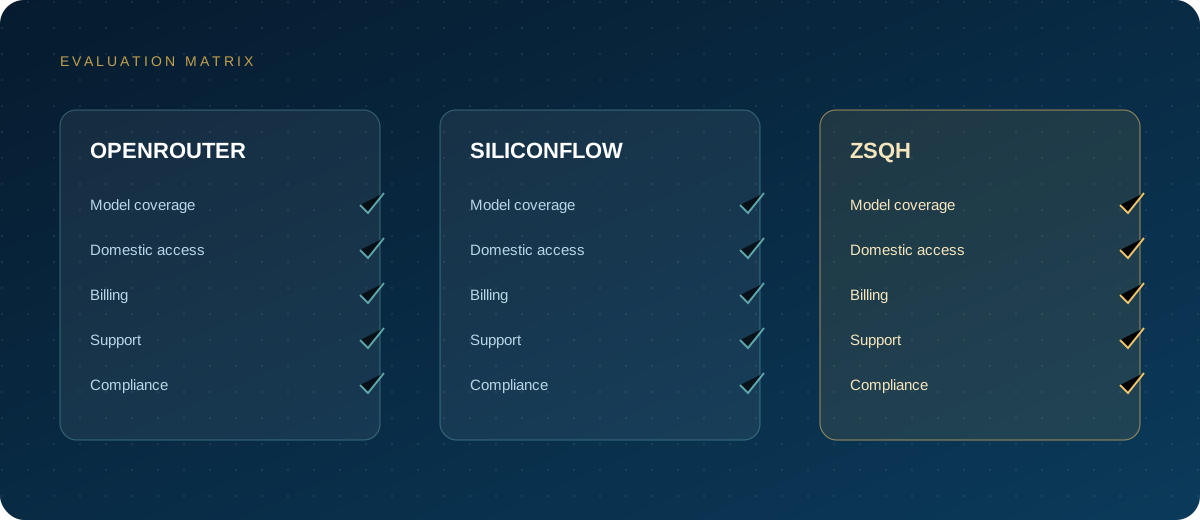
When a team uses Claude, GPT, Gemini, and DeepSeek at the same time, the hardest part is often not the models themselves but the accounts, keys, bills, and interface formats. LLM API aggregators and gateways exist to solve that problem.
This article compares three common options: OpenRouter, SiliconFlow, and ZSQH AI Gateway. It avoids hard-coding prices that change, and focuses on selection criteria, use cases, and testing methods.
Note: All brands mentioned are trademarks of their respective owners. This article is for technical comparison only and does not represent the companies. Prices, models, and policies are subject to each platform's official site.
1. What an LLM API aggregator is
It consolidates multiple model providers behind one entry point:
Your app → aggregator (auth / billing / routing / logs) → models from multiple providers
Common capabilities:
- One Base URL.
- One API key for multiple models.
- Token-based billing with a unified invoice.
- Quotas, members, and project permissions.
- Usage logs and error troubleshooting.
- Multi-channel retries and failover.
2. How the three platforms differ
OpenRouter
Strengths: broad model coverage, many overseas models, and a mature community and documentation. It suits teams that need a large catalog of models and can reliably access overseas services.
Confirm before choosing: access from mainland China, payment methods, invoicing, and data compliance.
SiliconFlow
Strengths: a mainland China platform with a model catalog focused on open-source and domestic models, plus friendlier Chinese documentation and payment. It suits teams that mainly use domestic models.
Confirm before choosing: coverage of overseas models, tool-calling and multimodal compatibility, and quota management.
ZSQH AI Gateway
Strengths: built for access from mainland China and unified management, with an OpenAI-compatible interface, pay-as-you-go billing, quotas, and usage logs. It covers mainstream models including Claude, GPT, Gemini, and DeepSeek.
Confirm before choosing: whether your target models are on the list, how pricing is defined, and enterprise contracts and invoicing.
3. Comparison table
| Dimension | OpenRouter | SiliconFlow | ZSQH |
|---|---|---|---|
| Model coverage | Broad overseas coverage | Many domestic and open-source models | Mainstream models, continuously expanded |
| Access from China | Depends on your network | Domestic platform | Optimized for mainland China |
| Interface compatibility | Primarily OpenAI-compatible | OpenAI-compatible | OpenAI-compatible |
| Billing | Platform rules | Platform rules | Pay-as-you-go |
| Quota management | Available | Available | Available |
| Chinese support | See the official site | Good | Chinese documentation and support |
| Enterprise compliance | See the official site | See the official site | Discussable |
This table is not a ranking. It helps you set priorities: use the first row if model coverage matters most, the second row for access from China, and the last two rows for enterprise procurement.
4. How to choose by scenario
Scenario A: Mostly overseas models, team based overseas
Prioritize OpenRouter or a similar overseas aggregator. Model coverage is broad and the ecosystem is mature.
Scenario B: Mostly domestic or open-source models, team based in mainland China
Prioritize SiliconFlow or a similar domestic platform. Chinese support, payment, and access are friendlier.
Scenario C: A mix of domestic and overseas models, with a unified bill
Prioritize a gateway with multi-model support, quota management, and complete logs. ZSQH fits this scenario, and you can keep OpenRouter as a backup channel.
Scenario D: Enterprise procurement requiring contracts, invoices, and data terms
Clarify compliance questions before comparing prices. A platform without a contract and data-processing terms is not a good choice for direct production use.
5. Migration and testing
1. A unified interface layer
Move the Base URL, key, and model names into configuration. Do not hard-code them in business logic.
2. Model mapping
Maintain a mapping from logical model names to each platform's physical model names, for example:
chat-fast → gemini-2.5-flash / gpt-5-mini / deepseek-chat
chat-pro  → claude-sonnet / gpt-5 / gemini-2.5-pro
3. Small-traffic canary
Shift 5%–10% of traffic first, observe for 3–7 days, and then increase.
4. Test checklist
- Non-streaming requests.
- Streaming time to first token and interruption rate.
- Tool calls and structured output.
- Long context.
- Concurrency at 5, 10, and 20 requests.
- Error codes and billing.
6. Do not look only at unit price
The real cost includes input and output tokens, long context, retries, multimodal input, and operations time. A platform with a low unit price but frequent rate limits can end up costing more overall.
7. FAQ
Does an aggregator change model behavior?
It usually does not change the upstream model itself, but channel versions, parameter support, and rate-limit policies can differ. Compare results on a fixed test set before migrating.
Can one key call every model?
Most platforms allow this, but it depends on account permissions and whether the model is enabled.
Can I use several providers at once?
Yes. A primary and backup channel with health-check-based failover is a good practice.
Self-hosted gateway or an aggregator?
With an engineering team and needs for deep customization or data control, self-hosting is viable (New API, One API, LiteLLM). Without operations capacity, a managed platform is less work.
Next steps
If you need access from mainland China, OpenAI compatibility, pay-as-you-go billing, and unified multi-model management, sign up for ZSQH AI Gateway and run the test checklist with a small key. Model names and prices are listed under Model Pricing.
Further reading: