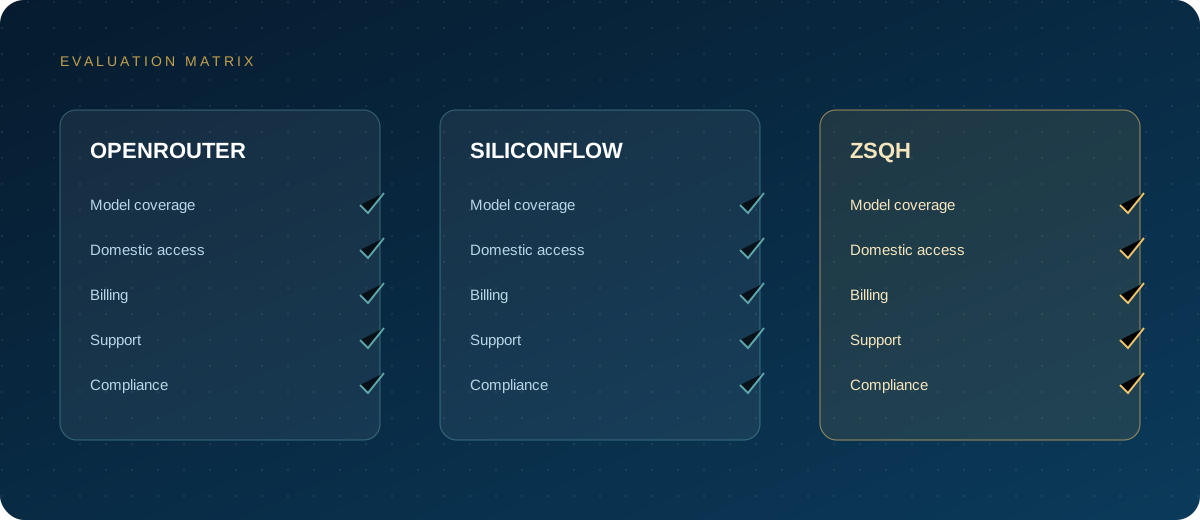
OpenRouter is a multi-model API aggregation platform. Developers can call models from many providers with a single key. Its model coverage is broad, its documentation is solid, and it is very friendly to developers outside China.
However, teams in China often run into access stability, payment methods, invoicing, Chinese-language support, and data compliance issues, which leads them to look for alternatives. This article is neither a pitch nor a hit piece; it explains how to evaluate, migrate, and test.
Note: OpenRouter is a trademark of its respective owner. This article is for product comparison and technical discussion only. It does not represent the company and does not recommend or disparage any provider. Prices and policies are subject to each platform's official website.
1. First, confirm whether you actually need an alternative
Not everyone needs to switch. Ask four questions first:
- Which models do you mainly use? Does the alternative cover all of them?
- Is your access stable? Are the error rate and latency acceptable?
- Can you complete payment, invoicing, and contracting?
- What are your data compliance requirements?
If you call models occasionally, your models are covered, and access is fine, you can stay. The value of an alternative usually comes from "stable access + unified billing + Chinese support + enterprise compliance," not from unit price alone.
2. Six criteria for evaluating an alternative
| Criterion | What to check | How to verify |
|---|---|---|
| Model coverage | Are the models and versions you need all available? | Compare the pricing page and model list |
| Compatibility | Does it support the OpenAI protocol, streaming, and tool calls? | Test directly with your existing SDK |
| Stability | Error rate, P95 latency, rate-limit policy | Run a small traffic share for 3–7 days |
| Billing | Unit price, multipliers, cache, refund rules | Run fixed requests and reconcile the bill |
| Support | Documentation, ticket response, invoicing | Confirm before topping up |
| Compliance | Whether data is stored, retention period, contract | Have sales and legal confirm |
Do not look only at "price per million tokens." Long context, output tokens, retries, and caching all affect actual cost.
3. What matters most for access from China
1. Access stability
Accessing overseas APIs from China can be affected by the network. An alternative that provides a reachable domestic endpoint is usually more stable. When testing, do not just ping; test real streaming requests.
2. Payment methods
Does it support the payment methods you commonly use? Can it issue invoices? What are the refund rules? These matter more for long-term use than unit price.
3. Model version updates
When an upstream model is upgraded, old model names may stop working. Check whether the provider updates its model list promptly and announces deprecations.
4. Data and compliance
For enterprise use, ask clearly: are requests and responses stored, for how long, are they used for training, and can you sign a data processing agreement?
4. Migration steps
For most OpenAI-compatible platforms, migration only requires three changes:
1. Change the Base URL
https://ai.zhongshangqihang.com/v1
2. Replace the API key
Create a new key at the ZSQH AI Gateway and set a quota.
3. Change the model name
Replace the original model name with a model name currently supported by the target platform. Model names are subject to the model pricing page.
Python example:
from openai import OpenAI

client = OpenAI(
    api_key="sk-your-key",
    base_url="https://ai.zhongshangqihang.com/v1",
)

resp = client.chat.completions.create(
    model="gpt-5",
    messages=[{"role": "user", "content": "Reply with OK only"}],
)
print(resp.choices[0].message.content)
If your code hardcodes OpenRouter's endpoint or model names, move them into configuration so you can switch more easily later.
5. Minimum test checklist before migration
- Non-streaming requests: Do they return, and how long do they take?
- Streaming requests: Time to first token and whether the stream is interrupted.
- Tool calls: Do function calls and structured output work correctly?
- Long context: Is content truncated, and is the cost abnormal?
- Concurrency: Success rate and P95 at 5/10/20 concurrent requests.
- Error codes: Are 401/404/429/5xx clear?
- Billing: Run 20 fixed requests and reconcile tokens and cost.
Migrate to production only after the tests pass. Do not cut over everything at once.
6. OpenRouter vs. ZSQH AI Gateway
| Criterion | OpenRouter | ZSQH AI Gateway |
|---|---|---|
| Model coverage | Broad, many overseas models | Mainstream models, continually expanding |
| Access from China | Depends on the network environment | Optimized for access from China |
| Payment | Per the official website | Top-up on site |
| Chinese support | Per the official website | Chinese documentation and support |
| Billing | Platform dashboard | Unified console |
| Compliance | Per the official terms | Enterprise options available on request |
This is not a "who is better" conclusion; it is "who fits your scenario better." Overseas teams that need extremely broad model coverage may find OpenRouter more suitable. Teams in China that need stable access and Chinese-language support should test ZSQH closely.
7. FAQ
Do I need to change code to replace OpenRouter?
If your code uses the OpenAI SDK, you usually only change the Base URL, key, and model name. If you use OpenRouter-specific parameters, you need compatibility work.
Will model output change after migration?
The same upstream model is usually very similar, but versions, parameters, and rate limits can differ between channels. Compare with a fixed test set before migrating.
Is it always cheaper?
Not necessarily. Do not look only at unit price; factor in retries, long context, output tokens, operations, and payment costs.
Can I use both providers at the same time?
Yes. For production, keep a backup channel and switch when the primary fails.
Next steps
If you are looking for an alternative that is reachable from China, supports the OpenAI protocol, and bills by usage, register for the ZSQH AI Gateway, run the checklist above with a small key, and then decide whether to migrate.
Related reading: