Teams that want to connect Midjourney to an API usually reach the same conclusion: Midjourney has no public, general-purpose API. As of October 2026, access is still mainly through the web app and Discord; most "Midjourney APIs" on the market are third-party wrappers that expose an HTTP interface through automated account pools.
Alternatives should be evaluated by modality: image and video differ in access, asynchronous workflow, billing, and commercial terms. This article compares Kling, Seedance, Sora, and mainstream image models. It does not provide an absolute ranking.
Note: Midjourney is a trademark of Midjourney, Inc.; Kling is a trademark of Kling AI; Seedance and Seedream are trademarks of ByteDance; Sora and OpenAI are trademarks of OpenAI; FLUX is a trademark of Black Forest Labs; Nano Banana and Gemini are trademarks of Google; all other names belong to their respective owners. This article is a technical comparison only and does not imply affiliation or endorsement.
1. Start with Midjourney API access limits
Midjourney does not publish a developer console, a general REST interface, or an API price list. Third-party wrappers usually take one of two forms: the provider maintains a pool of subscription accounts and automates Discord or the web app, or you supply the account and the provider only adds an automation layer. Neither is a direct official connection.
There are three risks. First, the terms of service restrict automated access, so accounts may be limited. Second, the interface depends on the web or Discord UI, and a change upstream can break it. Third, wrapper vendors may stop or shrink the business, so long-term availability cannot rest on reputation alone.
Before choosing, separate your needs. For occasional images, you can keep human-driven generation on the web and automate post-processing. For daily batch generation, make "public documentation, programmable calls, and queryable error codes" hard requirements.
2. By modality: image, video, and editing
Image generation is the direct substitution case for Midjourney. Kling has a separate image generation interface; ByteDance's Seedream covers generation and editing; FLUX is known for open weights and fine-tuning; Google's Nano Banana emphasizes editing and character consistency; Ideogram leans toward poster text; GPT Image and Tongyi Wanxiang also have interfaces. Model names and versions change quickly, so check the official documentation before calling.
Video generation is a separate line. Kling and Seedance both offer asynchronous video tasks, typically including text-to-video, image-to-video, and first/last frame control. Sora needs a separate note: the Sora 2 model and Videos API were discontinued on September 24, 2026, and the official notice states there is no one-to-one replacement interface. Existing integrations should migrate as soon as possible, and new projects should no longer list Sora as an option.
Image editing is often overlooked. Inpainting, outpainting, background replacement, and reference-image consistency are often closer to e-commerce work than generating from scratch. Treat editing as a separate evaluation item, and do not assume that a model strong at generation is also strong at editing.
3. Style and control: do not judge by demo images
Midjourney's reputation comes mainly from aesthetics: a cinematic feel, illustration quality, lighting, and stable composition. But "good style" is not an acceptance-testable engineering metric. An alternative evaluation should break it into at least six items: subject consistency, text rendering, hands and limbs, composition control, style stability, and rework rate.
Different models have different strengths: Kling leans realistic and commercial portraits; Seedream understands Chinese semantics relatively well; FLUX's open ecosystem suits LoRA and private styles; Nano Banana is good at multi-turn editing and character consistency; Ideogram suits text posters; GPT Image follows complex instructions relatively well. These are directions, not absolute conclusions.
The reliable method is a blind test. Prepare 10 to 20 real business prompts, fix the aspect ratio, resolution, and seed, hide the model names, and have design and operations score against the same criteria. Public demo images are curated, and the gap from your own category is often large.
4. Access paths: public APIs, cloud marketplaces, and third-party wrappers
There are usually three paths.
- Vendor public API: a console, documentation, keys, and error codes, suitable as the primary channel. Confirm available regions, identity requirements, concurrency limits, and data retention.
- Cloud marketplace: the same model may be offered by a cloud provider, with billing, invoices, region, and compliance handled by the cloud platform, though the model version may lag.
- Third-party wrapper or relay: a unified interface and quick onboarding, but one more layer, with price and availability risk carried by the provider. Midjourney's so-called APIs largely fall into this category.
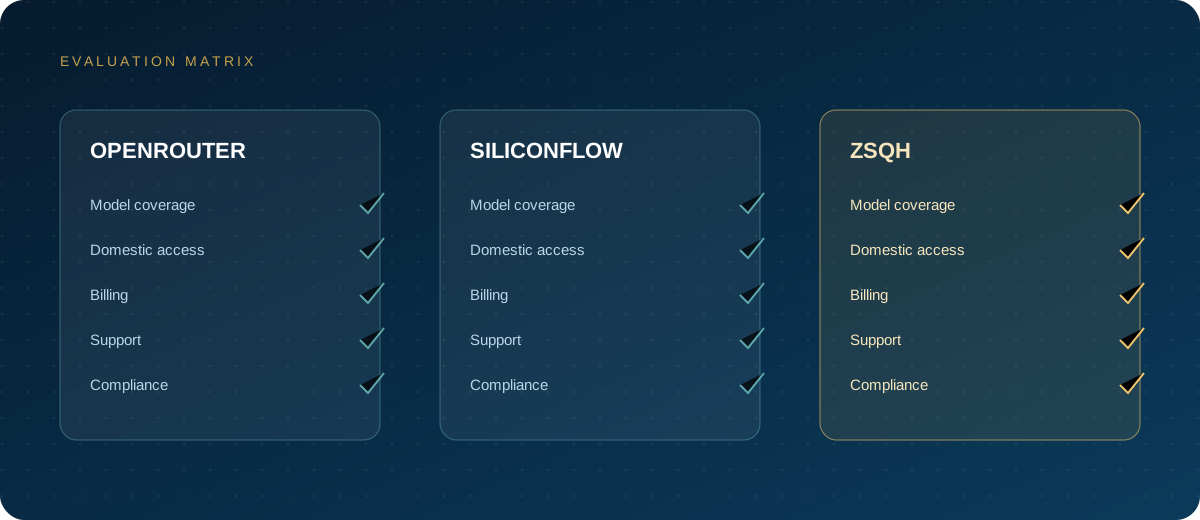
When evaluating a third party, check at least five items: documentation and status page, upstream and billing definitions, whether failed tasks are billed, data retention, and the support channel for incidents. ZSQH AI Gateway provides an OpenAI-compatible unified entry point; whether image and video channels are enabled and which models are supported depend on the in-site model list and model pricing. Do not assume that an unavailable model can be used.
5. Async workflows: different interfaces, the same skeleton
Some image interfaces return synchronously, while others create a task first; video is almost always asynchronous. A Midjourney wrapper adds another Discord round trip, so queuing and timeouts are more common. A production environment should be split into five steps: submit, obtain a task ID, poll or receive a callback, download, and persist.
import time

def wait_task(provider, task_id, timeout=600):
    deadline = time.time() + timeout
    delay = 3
    while time.time() < deadline:
        task = provider.get_task(task_id)
        if task["status"] == "succeeded":
            return provider.download(task["result_url"])
        if task["status"] in {"failed", "rejected"}:
            raise RuntimeError(task.get("error", "task failed"))
        time.sleep(delay)
        delay = min(delay * 1.5, 20)
    raise TimeoutError(f"task {task_id} timed out")
The code is not the important part; the constraints are. Persist tasks to a database with the business order number, task ID, status, and cost. Put a total timeout on polling. Persist result links promptly. Distinguish retryable from non-retryable failures. Otherwise, at peak times you will see requests that time out while the task keeps running, duplicate submissions, and duplicate charges.
6. Commercial terms and pricing models
Images are commonly billed per image, per task, in credit packs, or by subscription; video is commonly billed by generated seconds, resolution, or task. Headline unit prices are not directly comparable: one generation may return four images but only one usable result, and video also carries queuing, retry, and storage costs.
A more reasonable metric is "total cost per accepted asset":
total cost = (generation + retry + editing + storage + human review) / accepted assets
Review the terms separately: whether commercial use is allowed, whether data is used for training, how long data is retained, whether failed or rejected tasks are refunded, and how account bans and service shutdowns are handled. The commercial scope of a Midjourney subscription is governed by its official terms; a third-party wrapper does not change the upstream terms. Prices change, so this article does not list unit prices; refer to model pricing and your contract.
7. Scenario selection table
The table below only narrows the candidate set; it is not a recommended ranking. The final choice should come from running your own prompts and acceptance criteria.
| Scenario | Modality | Test first | Key checks |
|---|---|---|---|
| E-commerce main and detail images | Image | Kling image, Seedream, FLUX | Product consistency, logos, text, commercial terms |
| Brand concept art and style exploration | Image | Midjourney human workflow, FLUX, Ideogram | Style stability, rework rate, provenance |
| Chinese posters and campaign assets | Image | Seedream, Tongyi Wanxiang, Ideogram | Chinese typography, typos, font licensing |
| Short video and feed assets | Video | Kling, Seedance | Duration, first-frame control, queueing and failure rate |
| Multi-turn image revision | Image editing | Nano Banana, Seedream, GPT Image | Character consistency, inpainting boundaries |
| Existing Sora integration | Video migration | Seedance, Kling, Veo | Field mapping, result validity, migration cost |
8. Migration checklist
- Inventory current usage: prompt templates, parameters, upscaling and variations, post-processing, and human review steps.
- Write down acceptance criteria: what counts as a usable image, who scores it, and how rework is recorded.
- Choose two image candidates and one or two video candidates; do not test only one vendor.
- Run a blind test with the same set of real prompts, fixed parameters, and recorded success and rework rates.
- Build an adapter layer that encapsulates authentication, submission, polling, download, and error-code mapping in a separate module.
- Run a small batch of 50 to 100 tasks and measure total cost, P95 latency, and failure reasons.
- Review the terms: commercial scope, data retention, refund rules, account bans, and shutdown handling.
- Shift traffic gradually: start with 5% to 10%, keep a rollback path, and monitor success rate, 429 ratio, task timeout rate, and cost per accepted image.
9. Compliance and stability
Generated content involves portrait rights, copyright, trademark rights, and content policy. Obtain permission before uploading images of real people, confirm the source of reference images, and make sure advertising assets do not clearly misrepresent the actual product. A moderation rejection is not a technical failure; do not try to bypass it by rewording prompts.
For stability, prepare at least a backup model or channel. Split keys by project and environment. Set a quota cap on test keys. Monitor 429 responses and the task failure ratio. If you depend on a third-party Midjourney wrapper, assess the impact of an account-pool interruption, and do not put all traffic on a channel without an SLA.
FAQ
Does Midjourney have an official API now?
As of October 2026, there is no public general-purpose API with a published price list. Most services on the market are third-party wrappers; check the terms and risks before integrating.
Can Kling and Seedance replace each other?
Not completely. Both do video, but Kling also has image generation, while Seedance focuses mainly on video. Parameters, duration, authentication, and billing also differ, so test them against your scenarios.
Can the Sora API still be used?
Sora 2 and the Videos API were discontinued on September 24, 2026, and the official notice states there is no one-to-one replacement interface. Existing integrations should migrate to Kling, Seedance, or another video model with public documentation.
Do image APIs always return synchronously?
No. Some return synchronously, while others create a task and then require a query; third-party wrappers often switch to asynchronous mode to handle queuing. Confirm the response structure and timeout behavior before integrating.
Do I have to change models to replace Midjourney?
Not necessarily. If you only need batching and a stable interface, you can keep human Midjourney generation and automate selection, upscaling, storage, and delivery. Migration is worth it only when demand exceeds what the human workflow can handle.
Next steps
Start by listing real scenarios and acceptance criteria, then choose two vendors for a blind test. If you need a unified entry point, create a key in ZSQH AI Gateway and check the currently supported image or video models on the model pricing page.
Related reading: