AnyRouter is one of the common AI API relay and aggregation services. After using it for a while, many teams start evaluating alternatives because of model coverage, access stability, billing management, or collaboration needs.
This article does not judge specific providers. It presents a reusable framework for evaluation and migration. Prices, models, and policies are subject to each platform's official site.
Note: AnyRouter is a trademark of its rights holder. This article is for technical discussion only and does not represent the company.
1. List requirements before looking at prices
Divide your requirements into four categories:
- Models: which of Claude, GPT, Gemini, and DeepSeek do you need? Are the versions fixed?
- Protocol: does your existing code use the OpenAI SDK, the Anthropic SDK, or custom HTTP?
- Scale: daily requests, peak concurrency, and context length.
- Management: do you need members, projects, tiered key limits, and invoicing?
Once the requirements are clear, evaluate the candidate platforms. This keeps you from being led by "more models, lower price."
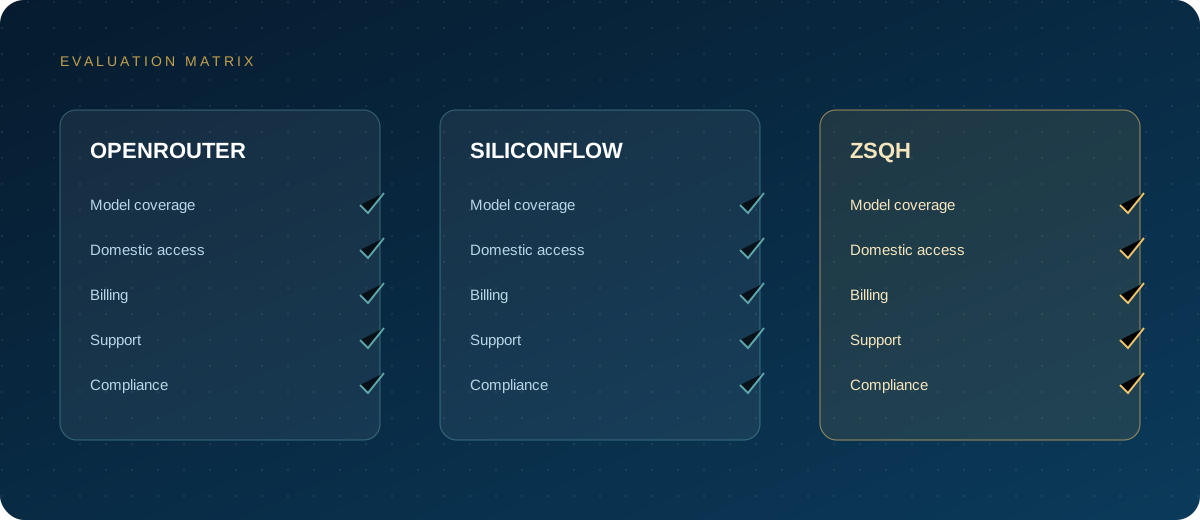
2. Alternative evaluation table
| Item | Questions to ask | Weight |
|---|---|---|
| Model coverage | Are the models you need available, and are the versions stable? | High |
| Compatibility | OpenAI/Anthropic protocols, streaming, tool calls | High |
| Stability | Error rate, P95, rate limits, retries | High |
| Billing | Input/output/cache, minimum spend, refunds | High |
| Billing breakdown | Can costs be split by key or project? | Medium |
| Support | Chinese documentation, tickets, response time | Medium |
| Compliance | Data retention, contracts, invoicing | High for enterprises |
Score each item, but do not rely only on the total. First check whether the high-weight items pass.
3. Run compatibility tests before migrating
1. Minimal request
curl "https://ai.zhongshangqihang.com/v1/chat/completions" \
  -H "Authorization: Bearer sk-your-key" \
  -H "Content-Type: application/json" \
  -d '{"model":"gpt-5","messages":[{"role":"user","content":"Reply with OK only"}]}'
2. Streaming request
Use stream: true to test time to first token, whether the stream breaks, and whether it ends cleanly.
3. Tool calls
Run a real function call and confirm the behavior of tools, tool_choice, and the response format.
4. Long context
Test with the longest document in your business and watch for truncation, timeouts, and cost.
5. Concurrency
Run 5, 10, and 20 concurrent requests, recording success rate, P95 latency, and the 429 ratio.
6. Billing
Send a fixed request 20 times and verify that the token count and cost match expectations.
4. Migration steps
- Move the Base URL, key, and model names into configuration.
- Create a test key on the new platform and set a limit.
- Change the Base URL to
https://ai.zhongshangqihang.com/v1. - Build a mapping from old model names to new model names.
- Shift 5%–10% of traffic and observe for 3–7 days.
- Increase traffic gradually and keep the old channel as a backup.
Python example:
from openai import OpenAI

client = OpenAI(
    api_key="sk-your-key",
    base_url="https://ai.zhongshangqihang.com/v1",
)

resp = client.chat.completions.create(
    model="gpt-5",
    messages=[{"role": "user", "content": "Reply with OK only"}],
)
print(resp.choices[0].message.content)
5. How to observe stability
Do not judge by whether one request feels fast. Record:
- Requests per hour.
- Success rate.
- P50 and P95 latency.
- The ratio of 429 and 5xx responses.
- Time to first token.
- The error distribution for each model.
Observe for 3–7 consecutive days before deciding to move all traffic. In production, keep primary and backup channels and switch based on health checks.
6. How to compare prices fairly
Include the following:
Monthly cost =
  input tokens × input unit price
+ output tokens × output unit price
+ retry request cost
+ extra long-context cost
+ multimodal input cost
Then compare unit prices across platforms. Do not forget that output tokens usually cost more than input, and that long context magnifies costs.
7. When migration is worth it
- The current channel frequently times out or rate-limits, affecting the business.
- You need a unified entry point for multiple models to reduce code branches.
- You need quota management at the member, key, or project level.
- You need Chinese-language support, invoicing, or enterprise contracts.
- You need more stable access from mainland China.
If the current service is stable, reasonably priced, and meets your needs, there is no need to migrate.
8. FAQ
Will migration interrupt service?
With a small-traffic canary and primary/backup channels, the switch can usually be transparent.
What if model names differ?
Maintain a mapping table and use only logical model names in business code.
Do I need to change SDKs?
On OpenAI-compatible platforms you usually keep the same SDK and change only the Base URL, key, and model name.
Next steps
If you are ready to run a migration test, sign up for ZSQH AI Gateway, create a small key, work through the checklist in this article, and then decide whether to switch. Model names and prices are listed under Model Pricing.
Further reading: